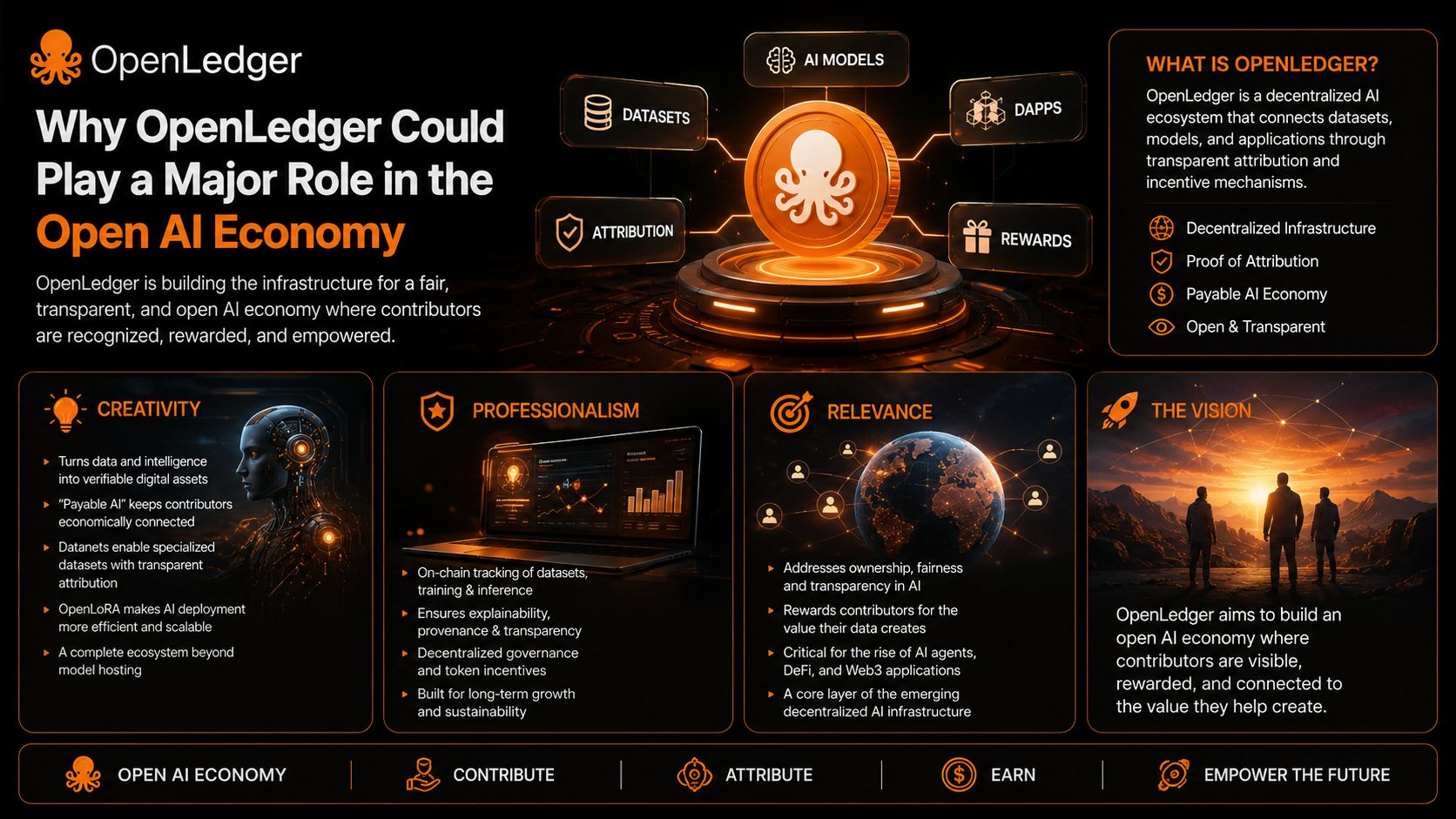
The AI industry is growing rapidly, but one major issue still remains unresolved. Most AI systems today operate inside centralized ecosystems where users contribute data, prompts, ideas, and knowledge without receiving proper recognition or rewards. Large companies control most of the infrastructure while contributors often remain invisible.
OpenLedger is trying to change that model by building a decentralized AI ecosystem focused on transparency, attribution, and fair value distribution. Instead of treating AI as a closed system, OpenLedger aims to create an open economy where developers, data contributors, and model creators can all participate directly in the value generated by AI.
One of the most important parts of OpenLedger is its Proof of Attribution mechanism. This system allows AI outputs to be linked back to the datasets, contributors, and models that influenced them. In traditional AI systems, it is difficult to know where data originated or who should receive credit. OpenLedger introduces a transparent framework where contributions can be verified and rewarded fairly.
[Creativity]
OpenLedger brings a fresh idea to the AI and blockchain space by combining decentralized infrastructure with transparent attribution systems. The project focuses on turning data and intelligence into verifiable digital assets instead of allowing them to disappear inside closed AI models.
Its concept of “Payable AI” is especially innovative because contributors remain economically connected to the value their data creates. Through decentralized Datanets, users can contribute specialized datasets used to train AI models while maintaining transparent attribution over time.
Another creative feature is OpenLoRA infrastructure, which aims to make AI deployment more efficient by allowing multiple specialized models to operate with reduced GPU requirements. This could significantly improve scalability and accessibility for decentralized AI applications.
The ecosystem also goes beyond simple model hosting. OpenLedger is building infrastructure where datasets, AI models, and decentralized applications can interact transparently while maintaining verifiable ownership and attribution.
[Professionalism]
From a technical perspective, OpenLedger demonstrates a strong understanding of both AI systems and blockchain infrastructure. The platform combines decentralized datasets, attribution systems, model deployment, governance, and incentive mechanisms into one ecosystem.
The project’s architecture supports transparent tracking of datasets, model training, and inference activity directly on-chain. This creates an environment where contributors can verify how their data is being used while receiving rewards based on measurable impact.
OpenLedger also focuses heavily on explainability and provenance, two areas becoming increasingly important in modern AI development. As AI systems become more advanced, industries are demanding greater transparency around how models are trained and which data influences their outputs.
The integration of decentralized governance and token-based incentives also suggests long-term ecosystem planning rather than short-term hype. Contributors, developers, and users all play roles within the network’s economic structure.
[Relevance]
OpenLedger is highly relevant because the AI industry is beginning to face serious discussions around ownership, fairness, and transparency. AI models rely heavily on massive amounts of human-generated data, yet contributors rarely benefit from the value created by those systems.
The project directly addresses this issue through attribution-based economics where contributors can potentially receive ongoing rewards when their data influences AI outputs.
Its relevance also extends to the growing AI agent economy. As autonomous AI systems become more integrated with blockchain applications and decentralized finance, transparent and verifiable AI infrastructure may become increasingly important.
The intersection of AI and Web3 is currently one of the fastest-growing sectors in crypto. Many projects discuss decentralized AI conceptually, but fewer are building complete systems focused on attribution, transparency, and monetization. OpenLedger is positioning itself directly within that emerging infrastructure layer.
In conclusion, OpenLedger stands out because it approaches AI not only as a technological challenge but also as an economic coordination problem. By combining blockchain transparency, decentralized datasets, attribution systems, and incentive mechanisms, the project aims to create a more open AI economy where contributors are visible, rewarded, and connected to the value they help generate.