
Based on the OpenLedger (OPEN) White Paper and official ecosystem documentation, here is a comprehensive structural analysis of the project, including a synthesis of its technical fundamentals, utility, and a forward-looking 5-to-10-year market evaluation.
Core Conclusions & Data from the White Paper
OpenLedger positions itself as a purpose-built, EVM-compatible Layer 1/Layer 2 "AI Blockchain" designed to address the deep-rooted centralization, "black box" opaque operations, and economic inequalities within the traditional Artificial Intelligence sector.
Key architectural components detailed in the white paper include:
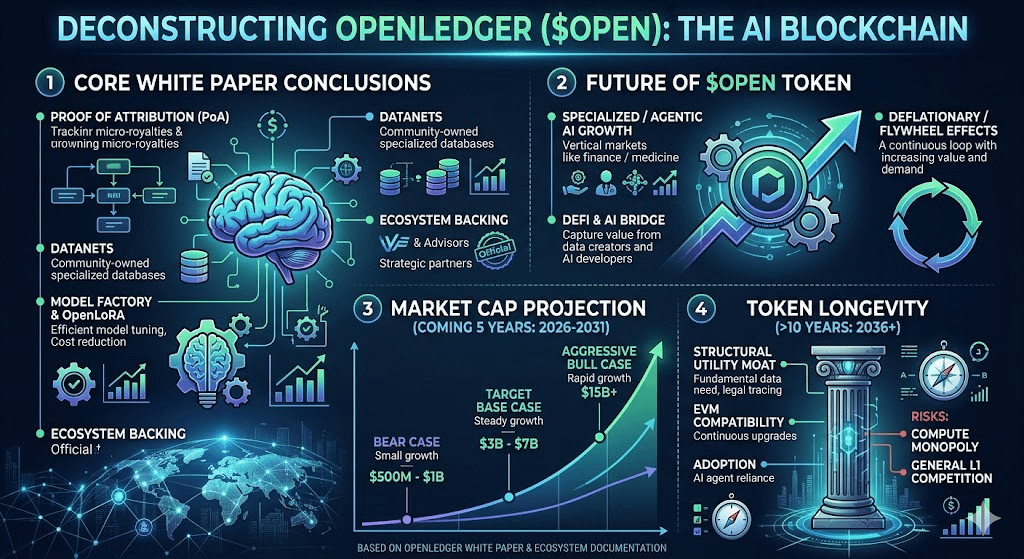
💡Proof of Attribution (PoA): This is OpenLedger’s core proprietary breakthrough. Unlike traditional AI where data contributors and model fine-tuners go uncompensated, PoA tracks every input (data uploads, algorithmic tuning, compute) on-chain. When an AI model generates an output ("inference"), the system traces the exact origin of the data used and automatically routes micro-royalties/rewards to the original contributors using pre-programmed smart contracts.
💡Datanets (Data Collaboration Networks): Community-owned, tokenized databases where users co-create and curate specialized niche datasets required for training specialized AI models.
💡Model Factory & OpenLoRA: A decentralized developer suite allowing full fine-tuning or low-rank adaptation (LoRA/QLoRA). OpenLoRA specifically introduces a technical threshold where thousands of fine-tuned adapters can run efficiently on a single GPU (claiming up to a 96% increase in performance thresholds), drastically driving down the prohibitive computing costs of modern AI.
💡Heavyweight Ecosystem Backing: The white paper and official ecosystem note high-tier Web3 validation, with advisors and infrastructure supporters including Balaji Srinivasan (Former CTO of Coinbase), Sreeram Kannan (EigenLayer), and strategic alignment with decentralized physical infrastructure networks (DePIN) like Aethir, io.net, Hyperbolic, and 0G.
The Role and Tokenomics of OPEN
The OPEN token operates as the lifeblood of this network with three structural pillars:
🔹Gas & Settlement: Powering all data tracking transaction fees, data validation costs, and smart contract computations.
🔹Economic Medium: Acting as the universal currency for purchasing specialized AI inferences, paying data contributors, and unlocking GPU resources.
🔹Governance & Security: Utilizing a hybrid on-chain governance system built via OpenZeppelin's Governor framework, where OPEN holders vote on model parameters and protocol updates.
What is the Future of OPEN Token?
The future of OPEN depends heavily on the macroeconomic shift from General AI (like generic LLMs) to Specialized/Agentic AI (highly verticalized AI models for medicine, finance, legal, and trading).
🔸The Web3 & AI Bridge: OpenLedger solves a trillion-dollar bottleneck: Data Provenance. As web platforms restrict AI scrapers, decentralized data pipelines (Datanets) will become highly valuable. OPEN is positioned to capture value from both sides—acting as a settlement token for data sellers and an access token for AI developers.
🔸Deflationary / Flywheel Effects: The token employs an implicit demand flywheel. As more dApps and AI "Agents" (via integrations with protocols like Virtuals and Morpheus) use OpenLedger to execute automated tasks, the velocity of OPEN increases. Real-time inference calls act as a continuous buy-side pressure for the token to pay out underlying data creators.
Market Cap Projection (Coming 5 Years: 2026–2031)
Predicting an exact figure in crypto is impossible, but we can look at the addressable market valuation models based on current growth trajectory data:
1- Conservative Bear Case (500M – 1B Market Cap): If the Decentralized AI (DeAI) space fails to pull market share away from Web2 corporate giants (OpenAI, Google) and remains a niche Web3 sandbox, OpenLedger will function primarily as a medium-scale infrastructure layer. Its valuation would mirror standard mid-tier L1/L2 networks.
2- Target Base Case (3B – 7B Market Cap): Over the next 5 years, the convergence of AI and crypto is widely forecasted to mature. If OpenLedger succeeds in becoming the premier accounting and "Proof of Attribution" data layer for Web3 AI agents—where thousands of active dApps depend on its chain for data provenance—OPEN could easily sit alongside top-tier infrastructure assets (similar to how top L2s or data availability layers like Celestia or Near operate).
3- Aggressive Bull Case (15B+ Market Cap): If "OpenLoRA" proves to be the globally preferred cost-saving infrastructure for open-source AI developers worldwide (greatly undercutting centralized cloud hosting), and if corporate entities adopt OpenLedger to legally prove they didn't violate copyright laws (using Proof of Attribution), OPEN would transition into a top-15 global cryptocurrency asset, tapping directly into the multi-trillion-dollar global AI infrastructure market.
Will the Token Last Longer than 10 Years? (>2036)
To survive a decade in blockchain, a token must outlive narrative hypes and establish a structural utility moat. For OPEN, longevity hinges on two main elements:
💡Why it CAN last longer than 10 years: OpenLedger isn't just a generic crypto token; it tackles a fundamental problem that will exist as long as AI exists: the need for high-quality, legally traceable, and fairly compensated training data. As long as developers need specialized data networks and micro-payments to run AI agents autonomously, the underlying network retains fundamental worth. Furthermore, its EVM compatibility ensures it can continuously upgrade its tech stack without losing its core developer ecosystem.
💡The Killer Risks to Longevity:
1. The Compute Monopoly: If centralized cloud providers (AWS, Microsoft Azure) lower their prices so drastically that decentralized GPU clustering loses its economic edge, the underlying incentive to build on-chain diminishes.
2. L1 Obsolescence: If general-purpose, hyper-scalable chains (like Ethereum L2s or Solana) natively implement ultra-cheap data-attribution models, OpenLedger’s status as a specialized AI chain would face severe competitive pressure.
Conclusion: The OpenLedger white paper details a highly sophisticated, fundamentally sound architecture that addresses the primary ethical and physical limitations of modern AI development. If the project executes its roadmap effectively over the next 3 to 5 years, OPEN will likely survive the decade, evolving from a speculative "AI token" into an essential piece of Web3 digital infrastructure.
