
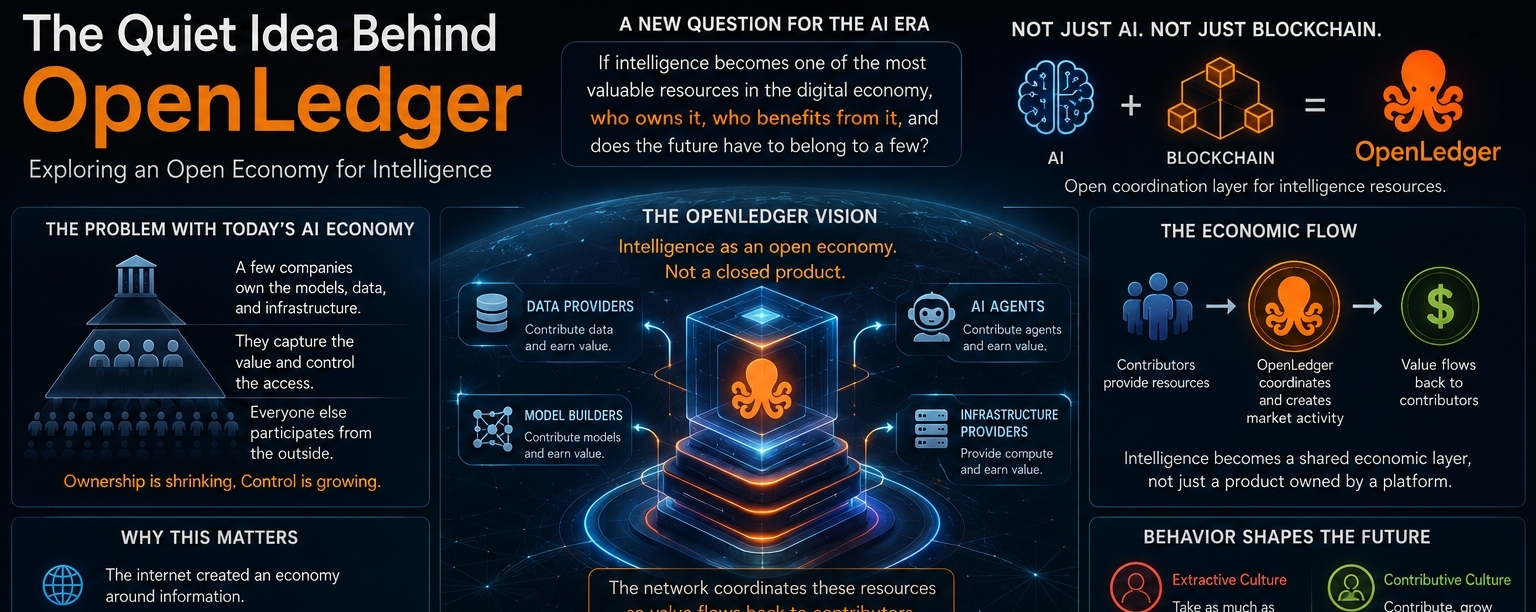
@OpenLedger Most AI projects today feel like they are racing toward the same destination. Bigger models, larger infrastructure, tighter control, and increasingly closed systems. The technology keeps advancing, but ownership keeps shrinking. A small number of companies train the intelligence, absorb the data, and control the economic upside while everyone else participates from the outside. That structure has become so normal that people rarely question it anymore.
OpenLedger feels interesting because it quietly questions that assumption.
Not in the loud way many crypto projects do, where every new protocol claims it will “revolutionize” an industry overnight. The project feels more like an attempt to rethink how intelligence itself could function as an open economy instead of a closed product. That difference may sound subtle at first, but it changes the entire direction of the system.
The idea behind OpenLedger is not simply about combining AI and blockchain because both are popular narratives. The deeper concept seems to revolve around ownership and coordination. Instead of treating data, models, and AI agents as assets controlled by a single platform, the project appears to explore whether these pieces of intelligence can become economic building blocks that different participants contribute to, monetize, and interact with collectively.
That is where the project becomes more philosophical than technical.
The internet created an economy around information. Social media created an economy around attention. OpenLedger seems to be asking whether AI could eventually create an economy around intelligence itself. Not just consuming intelligence, but participating in its creation and benefiting from its value.
The structure behind the project reflects that thinking. Contributors provide resources — data, models, agents, or infrastructure — while the network attempts to create a system where those contributions can generate economic activity. In theory, value flows back toward the people building and supplying intelligence instead of remaining concentrated only at the platform level.
Whether that works in practice is still uncertain, but the direction itself feels more thoughtful than many AI-related crypto projects that rely mostly on narrative momentum.
The token economy is probably the most important part to watch because this is where many ambitious systems quietly fail. In weak crypto projects, the token often feels disconnected from reality, existing mainly to create speculation around an idea rather than support an actual economy. Sustainable systems usually feel different. The incentives emerge naturally because participants are providing something the network genuinely needs.
OpenLedger will ultimately need to prove that its token belongs inside the ecosystem rather than orbiting around it artificially. If the network develops real demand for intelligence resources, then the economic layer begins to make sense. If activity depends mostly on rewards without meaningful utility underneath, the system risks becoming temporary attention rather than lasting infrastructure.
The more interesting question is what kind of behavior the network encourages over time.
Some ecosystems unintentionally train users to extract as much value as possible before leaving. Others slowly create cultures of contribution where participants remain because they feel connected to the growth of the network itself. OpenLedger appears designed around the second idea, but design alone is never enough. Human behavior always determines whether an ecosystem becomes sustainable or transactional.
That challenge becomes even more difficult in AI because intelligence markets naturally drift toward centralization. The companies with the most capital, computation, and distribution usually gain enormous advantages. OpenLedger is attempting to explore whether blockchain coordination can counterbalance some of that concentration by making participation more open and economically accessible.
That does not guarantee success.
The risks here are real and probably larger than many people admit. Building decentralized systems is already difficult. Building decentralized systems around AI infrastructure is even harder. The project still needs to prove that contributors will consistently provide high-quality resources, that users will actually demand open intelligence markets, and that the economics remain functional after speculative excitement fades.
There is also the uncomfortable reality that many users prefer convenience over openness. Centralized AI platforms succeed because they are simple, fast, and efficient. Open systems often struggle with fragmentation, inconsistent quality, and coordination problems. OpenLedger is not competing only against other crypto projects. It is indirectly competing against the natural tendency of technology itself to consolidate power around efficiency and scale.
Still, what makes the project compelling is that it is trying to explore a larger question before the industry fully arrives there.
If intelligence becomes one of the most valuable resources in the digital economy, who owns it? Who benefits from it? And does the future of AI inevitably belong to a handful of massive platforms, or can ownership become more distributed across contributors and networks?
OpenLedger does not fully answer those questions yet. It is still early, experimental, and largely unproven. But sometimes the most interesting projects are not the ones making the loudest promises. They are the ones quietly testing whether a different structure is possible before the rest of the market realizes why that structure matters.