I keep circling back to a simple but uncomfortable idea: everything I feed into digital systems my words, my clicks, my patterns, even my hesitation doesn’t just disappear into the void. It gets absorbed, learned from, reshaped, and eventually reflected back at me through systems that feel increasingly intelligent. And yet, I rarely own any part of what I contribute.
That gap is where ideas like AI blockchains begin to make sense to me. Not as hype, and not as another speculative layer of crypto jargon, but as an attempt still imperfect, still experimental to answer a question I don’t think we’ve properly resolved yet: if intelligence is built from collective human behavior, why does the economic value of it concentrate almost entirely at the top?
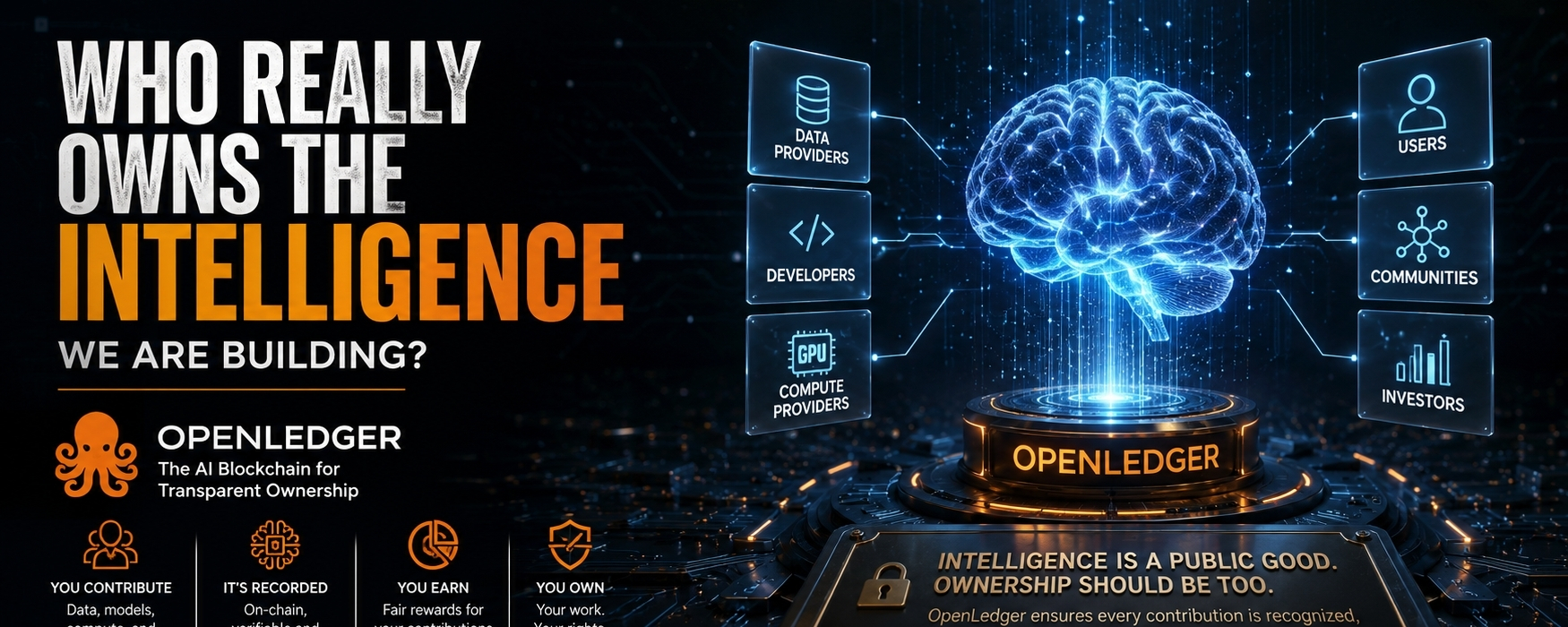
When I first came across the concept behind OpenLedger (OPEN), I didn’t see it as just another infrastructure project. I saw it more like a reaction to an imbalance I already feel every day but rarely articulate. The idea that data, models, and even autonomous agents could be treated as economic assets that carry ownership rights is both exciting and unsettling at the same time. It forces me to reconsider what I thought was “free” online.
Because nothing is really free. Not my attention. Not my data. Not even my participation.
The promise here is straightforward in theory. If data trains AI systems, then data should carry value. If models are built from that data, then those models should carry ownership traceability. And if AI agents software systems that act independently start performing real economic tasks, then their output should be accountable and distributable across whoever contributed to their existence.
In traditional systems, none of that happens in a transparent way. Everything gets absorbed into centralized platforms. My interactions become part of massive datasets. Those datasets become training material. And eventually, they reappear as commercial AI systems that I might have to pay to use again, even though I helped shape them indirectly.
That loop has started to feel strange to me.
So when I look at blockchain-based AI ideas, what interests me isn’t just the technology. It’s the attempt to make invisible labor visible. The idea that every dataset contribution or model improvement could be tracked and recorded in a way that allows value to flow back to its origin. In theory, that sounds like fairness encoded into infrastructure.
But I also know enough to be cautious about how clean that story sounds.
Even if I could track every piece of data I contribute, I still wonder how that data would be valued. Would my casual conversation matter as much as a structured dataset? Would my corrections to a model be worth anything measurable? Or would the system still end up rewarding scale over nuance, just in a more transparent-looking way?
Transparency alone doesn’t solve inequality. It just makes it easier to see.
What I find more interesting and more complicated is the idea of autonomous agents becoming economic participants. I imagine an AI agent that can execute tasks, make decisions, maybe even generate revenue by interacting with digital systems. On paper, it feels like a logical extension of automation. But then I ask myself: if that agent earns value, who do I think that value belongs to?
The creator? The users who influenced it? The network that hosts it? Or the system that records its activity?
There isn’t an easy answer, and I don’t think pretending there is one helps.
The more I think about it, the more I realize this isn’t just a technical question. It’s a philosophical one about what counts as contribution in a world where intelligence is no longer purely human or purely machine. The boundaries are getting blurry in a way I don’t think our current economic systems are ready for.
Supporters of ecosystems like OpenLedger argue that blockchain can act as a neutral layer where ownership is automatically tracked and rewards are distributed through smart contracts. I understand the appeal of that vision. It removes ambiguity. It replaces trust in institutions with trust in code. It turns participation into something measurable.
But I also keep asking myself whether measuring everything actually improves fairness—or just reduces human complexity into something easier to price.
Because I know how systems behave when incentives are introduced at scale. People optimize for them. Developers design around them. Behavior shifts toward what is rewarded, not necessarily what is meaningful. If intelligence itself becomes tokenized, I can easily imagine a world where the goal stops being better understanding and starts becoming better extraction.
That thought makes me pause.
Still, I can’t dismiss the direction entirely. I see why it’s emerging. The current model of AI development is heavily centralized. A small number of companies control the largest models, the largest datasets, and the largest distribution channels. If I care about ownership at all, I can understand why people are trying to build alternatives that redistribute value closer to the edges.
In that sense, systems like OpenLedger are not just technological experiments. They are reactions to concentration. Whether they succeed or fail, they are pointing at something real: the growing gap between those who generate data and those who profit from it.
And I think that gap is going to define the next phase of digital economics.
What I find hardest to resolve is my own position in all of this. I benefit from these systems. I use them. I rely on them. But I also contribute to them constantly without thinking about ownership or compensation. That contradiction sits in the background of almost every interaction I have online.
Maybe the future being proposed here this idea of AI systems tied to ownership ledgers and programmable value isn’t about fixing everything. Maybe it’s just about forcing acknowledgment. Forcing me to see that participation has weight, even if that weight is currently invisible.
At the same time, I don’t want a world where every interaction becomes transactional. I don’t want to optimize my behavior around tokens or rewards. I don’t want intelligence itself to feel like a marketplace where every thought has a price tag.
So I stay in this tension.
I understand the need for new systems. I understand the flaws in the current ones. But I also know that once we start encoding value into every layer of intelligence, there may be no easy way to separate meaning from monetization again.
And maybe that’s the real question I’m left with: not whether AI blockchains like OpenLedger will succeed technically, but whether I actually want a world where every contribution I make to intelligence human or machine is permanently accounted for, priced, and redistributed.