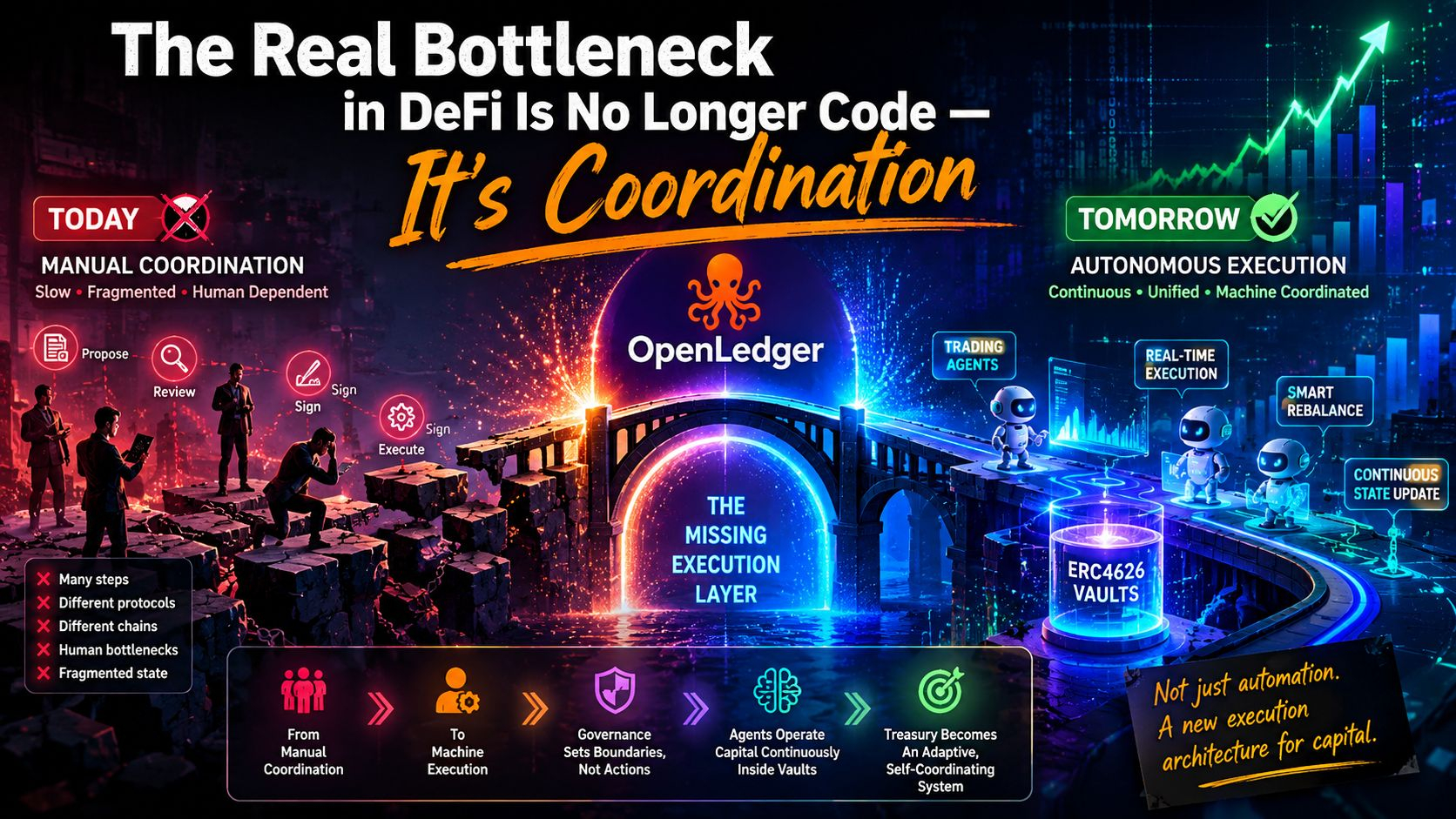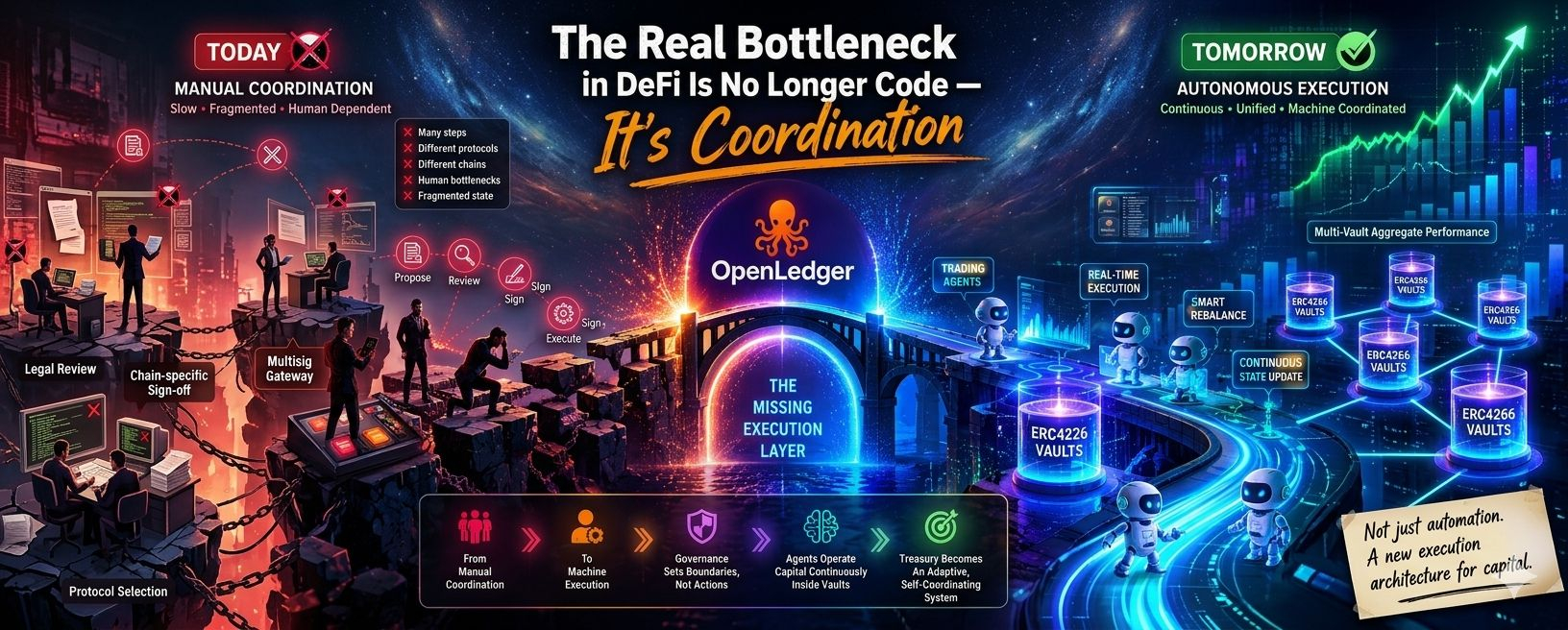
I used to think the hardest part of crypto infrastructure was building better code.
faster execution.
cheaper transactions.
smarter contracts.
Like most people in DeFi, I assumed the future would be won by whoever optimized the technical layer the most.
but recently, after spending time studying DAO treasuries and looking deeper into OpenLedger is architecture, I realized something uncomfortable:
crypto is biggest bottleneck is no longer computation.
it is human coordination.
that realization hit me after a conversation with a friend who works as a DeFi developer. He told me that most of his job no longer feels like writing smart contracts. instead, it feels like debugging coordination between people.
And honestly, the more I looked around, the more accurate that sounded.
On the surface, DAO treasuries look highly automated. you see governance systems, multisigs, ERC4626 vaults, dashboards, execution protocols, bridges, yield strategies. Everything appears fully on chain and structured.
but underneath, most treasury systems still operate lIke manual organizations.
a treasury rebalance is rarely just one action.
it becomes a chain of coordination:
someone proposes an allocation shift, someone reviews risk, signers approve transactions, another team monitors execution across multiple protocols and chains.
every step depends on humans reconnecting fragmented systems together.
At first, I thought this was simply the cost of decentralization. Governance naturally requires layers of approval and oversight.
But the deeper I looked, the more I realized the real issue is not governance itself.
the real issue is that crypto never built a unified execution layer.
Every protocol has diFferent logic.
every chain has dIfferent state.
every vault has different operational behavior.
CapItal does not move like one continuous system. it moves through disconnected environments that humans manually stitch together.
that fragmentation changes the way I now think about OpenLedger.
it no longer feels like just another DeFi project or treasury dashboard.
It feels more like infrastructure for autonomous coordination.
and that distinction matters.
Because ERC4626 already solved part of the problem. it standardized how vault-based capital is represented:
deposits, withdrawals, shares, and yield accounting all follow the same structure.
But ERC4626 only standardized representation.
it did not standardize continuous execution.
that is the missing layer I think OpenLedger is trying to address.
The architecture sitting above ERC4626 vaults starts functioning like a coorDination layer between capital, agents, and execution itself.
if ERC4626 standardized how capital is stored, this new layer standardizes how capital operates.
And once you look at it that way, something important changes.
Trading agents stop behaving like external automation tools.
They become execution actors directly inside the treasury environment.
Allocation, rebalancing, and state reactions no longer happen through fragmented human workflows. They begin happening continuously inside the system itself.
That’s a very different model from the DAO structures we are used to today.
Most DAO treasuries currently resemble bodies without nervous systems.
The organs exist:
vaults, governance, liquidity, strategies, execution infrastructure.
But every reaction still depends on humans sitting between signals and actions.
What OpenLedger seems to introduce is not just automation, but a nervous system for capital coordination.
A layer where execution becomes continuous instead of manually triggered.
And honestly, I think this changes the role humans play inside crypto systems.
Right now, humans are still acting as the execution layer. We monitor state, interpret risk, coordinate timing, and reconnect fragmented systems manually.
But maybe humans were never supposed to sit inside the execution path forever.
Maybe governance was always meant to define boundaries, risk limits, and objectives — while machines handled operational coordination underneath.
That transition feels subtle at first, but it completely changes how treasury systems behave.
Treasuries stop functioning like static pools of assets managed through governance cycles.
They start functioning like adaptive financial systems capable of reacting continuously in real time.
Of course, that also creates new questions.
When execution becomes autonomous, responsibility becomes harder to trace. Decisions no longer come from one person or one transaction. They emerge from interactions between data, agents, vaults, and state updates across multiple systems.
And maybe that’s the deeper shift happening underneath crypto right now.
For years, the industry focused on standardizing ownership, settlement, and capital representation.
But it never fully standardized execution coordination.
That missing layer is now starting to appear.
And the more I study OpenLedger through this lens, the less it feels like a product to me.
It feels like the beginning of a new execution architecture for capital itself.