
Market's been doing that thing lately where everything looks like it's moving but nothing actually is. Sideways noise. I had a few hours free and ended up going down a rabbit hole I didn't plan on.
I started poking around @OpenLedger — not for any specific reason, just one of those things that shows up in your feed and you keep scrolling past until one day you don't. I expected the usual: another chain promising speed, low fees, "the next evolution of Web3." That kind of thing.
But I kept reading, and something started feeling off in a way I couldn't immediately explain.
Here's what clicked after a while: most blockchain projects — even the serious ones — are still essentially building infrastructure for crypto people. The users are traders, developers, DeFi participants. The value loop exists inside the ecosystem. You need a wallet, you need tokens, you need to understand what a smart contract is before any of this does anything for you.
OpenLedger seems to be making a different bet. And I'm not sure I've seen it framed this way anywhere yet.
The project's actual positioning isn't really about being a better blockchain. It's about becoming the layer where data itself gets ownership rights. Not data storage. Not data transfer. Ownership. As in — the actual humans and entities who generate data can hold a verifiable claim over it, participate in its use, and get compensated through mechanisms that don't require them to understand what a blockchain is.
That's a completely different category of thing.
I kept thinking about how the internet monetizes attention and data right now. You use a platform, it harvests behavioral data, sells it or uses it to train models, and you get... the platform. For free. That's the deal. Most people don't think about it because the alternative has always been too complicated or too theoretical to matter in practice.
What OpenLedger seems to be arguing is that the infrastructure layer for a different deal is now actually buildable — and that blockchain is the mechanism, not the product.
Which is where I had to stop and sit with it, because this is also exactly the kind of pitch that sounds profound and is very easy to hollow out.
The uncomfortable part: I've seen versions of this framing before. "Giving users ownership of their data" has been a Web3 talking point since at least 2018. Projects have come and gone with this thesis. The gap between "the mechanism exists" and "anyone outside of crypto actually uses this" has historically been enormous. Not because the idea was wrong, but because adoption doesn't follow logic the way a whitepaper implies it does.
I'm genuinely not sure OpenLedger has solved that. The technical architecture might be sound. The economic design might be elegant. But getting non-crypto-native users — the people who actually generate the data that would make this valuable — to participate in a system that requires any degree of on-chain interaction is a distribution problem, not a design problem. And I haven't seen a convincing answer to the distribution problem yet.
There's also a timing question that bothers me. AI has changed the value of data significantly in the last two years. The demand for training data, behavioral data, specialized datasets — it's exploded. In theory, that makes OpenLedger's thesis more relevant than it ever was. But it also means the incumbents — the platforms, the AI labs, the cloud providers — have much more incentive now to lock that data in, not let it flow through an open system with user-controlled ownership. The window might be narrowing, not widening.
I thought about it like this for a while: being right about a problem doesn't mean you're positioned to capture the solution. OpenLedger might be pointing at something genuinely real and still end up a stepping stone for something that comes five years later and looks nothing like this.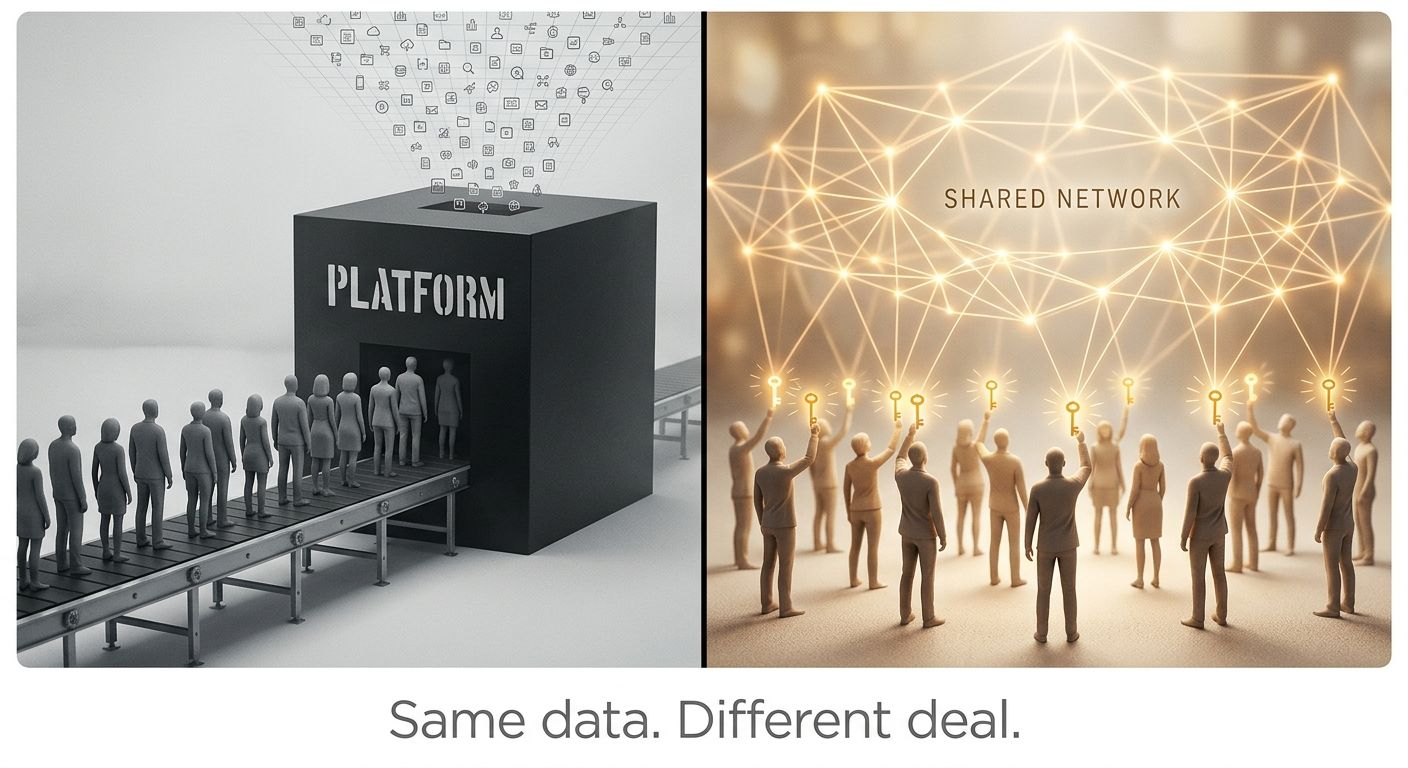
Or it doesn't play out that way at all. Maybe the AI data demand is exactly the forcing function that makes a project like this viable in a way it wasn't before.