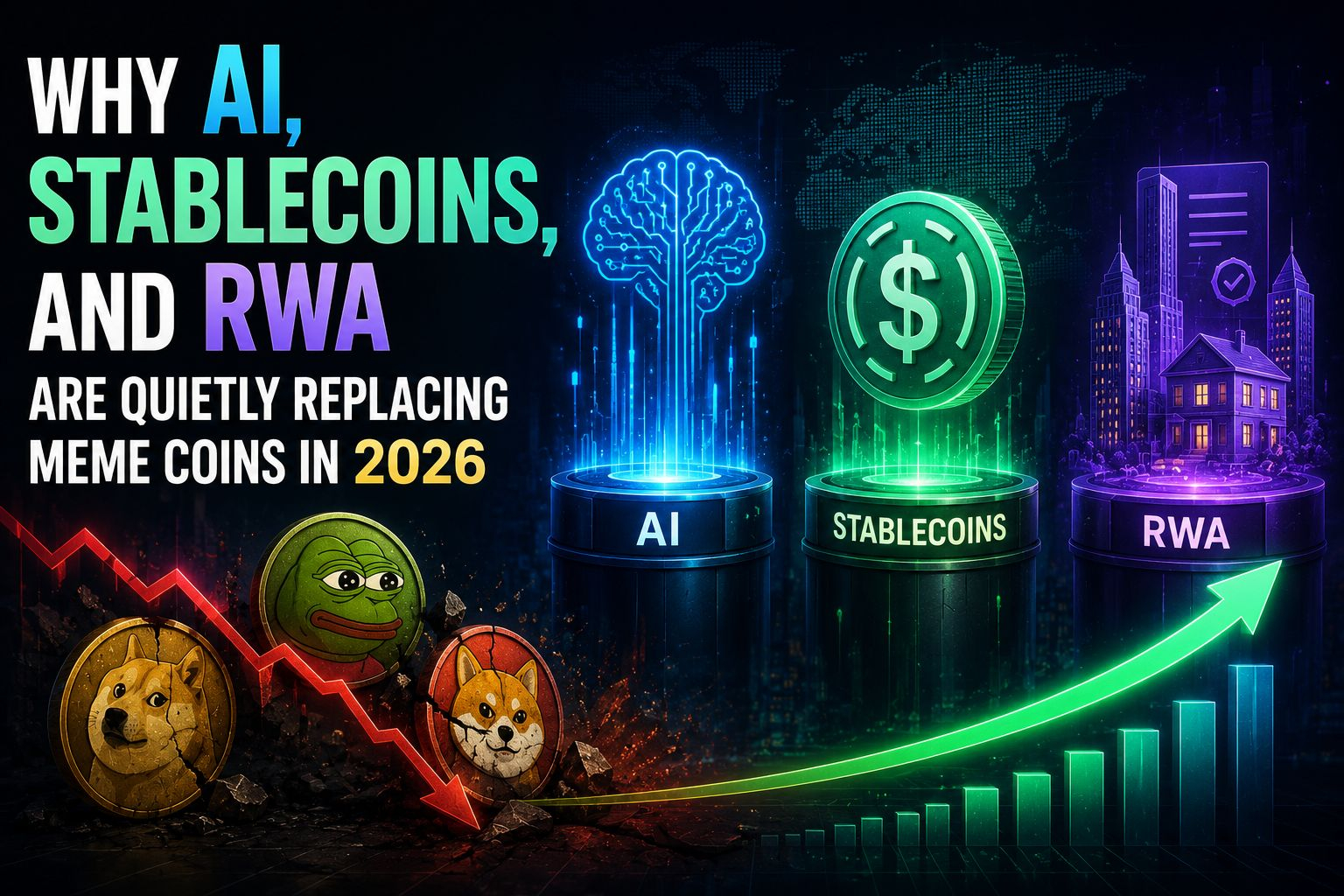


The crypto market in 2026 is undergoing a silent but powerful shift. While meme coins once dominated attention, liquidity, and social media hype, a new wave of narratives is steadily taking control. Artificial intelligence, stablecoins, and real-world asset tokenization are no longer niche sectors—they are becoming the core drivers of capital, innovation, and long-term growth in crypto.
During previous cycles, meme coins thrived on pure speculation. Their strength came from community hype, viral momentum, and the promise of fast profits. In 2021 and even parts of 2024, this model worked exceptionally well because retail liquidity was abundant and risk appetite was high. But the current cycle is different. The market is more mature, institutional participation is significantly higher, and capital is becoming increasingly selective. As a result, narratives backed by real utility are gaining priority over hype-driven tokens.
Artificial intelligence is leading this transformation. The global explosion of AI technologies has naturally extended into blockchain, where decentralized AI networks, autonomous agents, and data marketplaces are emerging rapidly. Unlike meme coins, which rely on attention, AI-based crypto projects offer infrastructure and long-term value propositions. Investors are no longer just chasing short-term pumps—they are positioning themselves in sectors that could define the next decade of technology. This shift has made AI one of the most capital-attracting narratives in the market today.
At the same time, stablecoins are quietly becoming the backbone of the crypto economy. What was once seen as a simple trading tool has evolved into a global financial layer. Stablecoins are now widely used for payments, remittances, DeFi activity, and even cross-border settlements. Institutional interest in stablecoin regulation and adoption continues to grow, reinforcing their importance. Unlike meme coins, which are volatile and speculative, stablecoins provide stability, liquidity, and real-world utility—making them essential for both retail users and large financial players.
Real-world asset tokenization (RWA) is another major force reshaping the market. By bringing assets such as government bonds, real estate, and private credit on-chain, RWA projects are bridging traditional finance with blockchain technology. This sector is attracting institutional capital because it offers something meme coins cannot: predictable yields and tangible value. Tokenized treasuries alone have seen rapid growth, signaling that crypto is evolving beyond speculation into a platform for real financial infrastructure.
One of the key reasons these narratives are replacing meme coins is the shift in liquidity behavior. In previous cycles, capital flowed freely into high-risk assets, often without concern for fundamentals. In 2026, liquidity is more concentrated and cautious. Bitcoin and Ethereum absorb a significant portion of institutional inflows, leaving less room for purely speculative plays. When capital does move into altcoins, it tends to favor sectors with clear use cases and long-term relevance.
Another important factor is sustainability. Meme coin rallies are often explosive but short-lived. They depend heavily on continuous hype and new participants entering the market. In contrast, AI, stablecoins, and RWA are building ecosystems that can grow independently of market cycles. They are supported by real demand, whether it’s for computation, financial transactions, or asset management. This makes them more resilient and attractive for long-term investors.
This does not mean meme coins are disappearing entirely. They still play a role in attracting attention and onboarding new users into crypto. However, their dominance is fading. Instead of leading the market, they are becoming secondary players—benefiting from liquidity after it has already flowed into stronger narratives.
The broader implication is clear: crypto is transitioning from a hype-driven market to a utility-driven one. The focus is shifting from quick gains to sustainable growth, from viral trends to foundational infrastructure. AI is shaping how decentralized systems think and operate, stablecoins are redefining how value moves globally, and RWA is connecting blockchain to real-world finance.
In this environment, success is no longer about chasing the loudest trend. It is about understanding where capital is flowing and why. And in 2026, that flow is increasingly directed toward sectors that offer real utility, institutional alignment, and long-term potential.
The era of meme dominance created massive opportunities, but the next phase of crypto is being built on something far more durable.