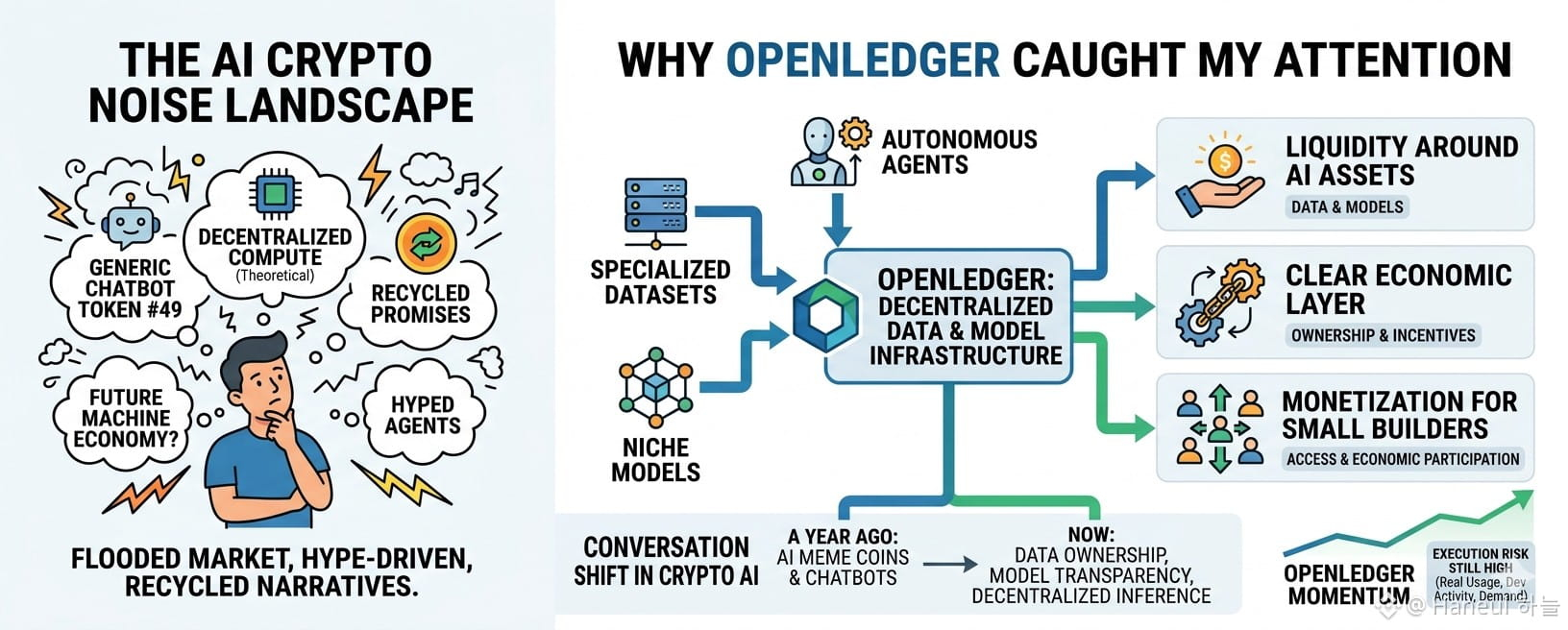
I honestly didn’t think much about OpenLedger at first. The market is flooded with AI projects right now and most of them feel like the same recycled story with different branding. Every week there’s another token saying it will power AI agents, decentralized compute, or some future machine economy that barely exists yet. After watching this space for years, I’ve learned to ignore most of the noise until I see people actually paying attention for reasons beyond pure hype. What caught my attention with OpenLedger was how often people started mentioning the idea of liquidity around AI data and models instead of just talking about another chatbot token.
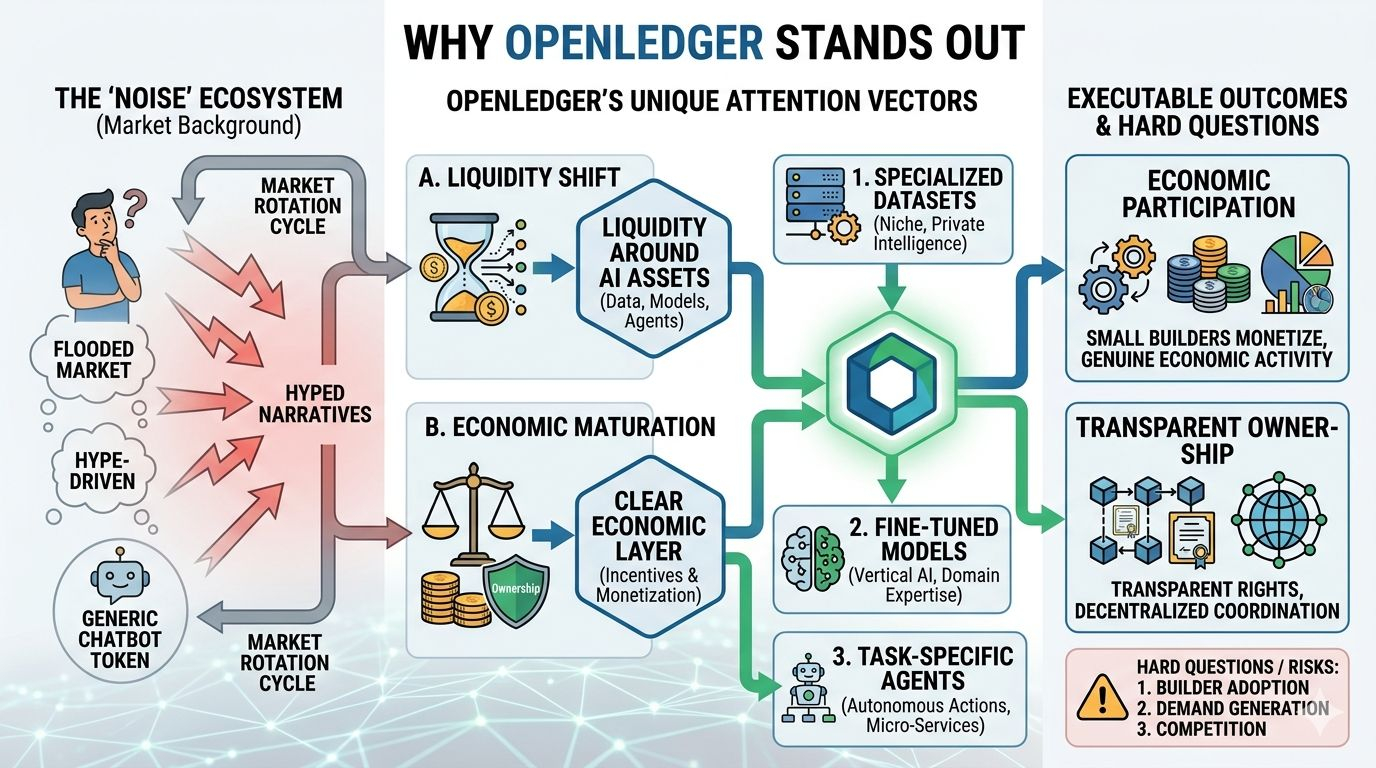
The market feels strange lately. Money keeps rotating from one narrative to another so fast that sometimes it feels impossible to know what people genuinely believe in anymore. One week it’s memes, then gaming, then AI infrastructure, then real world assets. But AI still keeps coming back no matter how many pullbacks happen. I think a lot of people understand that AI is not just a temporary trend inside crypto. The problem is that most AI projects still don’t have a clear economic layer behind them. Everyone talks about models and agents, but very few people talk about ownership, incentives, or how smaller builders can actually monetize what they create. That’s where OpenLedger started looking different to me.
The idea of turning data, models, and AI agents into something liquid and tradable actually makes sense in the current market environment. I keep seeing more people slowly talking about the future value of data itself. Not just data collected by giant tech companies, but specialized datasets, niche models, private intelligence layers, and autonomous agents that perform tasks. Crypto people naturally look at everything through ownership and liquidity. Once you start thinking that way, the OpenLedger narrative becomes easier to understand. They’re basically trying to build infrastructure where AI assets can be treated more like financial assets instead of isolated software tools sitting on centralized servers.
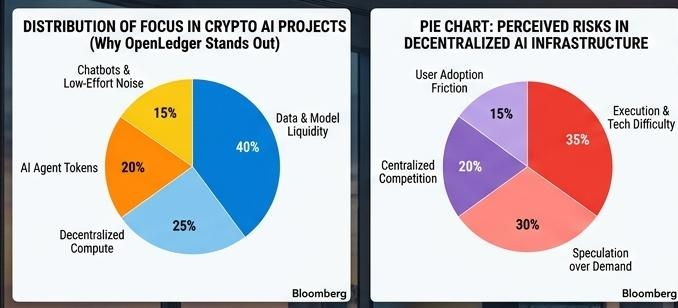
What really made me pay attention was how this connects to the broader shift happening in AI. Right now most valuable AI infrastructure is controlled by a small group of companies with insane amounts of compute and private data. Smaller developers struggle to compete because they can’t properly monetize their work or access enough liquidity. OpenLedger seems to be targeting that exact problem. The idea is that contributors can create value through data, models, or agents and then actually have transparent ownership and economic participation around it. In theory, that sounds powerful because crypto markets are extremely good at pricing narratives around ownership.
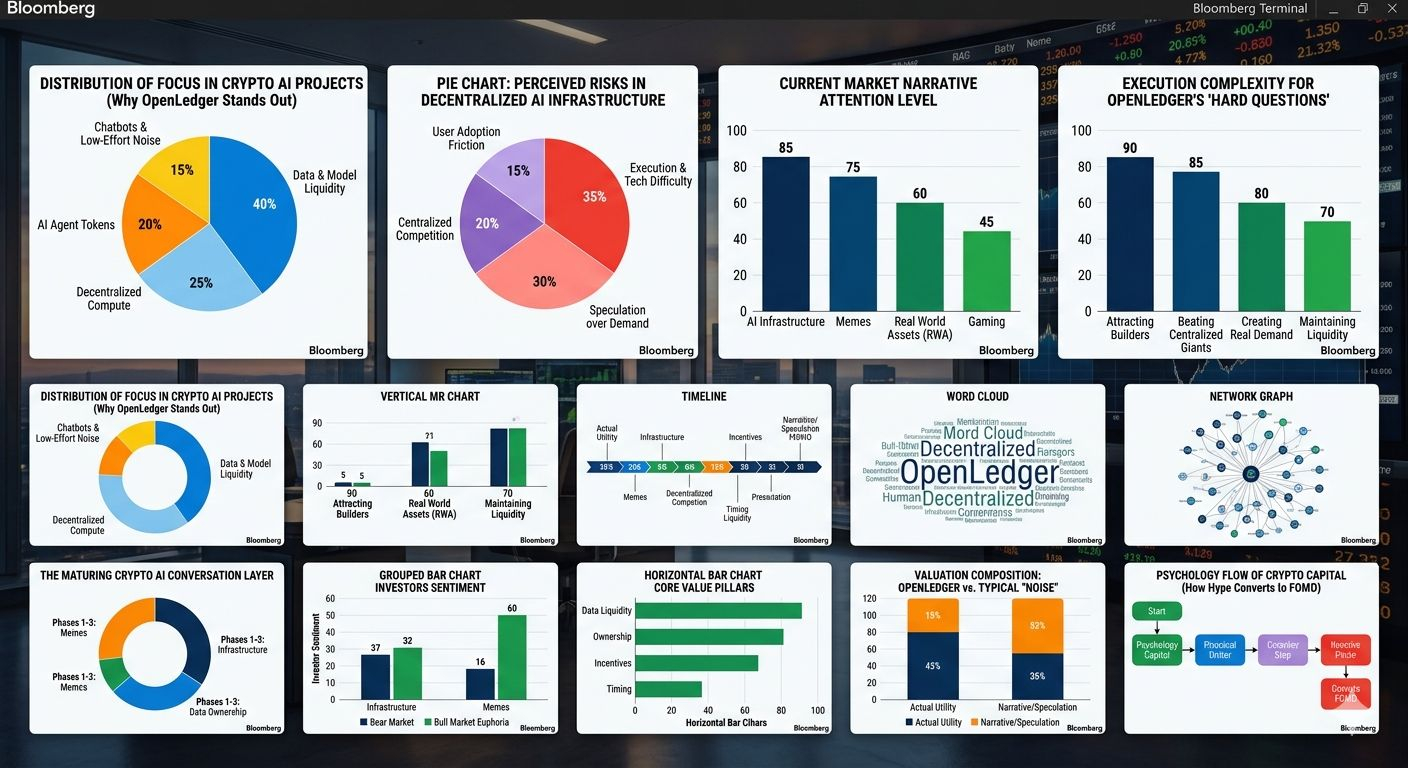
Still, I think people are getting ahead of themselves in some areas. I see traders throwing around massive expectations every time AI and blockchain are mentioned together. The reality is that building useful decentralized AI infrastructure is incredibly hard. Most users still don’t care whether something is decentralized if the product itself isn’t clearly better or cheaper. I still think there are risks people are ignoring. Adoption is not automatic just because a project combines two hot sectors. A lot of these ecosystems depend heavily on speculation before real usage arrives, and sometimes the actual user demand never catches up.
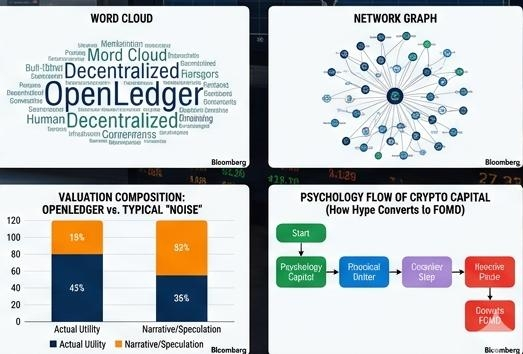
Another thing I’ve noticed is how sentiment around infrastructure projects changes during different market phases. When the market gets euphoric, people suddenly care about future systems and big long-term visions again. That’s usually when projects like OpenLedger start gaining momentum because investors begin positioning for what they think the next cycle will value. During bearish periods, nobody wants to hear about infrastructure. Everyone only wants immediate users, revenue, and attention. But when liquidity comes back, narratives matter again, especially narratives tied to AI because institutions, venture capital, and even retail traders all seem obsessed with the sector now.
I also think OpenLedger benefits from timing more than people realize. AI conversations are becoming impossible to ignore globally. Every major tech company is racing into AI, and crypto markets naturally want exposure to that trend somehow. The problem is that many crypto AI projects feel disconnected from real infrastructure needs. OpenLedger at least tries to focus on something practical inside the AI economy instead of just creating another assistant or token with “AI” in the branding. That alone separates it from a lot of low-effort projects I’ve seen recently.
At the same time, I can already see the danger of overvaluation narratives forming too early. Crypto markets love pricing future dreams years ahead of reality. Sometimes that works, sometimes it completely collapses. I’ve watched enough cycles to know that strong narratives can push tokens much further than fundamentals for a while. But eventually people start asking harder questions about adoption, developer activity, ecosystem growth, and actual demand. OpenLedger will eventually face those same questions. Can it attract real builders? Can it create genuine economic activity around AI assets? Can it compete against centralized AI systems that already dominate the market? Those are the things I keep thinking about when I watch the price action and sentiment evolve.
 What I find interesting is that the conversation around AI inside crypto is slowly maturing. A year ago, most people only cared about AI meme coins or simple chatbot integrations. Now I’m noticing more discussions around data ownership, model transparency, decentralized inference, and AI coordination layers. That shift matters. It tells me the market is slowly moving deeper into infrastructure thinking instead of surface-level hype. OpenLedger seems positioned right in the middle of that transition, which is probably why attention keeps growing around it.
I also can’t ignore how much psychology drives this market. Once traders believe a project represents an important future narrative, liquidity starts flowing almost automatically. Then influencers start posting charts, communities become more active, and suddenly people who ignored the project earlier begin chasing it higher. I’ve seen this happen with so many sectors over the years. Sometimes the hardest part is figuring out whether the narrative has real staying power or if it’s just temporary momentum. With OpenLedger, I feel like the narrative itself has more depth than most AI plays, even if execution risk is still very high.
Right now I’m mostly watching how the market reacts over time instead of getting caught in immediate excitement. I want to see whether developers genuinely build around the ecosystem and whether users actually interact with these AI liquidity systems in meaningful ways. That’s usually where reality starts separating stronger projects from temporary hype cycles. Still, I understand why people are paying attention. The combination of AI, ownership, liquidity, and decentralized infrastructure touches multiple narratives that the market already cares deeply about.
I think that’s why OpenLedger feels different to me compared to a lot of random AI tokens floating around. It doesn’t feel entirely built around short-term attention. There’s at least an attempt to solve something connected to the future economic layer of AI systems. Whether they can actually execute on that vision is another story completely. Crypto has taught me that good ideas alone are never enough. But I also know that when a project catches the market’s imagination at the intersection of two major trends, things can move very fast. Right now AI infrastructure still feels early, messy, and uncertain, but I can definitely feel the market s
lowly leaning toward it.