
Artificial intelligence is quickly becoming one of the most important technologies in the global economy. From finance and healthcare to gaming, logistics, and education, AI systems are now deeply connected to how businesses operate and how people interact online. But while AI adoption is accelerating at an incredible pace, one major issue is becoming impossible to ignore: almost all AI infrastructure is controlled by a small number of centralized companies.
Today, the most powerful AI models, cloud systems, GPU clusters, and data pipelines are concentrated inside a few dominant tech firms. This creates growing concerns around censorship, ownership, transparency, privacy, compute access, and vendor lock-in. As AI becomes more economically valuable, the battle over who controls the infrastructure behind it may become even more important than the models themselves.
This is why decentralized AI infrastructure is gaining serious attention across both the blockchain and AI industries.
Decentralized AI infrastructure refers to distributed networks that provide compute power, storage, data sharing, model training, inference systems, and AI coordination without relying entirely on centralized cloud providers. Instead of depending on a single company, these systems use open networks where contributors can provide resources and earn incentives for participation.
The importance of this shift becomes clearer when looking at the current state of the AI market. Demand for GPUs and AI compute is now growing faster than centralized supply. Massive investments are flowing into AI data centers, cloud infrastructure, and specialized chips because existing systems are struggling to keep up with global demand.
This shortage creates a natural opportunity for decentralized networks.
Rather than allowing unused GPUs and computing resources to sit idle across the world, decentralized AI networks can aggregate those resources into open marketplaces where developers and businesses access compute power more efficiently. This model introduces a market-driven supply layer that could significantly reduce infrastructure bottlenecks while expanding access to AI development globally.
Another major reason decentralized AI infrastructure could become massive is ownership.
In traditional AI systems, users generate enormous amounts of valuable data, but the economic benefits are usually captured by centralized platforms. Decentralized systems attempt to change this dynamic by creating transparent incentive structures where data providers, model trainers, compute providers, and developers can all participate directly in value creation.
This creates an entirely different economic model for AI.
Instead of AI being controlled by a few corporations, decentralized networks could transform AI infrastructure into open digital economies where contributors are rewarded proportionally for the value they help create. This idea is becoming increasingly attractive as AI evolves from a software feature into foundational infrastructure for the internet economy.
Transparency is another major factor driving decentralized AI adoption.
One of the biggest criticisms of centralized AI is opacity. Most users cannot verify how models are trained, what data is used, how decisions are made, or whether outputs are manipulated. Decentralized AI systems can introduce verifiable training pipelines, transparent governance, cryptographic validation, and proof-based execution models that improve trust and accountability.
As governments, enterprises, and regulators demand safer and more auditable AI systems, transparency may become a competitive advantage rather than just a philosophical idea.
The intersection between blockchain and AI also strengthens this trend.
Blockchain technology provides decentralized coordination, immutable records, token incentives, and verifiable execution. AI brings automation, decision-making, and large-scale intelligence. Together, they create systems where autonomous AI agents can interact economically, manage resources, execute transactions, and coordinate infrastructure without centralized intermediaries.
This convergence is already starting to reshape industries like decentralized finance, cloud computing, digital identity, and tokenized assets.
Energy efficiency may also become a surprising advantage for decentralized models.
As AI data centers face growing criticism over electricity usage, environmental impact, and infrastructure strain, decentralized approaches that optimize resource distribution could become increasingly important. Public backlash against massive centralized AI infrastructure projects is already emerging in several regions due to concerns about power consumption and economic inequality.
At the same time, decentralized AI aligns closely with broader technology trends shaping the next decade.
Businesses are moving toward distributed cloud systems, multi-cloud environments, open ecosystems, and infrastructure flexibility. Organizations increasingly want systems that reduce dependency on single vendors while improving scalability, resilience, and cost efficiency.
Decentralized AI infrastructure fits naturally into this direction.
The industry is still early, and many challenges remain unresolved. Centralized providers still dominate performance for large-scale AI workloads, and decentralized systems must improve coordination efficiency, latency, reliability, and user experience before achieving mainstream adoption. Regulatory uncertainty, hardware limitations, and sustainable business models also remain open questions.
However, the long-term opportunity is difficult to ignore.
AI is rapidly becoming infrastructure rath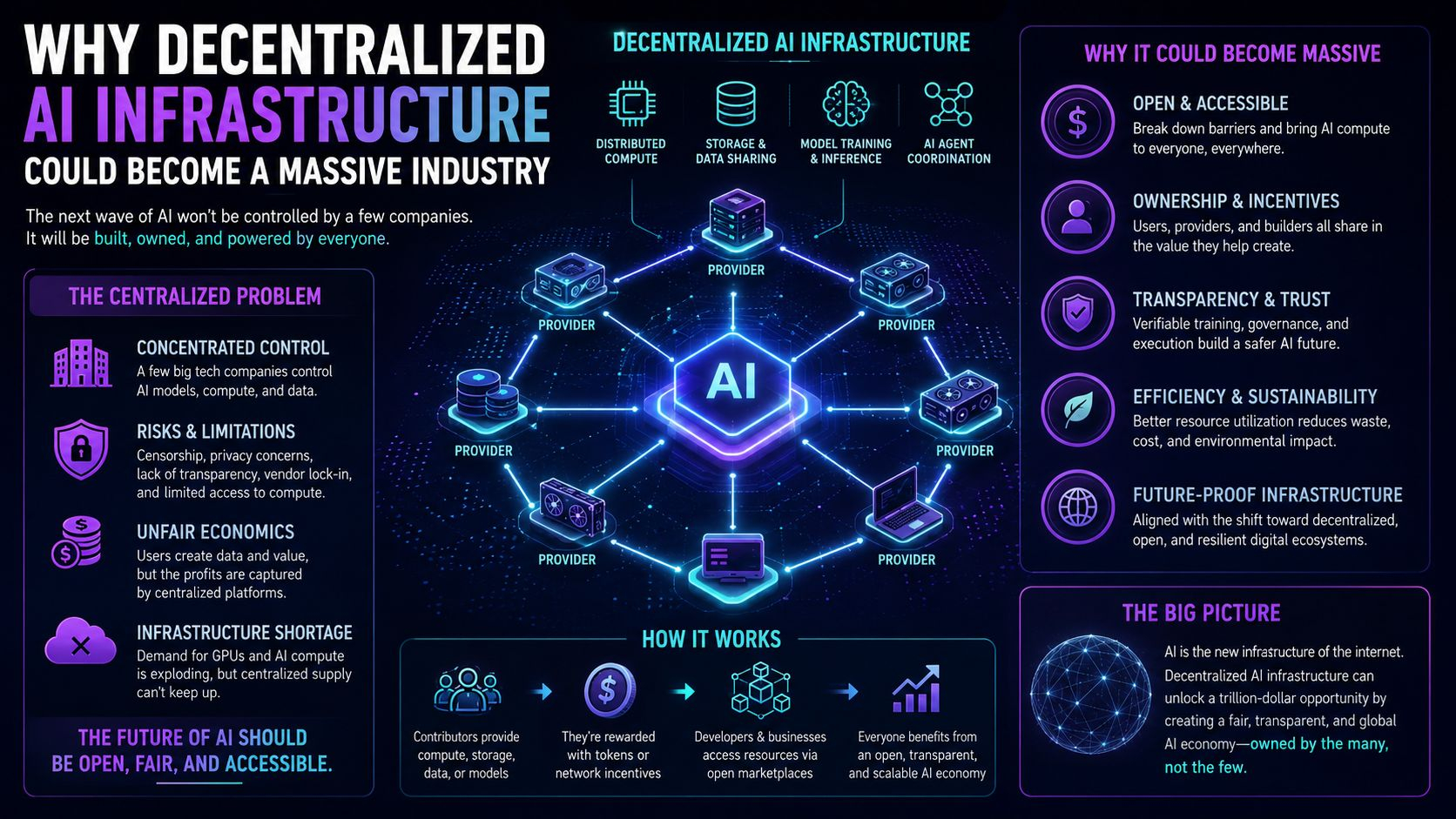 er than simply software. As that transformation continues, the systems controlling compute, data, and intelligence will likely become some of the most valuable digital assets in the global economy. Decentralized AI infrastructure offers an alternative vision where ownership, coordination, and value creation are distributed across open networks rather than concentrated inside a handful of corporations.
If decentralized systems can solve scalability, trust, and economic alignment at scale, they may become one of the defining infrastructure industries of the AI era.
