
I was at a tea stall near the main road a few nights ago when the owner suddenly stopped taking digital payments. Customers were confused because the internet was still working. Videos were loading. Messages were sending. But the payment machine kept failing in the middle of transactions.
Then the usual cycle started.
The bank blamed the network. The network provider blamed a server issue. Customer support kept saying the system was “stable.”
Everybody depended on the infrastructure. Nobody really understood where the failure was happening.
That situation stayed in my head later while reading OpenLedger’s recent infrastructure updates because AI systems are slowly entering the same phase now.
From the outside, everything still looks smooth.
People see chatbots generating answers instantly. AI agents completing workflows. Models producing images, code and research summaries in seconds. The interfaces look polished enough that most people assume the infrastructure underneath must already be mature.
It is not.
A lot of AI deployment today is still messy behind the scenes.
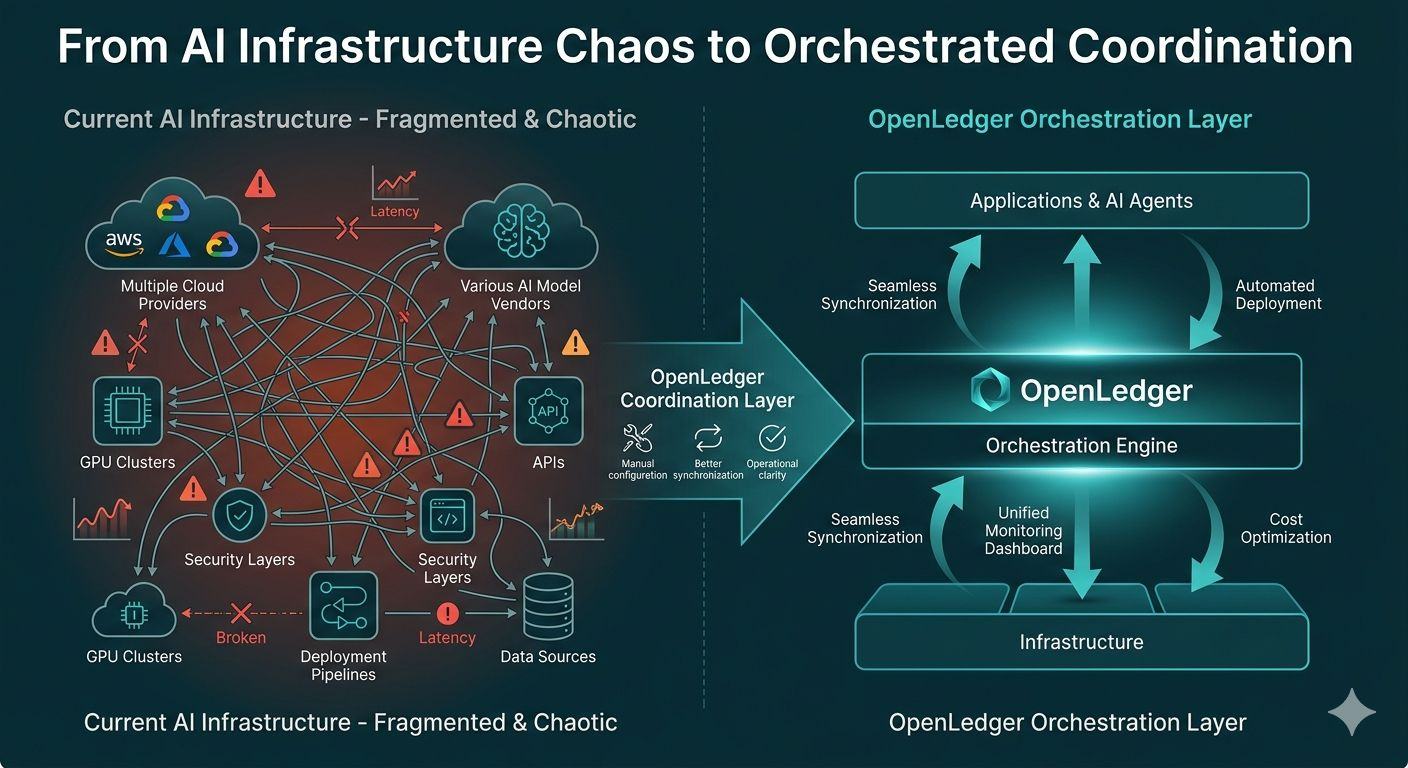
Engineering teams spend huge amounts of time dealing with broken integrations, unstable APIs, cloud synchronization problems, GPU allocation issues and rising compute costs that become difficult to predict once usage grows.
The systems often function. But many of them are far less stable than the public demos suggest.
That is the environment OpenLedger is stepping into.
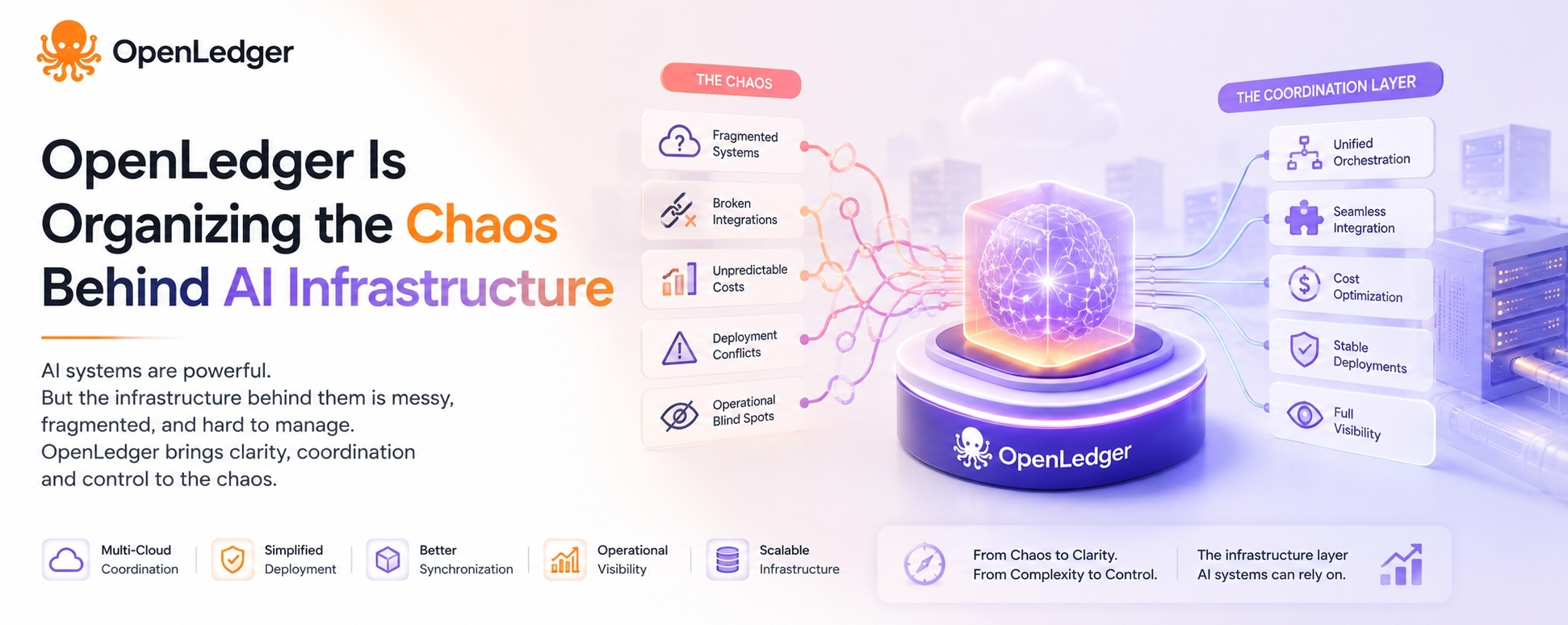
The company’s latest updates are focused on cloud coordination and AI deployment management. Cleaner orchestration. Less manual configuration. Better synchronization between environments.
And honestly, the problem itself is real.
AI infrastructure has become difficult to manage very quickly.
Different cloud providers. Different model vendors. Different security rules. Different deployment pipelines. Different operational requirements depending on geography and industry.
Once companies move beyond experimentation and start deploying AI into actual production environments, complexity multiplies fast.
OpenLedger’s basic argument seems simple: AI systems are becoming too fragmented to coordinate manually, so companies need a cleaner operational layer sitting above the infrastructure.
That makes sense.
But this is also where I become careful with words like “simplification.”
Because the technology industry has been repeating the same cycle for years.
Infrastructure becomes difficult. A platform appears promising abstraction. Companies adopt it because operational pressure becomes exhausting. Then over time the abstraction layer itself becomes another dependency.
The complexity never really disappears.
It changes location.
That difference matters more than most marketing pages admit.
Platforms like OpenLedger do not remove the chaos underneath AI systems. They organize it into a coordination layer companies interact with instead of managing everything directly themselves.
At first, that feels efficient.
Developers configure less manually. Operations become cleaner. Dashboards look more organized. Deployment processes become easier to repeat.
Naturally businesses like that.
But abstraction always comes with a tradeoff.
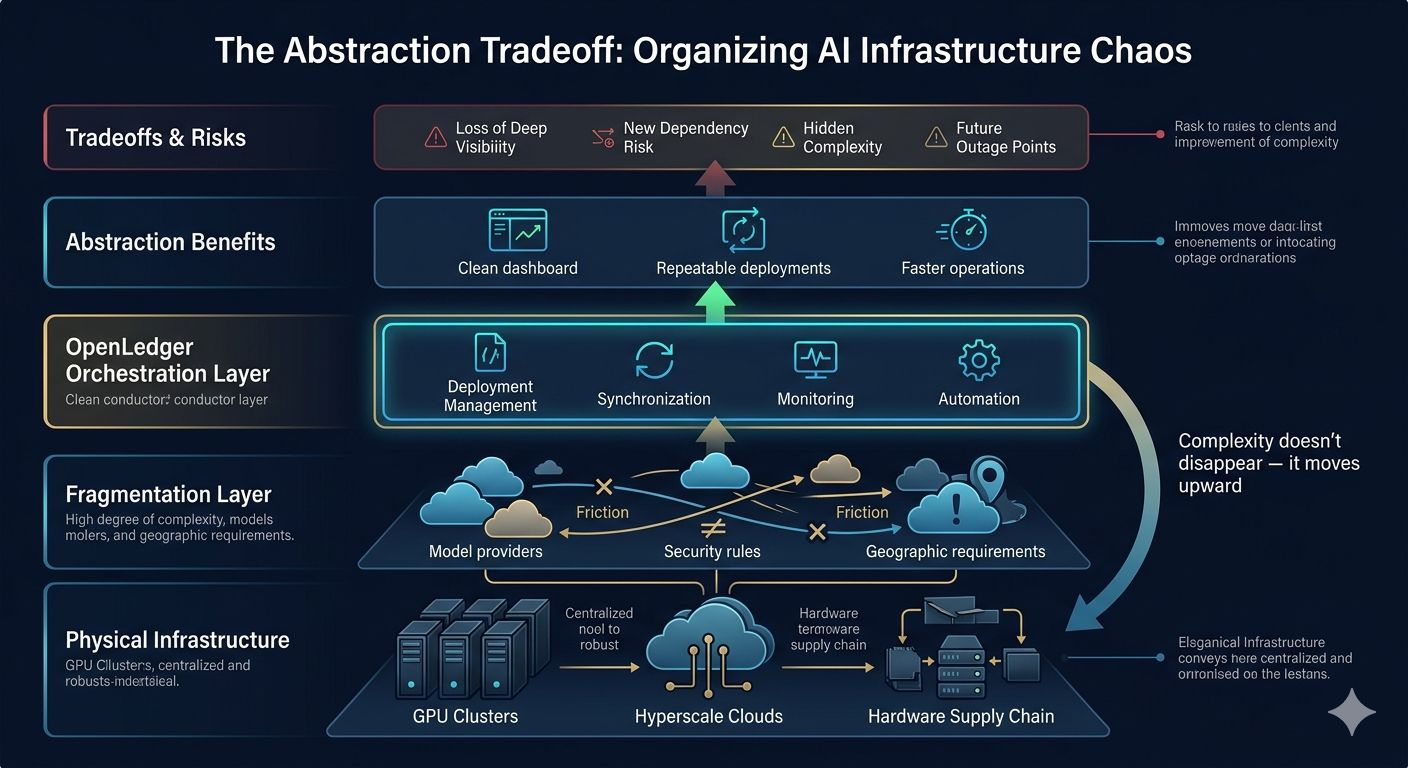
The more operational knowledge gets pushed into orchestration layers, the less companies understand the infrastructure underneath their own systems.
And eventually that becomes dangerous.
Because something always breaks later.
An outage. A scaling problem. A deployment conflict. A compliance issue. A dependency failure nobody noticed building quietly underneath the surface.
That is usually when companies realize they no longer fully understand the systems they became dependent on.
Cloud computing followed this exact pattern.
At first, cloud infrastructure genuinely helped businesses move faster and avoid maintaining expensive internal systems. But over time organizations discovered they had rebuilt large parts of their operations around ecosystems they could not easily leave anymore.
Migration became painful. Tooling became deeply integrated. Costs became harder to control as systems scaled.
AI infrastructure is moving in a similar direction now, except AI systems introduce even more unpredictability.
Traditional software behaves relatively consistently once deployed.
AI systems do not.
Costs fluctuate depending on usage. Models drift over time. Latency changes unexpectedly. Security risks evolve constantly. Operational behavior becomes harder to forecast.
Which means infrastructure coordination stops being a one-time engineering task.
It becomes a permanent operational burden.
That is why orchestration platforms are becoming attractive so quickly. Companies are under pressure to adopt AI fast while the infrastructure standards underneath are still immature.
OpenLedger understands that pressure.
But there is another layer to this conversation that matters too.
The decentralization narrative.
A lot of AI + blockchain projects describe themselves as decentralized infrastructure alternatives. Fine. But the physical reality underneath AI remains heavily centralized.
A small number of corporations control most high-end GPUs. A handful of providers dominate hyperscale cloud infrastructure. The hardware supply chain requires enormous capital.
So when projects talk about decentralized AI infrastructure, I think the more honest question is:
How decentralized can the system really become if the compute layer underneath still depends on centralized industrial infrastructure?
That does not mean decentralized coordination has no value.
It just means coordination software and physical infrastructure are two different things.
And enterprises understand that difference very clearly.
Crypto markets tolerate experimentation. Large organizations usually do not.
Compliance departments dislike uncertainty. Finance teams dislike operational systems connected to volatile assets. Legal teams move slowly around unclear regulations.
That is why enterprise adoption for token-linked infrastructure tends to happen much slower than crypto communities expect.
Not because the tooling is useless.
Because operational trust takes time.
Still, I think OpenLedger is focusing on a real shift happening inside the AI industry.
The conversation is slowly moving away from raw intelligence and toward coordination.
How do companies manage deployment complexity? How do they synchronize infrastructure across environments? How do they maintain visibility once systems become too complicated for small teams to monitor manually?
Those questions matter now because AI is leaving the demo phase and entering the operational phase.
And operational phases are always less glamorous.
But they are usually where the real infrastructure companies start separating themselves from the temporary hype cycles.
The important thing is whether these coordination layers actually reduce long-term complexity or simply hide it well enough that businesses notice the problem later instead of earlier.
Because eventually every infrastructure system reaches a moment where pressure exposes what was quietly building underneath the surface the entire time.