
Phone died during a trade yesterday. Not during something major — just a setup I'd been watching. Found a charger, came back, the move had already happened. Sat there for a few minutes feeling vaguely annoyed at nothing in particular.
Then I got distracted reading about OpenLedger instead of finding the next setup. Which, honestly, might have been the better use of the afternoon.
"The internet is built on your data but you earn nothing." I've read versions of that sentence hundreds of times. It's the founding grievance of the entire data rights conversation. And every time I read it I nod along and move on like it's settled, obvious, a done deal.
But I started pulling on it today and something shifted.
What if that sentence is actually wrong? Not wrong like factually incorrect — but wrong in the way it frames the problem.
Because you do earn something from your data. You've been earning something this whole time. You earn Google Search. Gmail. YouTube without paying a subscription. Instagram. Maps that actually work. The recommendation engines that make all of it feel frictionless. These things have a real dollar value if you tried to pay cash for them. And most people, given the actual choice, would prefer the data deal.
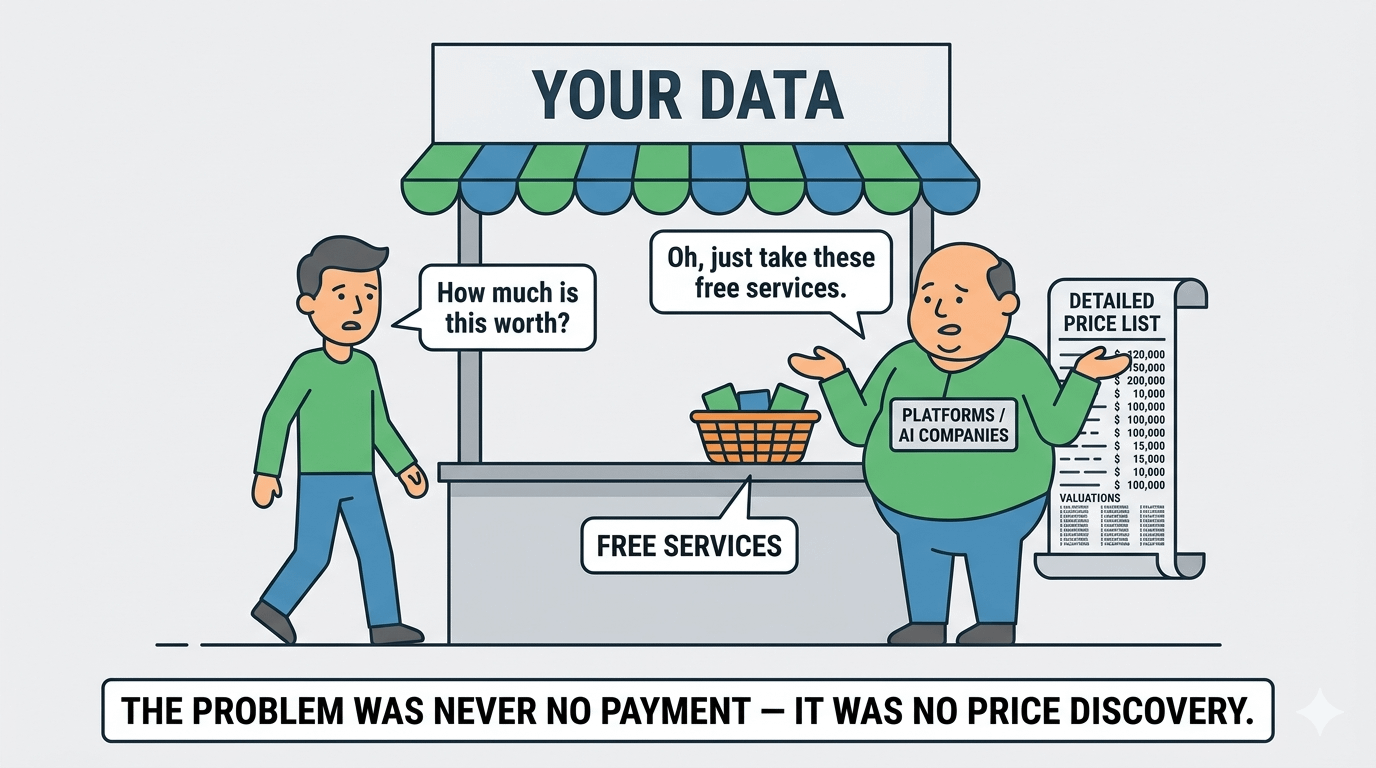
The real problem — the one that's harder to say out loud — isn't that you earn nothing. It's that you never knew the price before you agreed.
You accepted a trade without knowing the exchange rate. Google knew exactly what your search history was worth. You didn't. Meta knew what your social graph was worth. You didn't. So you handed over something valuable in exchange for services, and the asymmetry wasn't that the trade was unfair — it's that you were negotiating blind. One side had the valuation. The other side was guessing.
That's the thing I kept coming back to with OpenLedger. The project gets framed as "finally pay people for their data" — $OPEN as the mechanism for that payment. But actually the more interesting thing OpenLedger is trying to build is price discovery. A system where data has a legible, transparent value before it's exchanged, not after. Where the exchange rate gets established in the open rather than buried in a terms of service document nobody reads.
That's different. And it's a harder, more interesting problem than simply adding a payment layer to the existing arrangement.
But here's the part that genuinely doesn't sit right with me.
Knowing the price doesn't give you negotiating power if there's only one buyer — or rather, if the buyers are so entrenched that the practical alternative to accepting their terms is opting out of the internet entirely. Which most people can't do and won't do.
So even if OpenLedger creates perfect price transparency for data, even if every person could see exactly what their browsing history is worth to an AI training pipeline... what do they do with that information? The services that consume data have network effects so deep that pricing power hasn't actually transferred just because the price is now visible.
I thought about this for a while. Transparency feels like it should translate to leverage. But knowing you're underpaid and being able to do something about it are two different things. I'm not fully convinced that price visibility alone shifts the power dynamic without some other change in the competitive landscape.
Maybe that change comes from AI. If multiple AI companies are competing aggressively for training data, and OpenLedger creates a standardized market for it, the buyer competition might create the leverage that visibility alone couldn't. That's the version where this actually works.
But that requires a lot of things to align — regulatory environment, competitive AI market, critical mass of contributors, enterprise adoption — all at the same time. Each of those is uncertain on its own.
Who this matters to right now: probably not the average internet user who just wants free services and doesn't care about exchange rates. More likely the people who generate high-value behavioral data — researchers, professionals, specialized contributors — who might actually have leverage to negotiate once a price discovery mechanism exists.
When it matters: probably when AI training data becomes scarce and competitive enough that companies can't just scrape the open web and call it done. At that point the people with quality data have something real to sell, and a pricing infrastructure becomes meaningful rather than theoretical.
Anyway. Still haven't found a replacement for that setup I missed yesterday. Market's doing its sideways thing again.
@OpenLedger #OpenLedger