
For a long time, I used to think the AI race was only about who builds the smartest model. Faster inference. Bigger datasets. More GPU power. Better outputs.
But after spending more time studying @OpenLedger , I realized something much deeper may be happening behind the scenes.
The next AI economy may not be controlled by the companies with the loudest products…
It may be controlled by the networks that own the DATA FLOW itself.
And this is exactly where OpenLedger starts looking different from almost every other AI project in crypto.
Most AI systems today are still built like closed empires.
Users contribute prompts, behaviors, feedback loops, datasets, and valuable interactions every single day…
yet almost none of that value flows back to the people creating it.
OpenLedger is trying to redesign that entire structure from the ground up.
Not by creating “another chatbot.”
But by building an AI-native blockchain where data becomes a financial asset class.
That changes everything.
Because once data ownership becomes programmable on-chain, AI stops being just a software product…
and starts becoming an economic network.
The most powerful part of OpenLedger, in my opinion, is not even the hype around AI agents.
It is the architecture underneath it.
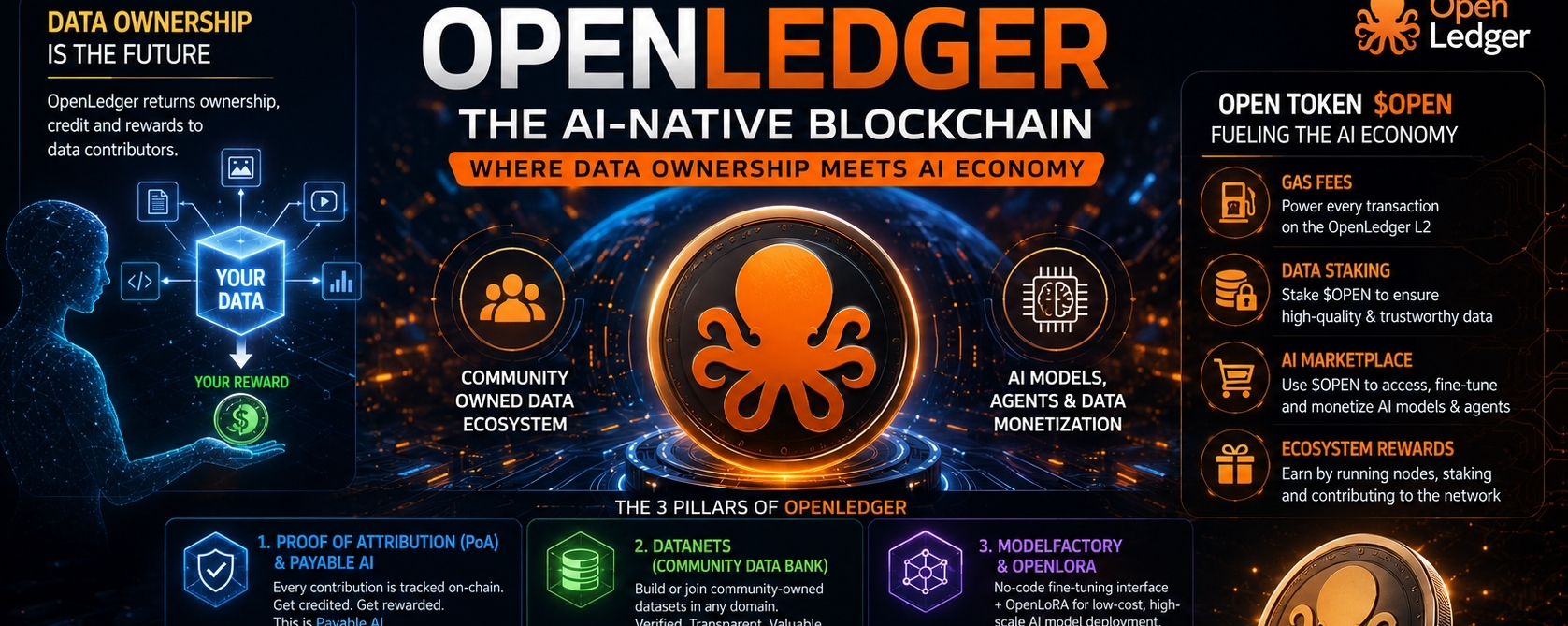
Their Proof of Attribution engine is a major shift from traditional AI infrastructure.
Every dataset contribution can be cryptographically tracked, verified, and linked to the models that use it.
Meaning:
If your contributed data helps train a successful AI model…
or improves an AI-generated output…
the network can automatically distribute rewards back to you through $OPEN.
This concept of “Payable AI” may become one of the most important narratives of the next cycle.
Because for the first time, intelligence generation itself becomes monetizable for contributors instead of only corporations.
And honestly…
that creates an entirely new economic layer for the internet.
Another thing that makes OpenLedger extremely important is its Datanet architecture.
Most people still underestimate how valuable structured data will become once AI systems mature.
Raw data alone is not enough anymore.
AI models need:
• verified sources
• clean labeling
• contextual accuracy
• specialized datasets
• transparent provenance
OpenLedger’s Datanets are essentially community-owned intelligence hubs where contributors can build high-quality vertical datasets for industries like:
• healthcare
• legal systems
• finance
• DeFi security
• governance
• enterprise analytics
That matters because institutional AI adoption will depend heavily on trust and traceability.
And centralized AI companies still struggle with that problem today.
Then comes another massive layer:
ModelFactory + OpenLoRA.
This is where OpenLedger quietly becomes infrastructure instead of just narrative.
Developers can fine-tune powerful open-source models like DeepSeek, LLaMA, and Mistral without heavy engineering complexity.
At the same time, OpenLoRA dramatically reduces GPU overhead by allowing thousands of lightweight specialized models to operate efficiently on shared infrastructure.
In simple terms:
lower costs
higher scalability
faster deployment
more decentralized experimentation
That combination could become incredibly attractive for startups building AI products without massive compute budgets.
What also stands out to me is that OpenLedger is not building isolated AI tools.
They are building an entire execution economy around AI.
According to their long-term roadmap, AI agents inside the ecosystem will eventually:
• transact autonomously
• pay for services
• monetize outputs
• purchase data
• coordinate with other agents
• distribute revenue streams on-chain
This is where the idea becomes much bigger than “AI + crypto.”
It starts looking like a programmable marketplace for machine intelligence itself.
And if that vision works…
then OPEN is not simply a governance token.
It becomes the economic fuel behind:
• transaction settlement
• AI marketplace activity
• staking for data quality
• network security
• model monetization
• autonomous agent coordination
That creates a much stronger utility loop than most speculative AI tokens currently have.
The tokenomics side also looks structurally healthier than many short-term hype projects.
The supply is capped.
Large portions are allocated toward ecosystem growth.
Mainnet incentives already reward node operators and contributors.
And linear unlock structures reduce sudden supply shock risks from early investors.
That matters because sustainable AI infrastructure cannot survive on narrative alone.
It needs economic alignment.
And this is probably why OpenLedger keeps attracting attention from serious crypto infrastructure investors instead of only retail speculation.
At the end of the day, I think the market is still massively underestimating one thing:
AI will eventually need a transparent ownership layer.
Not just smarter models.
Not just bigger GPUs.
Not just better prompts.
Ownership.
Attribution.
Monetization.
Verification.
And decentralized coordination between humans, datasets, models, and autonomous agents.
That is the layer OpenLedger is trying to build.
So while most people are chasing AI applications on the surface…
OpenLedger may quietly be building the economic rails underneath the entire AI economy itself