
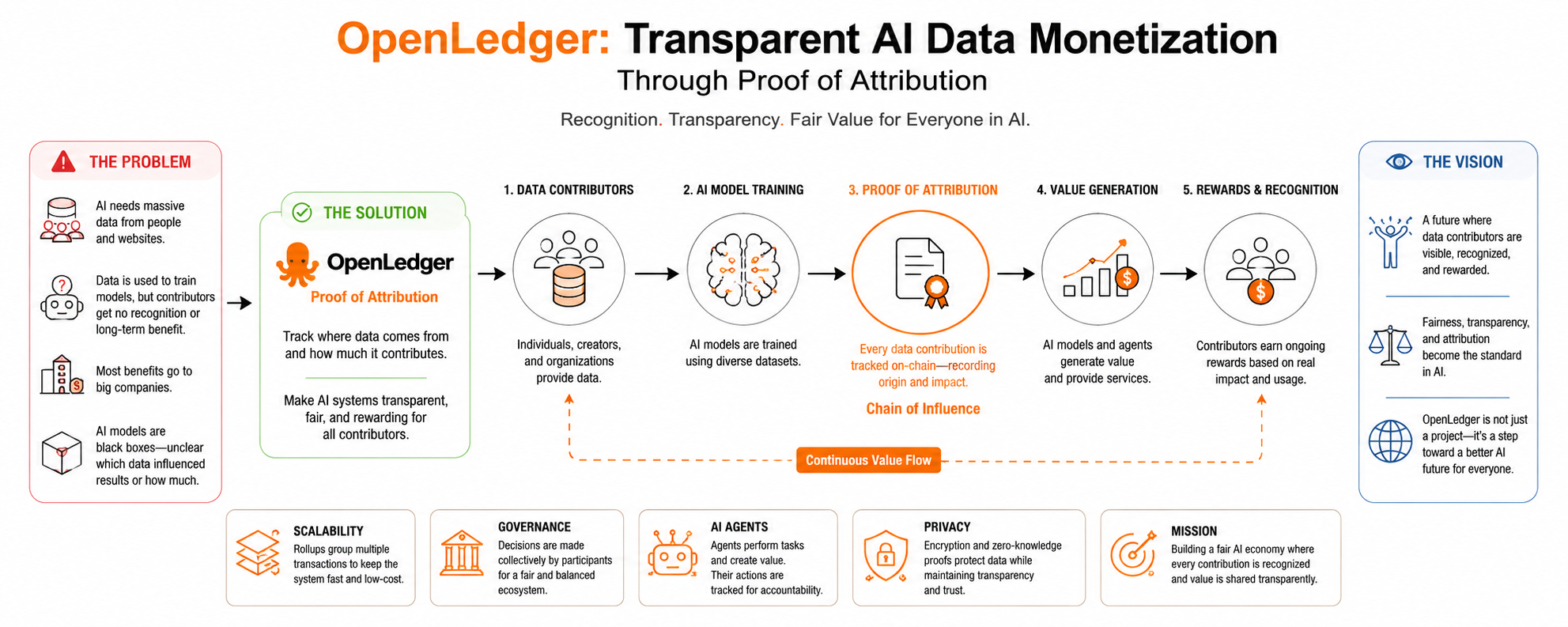
When I was learning about AI systems, I noticed one thing again and again: the system feels a bit unbalanced. AI needs a huge amount of data to work, and this data comes from people and different websites. But once this data is used to train AI models, the original contributors usually don’t get any recognition or long-term benefit.
In my opinion, this is one of the biggest hidden problems in today’s AI world. On the surface, everything looks very advanced and powerful, but behind the scenes, most of the benefits go to big companies. The people who actually provide the data are mostly left behind. And it is also not clear how much impact a specific piece of data has on the model.
When I look at @OpenLedger I feel it is trying to solve this problem. Its main idea is called Proof of Attribution. This means data is not just used and forgotten, but it is tracked—where it came from and how much it contributed to the AI system.
What I find most interesting is the idea of transparency. Today, most AI models are like “black boxes.” Even the developers often cannot clearly explain why a model gave a certain output or which data influenced it the most.
OpenLedger tries to make this clearer by tracking the chain of influence.
There is also an economic side to this. Right now, big companies earn from data, but the original data creators usually don’t get anything after the initial use. @OpenLedger changes this idea by allowing data to keep generating value over time.
So if your data helps improve an AI model, you may continue to earn rewards based on its real impact and usage.
However, this idea is not easy to implement. It is very difficult to measure exactly how much a single dataset contributes to an AI model because everything gets mixed during training.
Scalability is another challenge. AI systems handle huge amounts of data and activity. If everything is recorded directly on a blockchain, it could become slow and expensive. That is why rollups are used to group multiple actions together before recording them.
Governance is also an important part of the system. Instead of being controlled by one company, decisions are made collectively by participants. This makes the system more fair and balanced.
AI agents are also part of the system. These agents don’t just generate responses—they perform tasks and create value. Their actions can also be tracked, which adds accountability.
Privacy is another key concern. Full transparency can create risks, so technologies like encryption and zero-knowledge proofs are used to balance privacy and transparency.$POND
Overall, OpenLedger is not just another AI or blockchain project. It is trying to change how value is shared in AI systems.
For me, the most important idea is recognition. As AI continues to grow, the people who provide data should not remain invisible. Whether OpenLedger succeeds or not, the direction it points toward—fairness, transparency, and attribution—feels very important for the future of AI.