
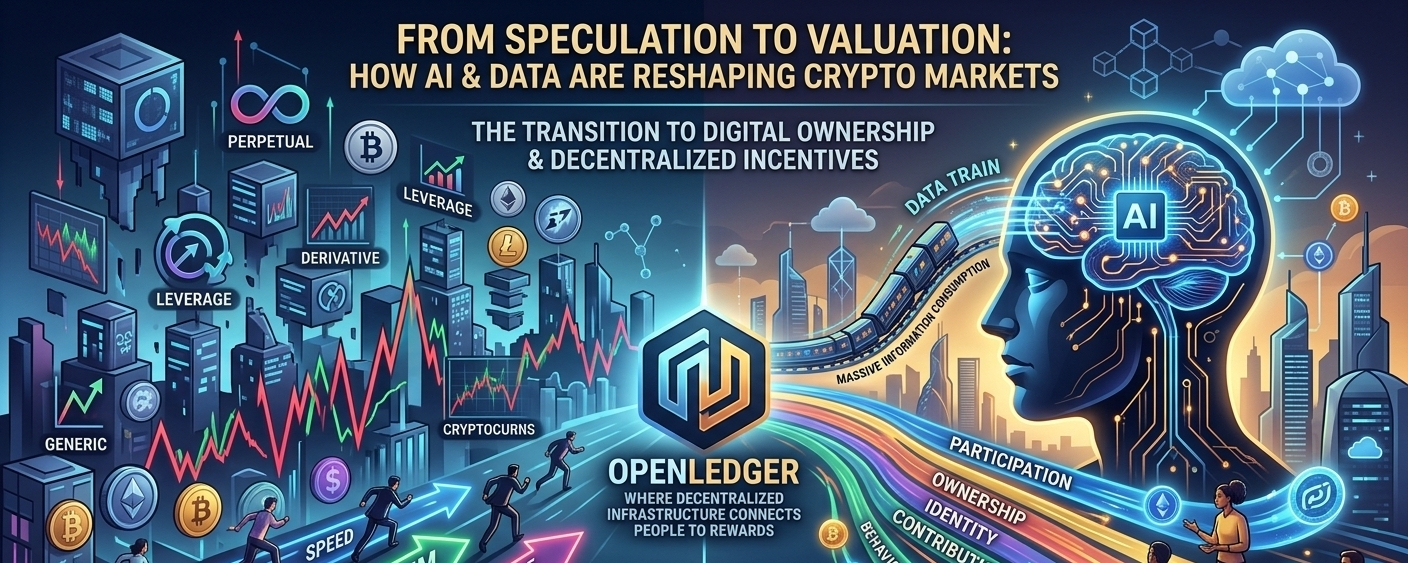
The first time I came across OpenLedger, I honestly didn’t think much of it. Another AI-related crypto project. Another attempt to attach blockchain infrastructure to the explosion of machine learning narratives that have been dominating timelines for months. Lately, the market has been flooded with projects trying to position themselves somewhere between AI, data, agents, and decentralized systems, and after a while they all start sounding the same.
But I kept noticing something strange in the market recently. Liquidity isn’t moving the way it used to.
A couple of years ago, traders chased speed. Fast rotations, meme momentum, hype cycles that lasted days instead of weeks. Now it feels more fragmented. Capital still moves aggressively, but attention has become more selective. People are looking for systems instead of stories. Infrastructure instead of slogans. Even retail traders who normally only care about price action are starting to ask deeper questions about where AI models get their data, who owns it, and who actually profits from it.
That shift is what made me go back and look at OpenLedger more carefully.
What caught my attention wasn’t the blockchain part. It was the idea that data itself is becoming an asset class inside crypto. Not in the abstract way we’ve heard for years, but in a more direct and uncomfortable way. AI models are consuming enormous amounts of information every second, yet most people contributing to that flow have no ownership over the value being created. The internet trained the machines, but the internet users rarely benefit from it.
I think that imbalance is becoming impossible to ignore.
For a long time, crypto markets were obsessed with financial abstraction. Derivatives, leverage, yield loops, perpetual liquidity. Everything became about optimizing capital efficiency. But AI is changing the emotional center of the market. Suddenly people care about contribution, ownership, and identity again. Not because they became ideological overnight, but because they’re starting to realize data has value far beyond advertising.
That realization changes behavior.
You can actually feel it in the market sentiment lately. Traders still speculate, of course, but there’s more curiosity around ecosystems that connect information, computation, and incentives together. I’ve noticed people spending more time discussing infrastructure layers instead of just price targets. Even when sentiment gets shaky, AI-related narratives tend to recover attention faster because investors think there’s a bigger structural shift happening underneath the volatility.
And honestly, I understand why.
Most crypto cycles have been driven by a search for the next source of liquidity. DeFi unlocked on-chain capital. NFTs monetized digital culture. Memecoins monetized attention itself. But AI might be monetizing something even deeper: participation in digital existence.
That sounds dramatic when I write it out, but the market already behaves like it believes this.
When people interact online now, they’re not just consuming content anymore. They’re generating training signals, behavioral patterns, preferences, reactions, and contextual knowledge. Every click feeds some system somewhere. The strange thing is that crypto might finally be creating infrastructure where those contributions can be measured and rewarded instead of silently extracted.
That’s where OpenLedger started making more sense to me.
Not necessarily as a short-term trade, but as a reflection of where market psychology is drifting. The idea of tokenizing data flows and AI interaction feels aligned with how investors are mentally repositioning themselves right now. There’s growing discomfort around centralized AI monopolies, but there’s also realism. Most people know AI isn’t slowing down. So instead of resisting it, the market seems to be searching for ways to participate in its economic layer.
I’ve noticed this especially during quieter market periods. When volatility cools off, the conversation becomes more revealing. That’s usually when narratives with no real foundation fade away. But AI infrastructure discussions keep resurfacing, almost stubbornly. It reminds me of early cloud computing conversations years ago. Most people didn’t fully understand the technical side, but they sensed the direction of travel.
Crypto markets often move like that. Emotion first, understanding later.
At the same time, I think there’s still a lot of uncertainty here. Some AI projects will absolutely overpromise. Some will attach blockchain to problems that don’t need it. And honestly, I still struggle with the question of how decentralized these systems can realistically become once massive computational resources enter the equation.
But uncertainty doesn’t necessarily weaken a narrative. Sometimes it strengthens it.
The strongest market themes usually emerge when investors collectively feel that something important is changing, even if nobody fully understands the final form yet. Right now, AI feels less like a trend and more like a pressure slowly reshaping how value moves through the internet.
And maybe that’s why projects like OpenLedger are getting attention beyond simple speculation. They sit at the intersection of multiple anxieties at once: ownership, automation, monetization, identity, contribution. Those are emotional themes, not just technical ones. Markets are always more emotional than people admit.
Personally, I’ve become more cautious about chasing hype this cycle. I’ve watched too many narratives explode and disappear overnight. But I’ve also learned that ignoring shifts in collective attention can be just as dangerous. Sometimes the market reveals future priorities long before the technology matures enough to support them.
What interests me now isn’t whether every AI-related token succeeds. Most won’t. What interests me is the broader behavioral transition happening underneath the surface. Investors are starting to think about digital ownership differently. They’re questioning who controls intelligence, who supplies the raw material for it, and whether decentralized systems can create fairer economic relationships around that process.
That’s a much bigger conversation than price action.
And maybe that’s the strange part about this market right now. For all the noise, leverage, and speculation, there’s also a growing sense that crypto is drifting back toward something philosophical again. Not idealism exactly, but negotiation. A negotiation over who owns value in an internet increasingly shaped by machines.
I don’t know if OpenLedger becomes a major part of that future. Nobody really knows yet. But the fact that the market is even asking these questions tells me something important has already started changing.
