
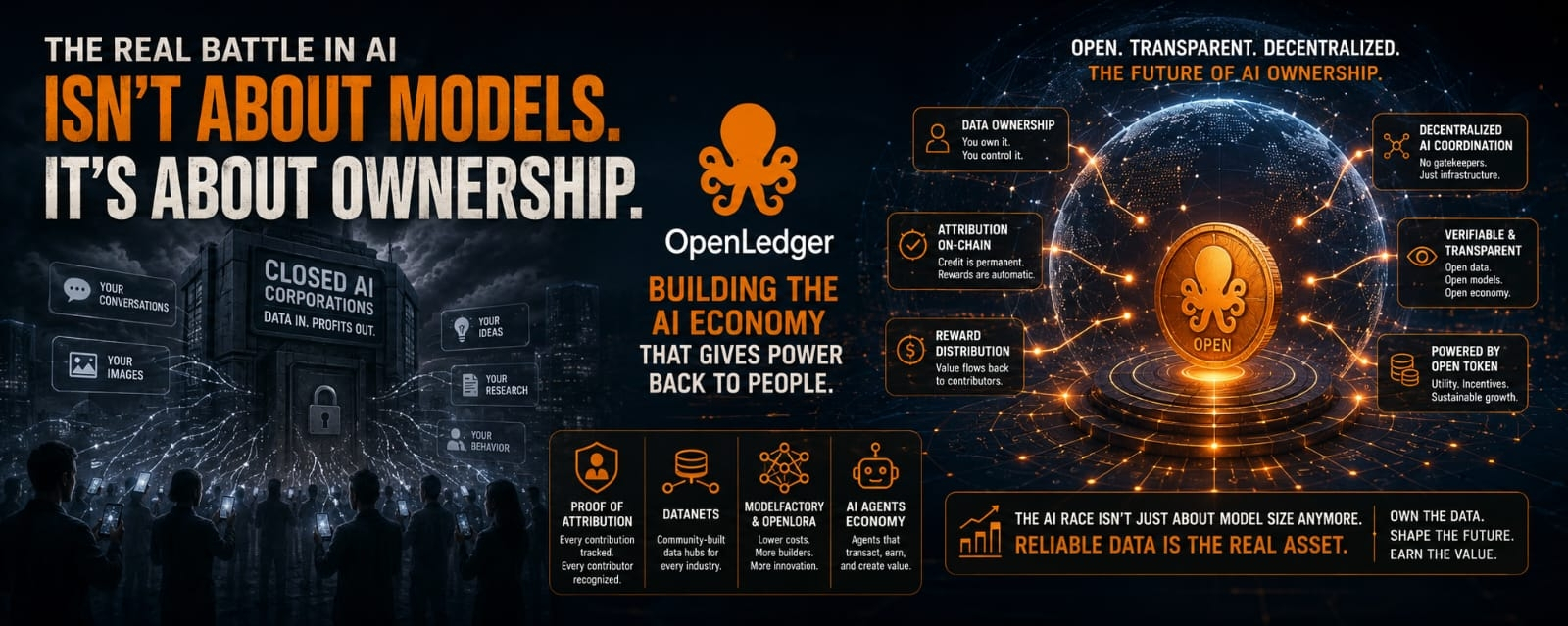
Most people still think AI is only about chatbots, image generators, or tools that answer questions faster than humans. But the deeper I look into this industry, the more I realize the real battle is happening somewhere else entirely.
The biggest war in AI is not about who creates the smartest model.
It’s about who owns the data.
Right now, almost every major AI company operates behind closed doors. Users feed these systems with conversations, images, ideas, research, and behavior every single day, yet the people providing that value rarely receive anything back. The models improve. The corporations grow. The users stay invisible.
That imbalance is exactly why OpenLedger started standing out to me.
What makes OPEN interesting is that it is not trying to become “another AI app.” Instead, it is building infrastructure for an entirely different type of AI economy — one where data ownership, attribution, and revenue distribution are handled directly on-chain.
And honestly, that changes the conversation completely.
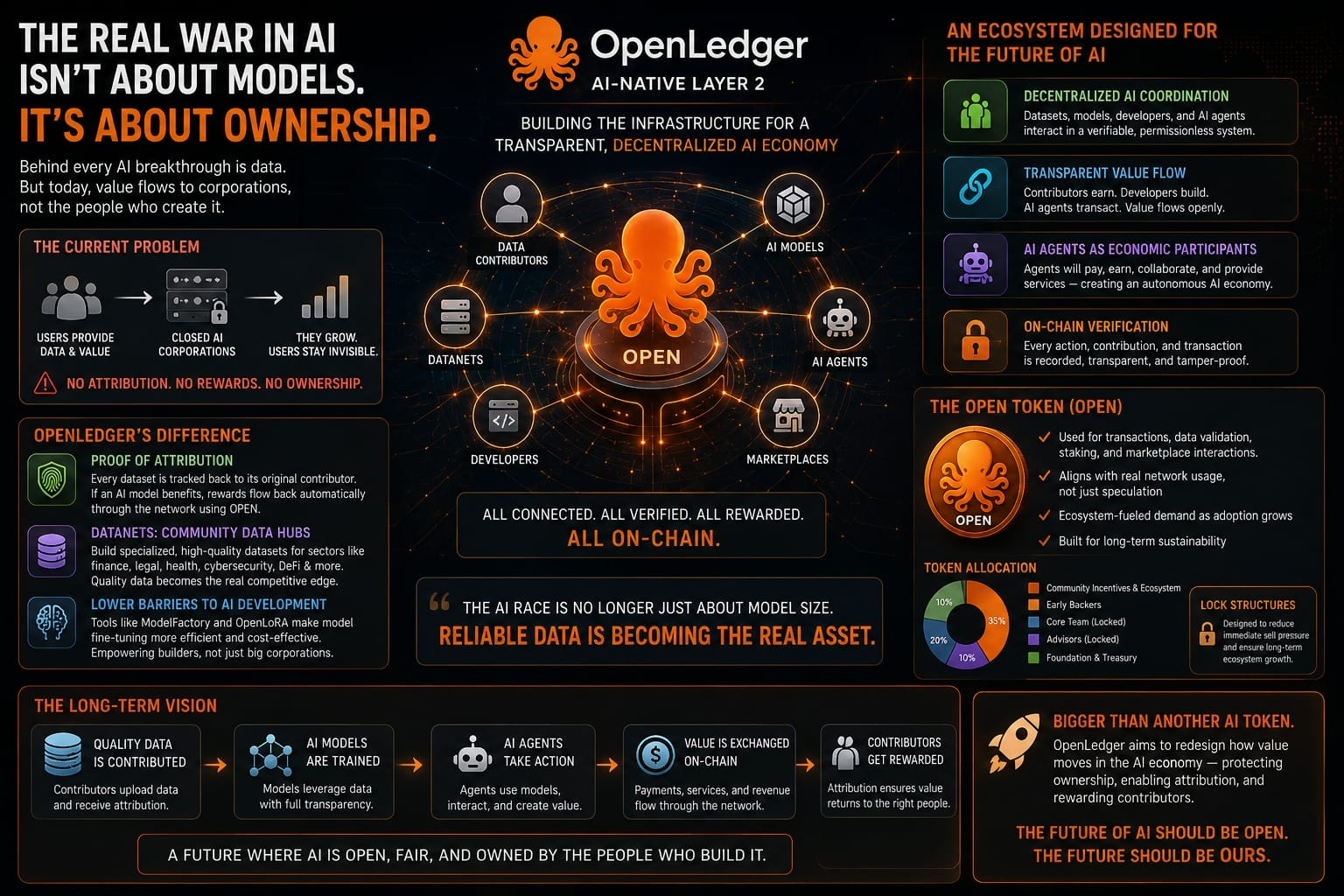
OpenLedger is positioning itself as an AI-native Layer 2 ecosystem designed specifically for transparent data contribution and decentralized AI coordination. Instead of AI running inside black-box corporations, the idea is to create an environment where datasets, models, contributors, and AI agents can all interact in a verifiable and reward-driven system.
One of the concepts that caught my attention first was their approach to attribution.
In today’s AI landscape, contributors lose control the moment their data enters a system. OpenLedger tries to solve this through its Proof of Attribution framework. Every dataset uploaded to the network can be tracked and connected back to its original contributor. If an AI model later benefits from that data, rewards can flow back automatically through the network using OPEN.
That creates something the current AI industry almost completely lacks:
Economic recognition for contributors.
And the more I think about it, the more important that becomes as AI scales globally.
Another layer that makes the ecosystem interesting is the idea of “Datanets.” Instead of relying on random internet scraping, communities can build specialized data hubs around specific sectors like finance, legal systems, healthcare, cybersecurity, or DeFi analytics. That structure could eventually become extremely valuable because high-quality AI systems depend heavily on trusted and well-organized datasets.
The AI race is no longer just about model size.
Reliable data is becoming the real asset.
What also surprised me is how OpenLedger is trying to lower the technical barrier for AI development itself. Through systems like ModelFactory and OpenLoRA, developers can fine-tune AI models more efficiently without needing massive infrastructure costs. If this scales properly, it could reduce one of the biggest problems in AI development right now — computational expense.
And that matters more than people realize.
Most smaller builders cannot compete with trillion-dollar companies on hardware alone. Lowering those costs could open the door for far more independent AI experimentation across crypto ecosystems.
The bigger vision becomes even more interesting when looking at the long-term roadmap.
OpenLedger appears to be building toward an ecosystem where AI agents eventually operate almost like autonomous economic participants. Agents interacting with other agents. Paying for services. Sharing revenue. Executing tasks. Coordinating value exchange without centralized oversight.
Whether the industry reaches that future quickly or slowly, the direction itself feels inevitable.
That is also where the OPEN token starts making more sense fundamentally.
Instead of existing only for speculation, the token is integrated into multiple layers of network activity — transaction execution, data validation, staking mechanisms, and future AI marketplace interactions. If adoption around the ecosystem grows, token demand would theoretically grow alongside actual network usage rather than depending purely on hype cycles.
I also think the token structure matters here.
A large portion of the supply is allocated toward community incentives and ecosystem growth, while lock structures reduce immediate sell pressure from insiders. In crypto, sustainability often depends less on marketing and more on how incentives are distributed over time.
And in AI infrastructure narratives, incentive design may become everything.
At this point, I honestly don’t see OpenLedger as just another AI token trying to ride a temporary trend. It feels more like an attempt to redesign how value moves inside the AI economy itself.
Maybe it succeeds.
Maybe it doesn’t.
But the idea behind it is far bigger than another chatbot launch.
If AI truly becomes one of the dominant industries of the next decade, then systems that protect ownership, attribution, transparency, and contributor rewards could eventually become just as important as the models themselves.
That’s the part of OpenLedger that I think many people are still underestimating.