
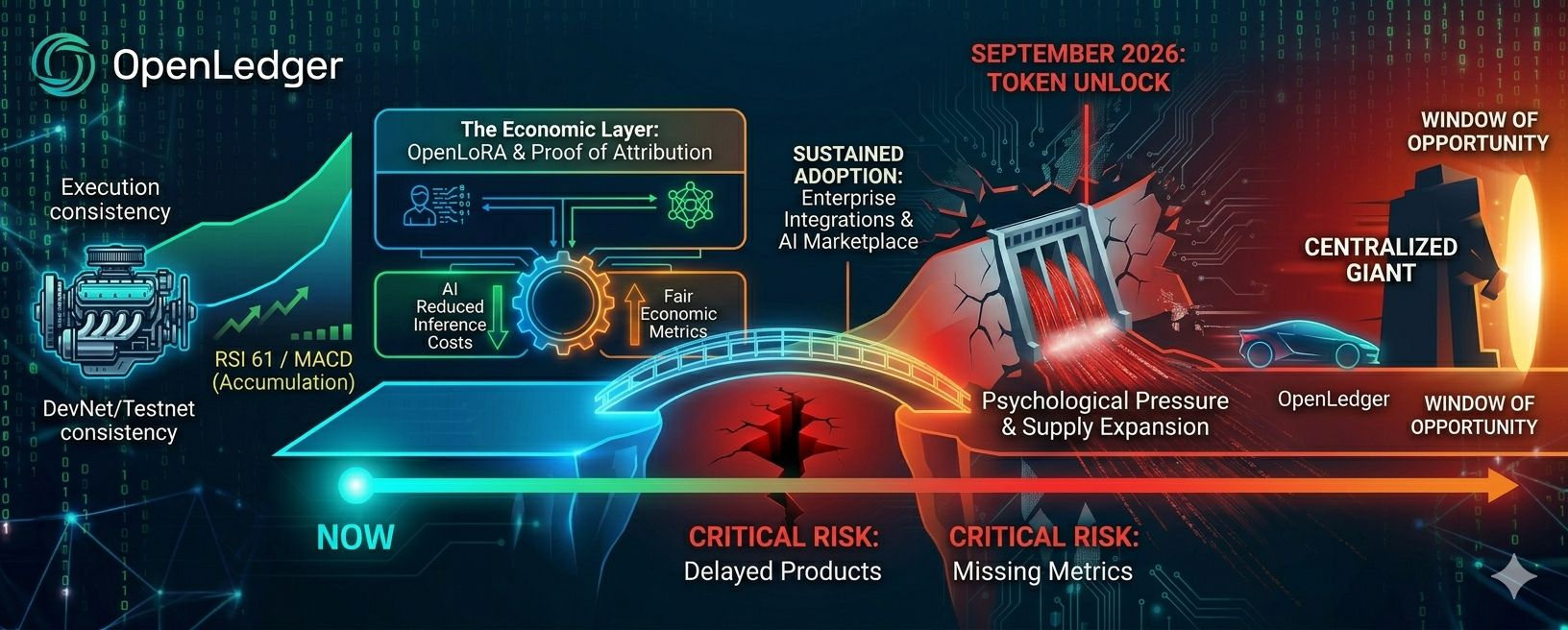
Recent market positioning feels to me like a reflection of a pattern that often appears in early-stage AI infrastructure projects: the market is beginning to acknowledge technical progress, but there is still not enough evidence to confidently justify long-term valuation based on real adoption.
That distinction feels extremely important to me.
A 1.9% move in 24 hours may seem relatively small by crypto standards, but the reasons behind that move carry much more weight. I believe investors are responding primarily to consistency. The successful rollout of DevNet and testnet versions signals that OpenLedger is not just marketing a vision — it is actively delivering products. In today’s AI-token environment, where many projects sell future promises without building usable infrastructure, steady execution itself becomes a major strength.
Features like OpenLoRA and Proof of Attribution also stand out to me because they attempt to solve genuine structural problems inside the AI industry.
AI inference costs remain one of the biggest barriers to scalable AI deployment today. If OpenLedger can meaningfully reduce those costs, it moves closer to becoming real AI infrastructure rather than simply another speculative token. At the same time, Proof of Attribution addresses an even deeper issue: how contributors inside decentralized AI systems can be economically recognized and rewarded for their data.
This narrative feels powerful to me because discomfort around centralized AI monopolies is clearly growing. Markets are beginning to understand that the future value of AI may not belong only to major model creators, but also to the communities providing training data, behavioral feedback, and domain expertise. OpenLedger’s vision appears closely aligned with that emerging economic shift.
Even so, the current bullish sentiment still feels cautious rather than euphoric.
An RSI climbing toward 61 and a positive MACD indicate constructive short-term momentum, but the market does not yet appear overheated. To me, this resembles an accumulation phase where traders are willing to maintain exposure while still waiting for stronger adoption signals.
The real pressure, however, sits within the project’s risk profile.
The September 2026 token unlock could create serious psychological pressure on the market. In my view, token unlocks matter not only because of potential selling pressure, but because they change perceptions around future scarcity. Once investors know that a 36-month distribution cycle for team members and early investors is approaching, long-term positioning naturally becomes more defensive.
That could become a defining challenge for OpenLedger.
I believe the project will need strong ecosystem growth capable of absorbing future supply expansion. Without genuine network demand, unlock events can quickly become narrative turning points where optimism slowly shifts into caution.
The lack of commercial transparency only deepens that uncertainty.
From my perspective, crypto markets initially price stories — but eventually, they price usage.
At some point, OpenLedger will need to publicly demonstrate meaningful metrics around Datanet activity, active contributors, enterprise integrations, AI inference demand, and marketplace liquidity. Without visible economic throughput, valuation remains heavily narrative-driven, and narrative-driven markets tend to weaken once momentum fades.
That is why the delayed launch of products like the AI Marketplace and “Payable AI” is being viewed as a serious concern. The AI infrastructure sector is becoming increasingly crowded, with decentralized projects competing not only against each other but also against centralized AI giants backed by significantly larger capital and resources.
To me, delays do not simply slow growth — they risk reducing relevance altogether.
Despite these concerns, OpenLedger still appears to be one of the more intellectually compelling projects within the AI-crypto ecosystem. Unlike many AI tokens built purely around buzzwords, OpenLedger is attempting to solve real problems related to data ownership, attribution, and machine economies.
That is why its conceptual foundation feels stronger than many competing projects.
The real question now is whether that conceptual strength can evolve into genuine economic demand.
In my opinion, this is becoming the key framework for investors: OpenLedger no longer needs to prove that its idea is interesting. It now needs to prove that the network can generate sustained activity, real adoption, and durable demand — before dilution pressure and competitive intensity become significantly stronger.
For now, the market appears willing to give the project time, but probably not unlimited time.
