
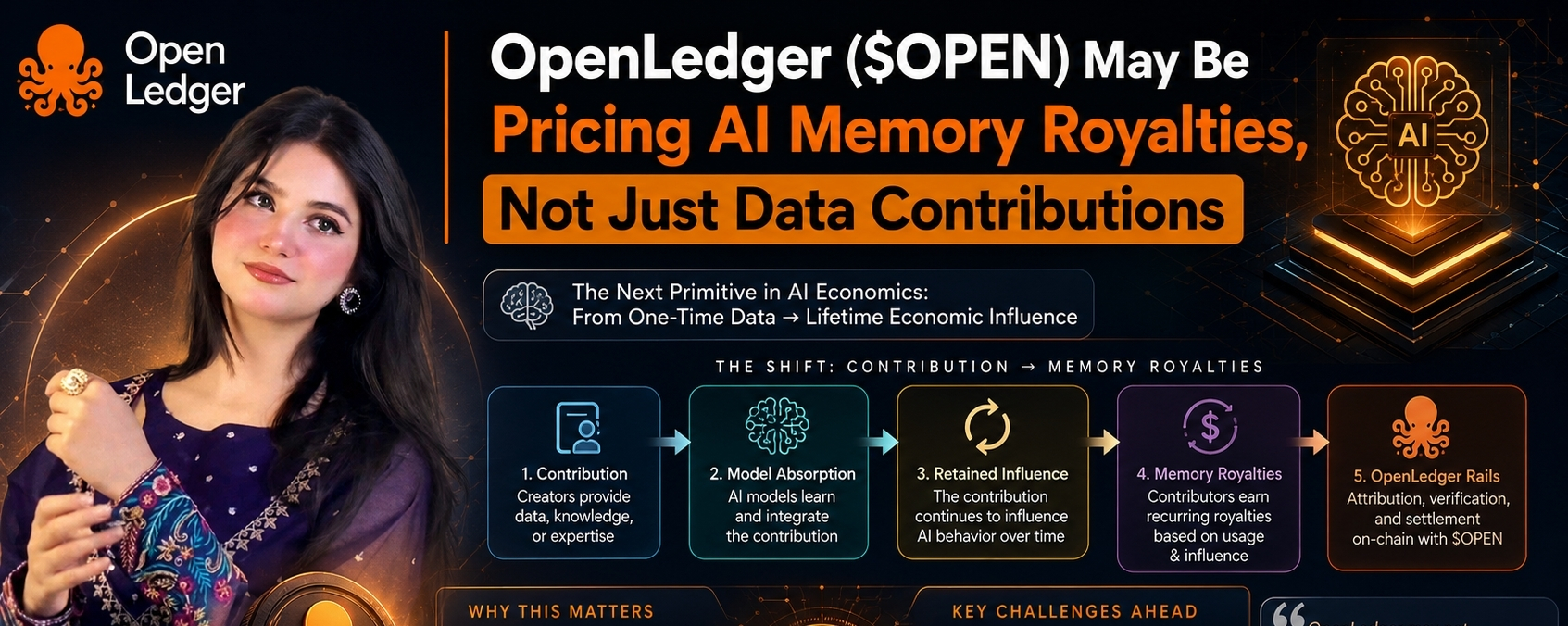
I keep thinking about how strange ownership becomes once intelligence starts remembering.
If I upload a photo somewhere, ownership feels intuitive. If I write an article, same thing. Even if enforcement is messy, at least the mental model exists. But AI memory feels structurally different. Because the value may not come from the original contribution itself. It may come from what the machine keeps doing with that contribution later.
That distinction keeps bothering me.
I initially thought OpenLedger was another familiar crypto-AI infrastructure story. Data contributors. Verification. Attribution rails. Token incentives. Standard architecture language. But the more I sit with it, the less convinced I am that data contribution is actually the deepest economic layer here.
Maybe the real thing being priced is memory.
Not storage memory. Economic memory.
Because AI systems increasingly behave less like static software and more like entities that accumulate retained behavioral advantage. Once a model learns from something useful, that contribution stops being a one-time event. It becomes embedded capability. Maybe subtly. Maybe invisibly. But still economically active.
That changes the framing completely.
A normal marketplace pays for labor once. Deliver task. Receive payment. Done.
But if a contributor provides something that permanently improves model behavior, why should compensation behave like disposable labor?
That feels structurally wrong.
And if that intuition is correct, then OpenLedger may not just be organizing data contributions. It may be trying to create the accounting rails for recurring AI memory royalties.
Which is a much stranger market.
Because now the question stops being: who contributed?
Now it becomes: how long does that contribution remain economically productive?
That sounds elegant. Maybe too elegant.
Because attribution is relatively clean compared to persistence accounting.
It is one thing to say Contributor A helped train behavior X.
It is another thing entirely to determine whether behavior X continues influencing outcomes months later, across derivative model states, inference layers, agent interactions, fine-tuned descendants, or hybrid retrieval architectures.
That gets ugly fast.
Imagine teaching a junior trader a useful pattern once. Years later, they still profit from versions of that pattern mixed with hundreds of other learned experiences. What exactly are you owed?
This is where AI economics starts looking less like cloud infrastructure and more like music publishing.
Royalties.
Residual value.
Usage-linked compensation.
Memory licensing.
And if OpenLedger is moving in that direction, then $Open might not behave like conventional utility at all.
It might function closer to economic settlement permission.
Because recurring royalties require infrastructure discipline.
You need provenance systems that track contribution lineage.
You need identity layers.
Dispute resolution logic.
Behavioral attribution checkpoints.
Payment routing.
Commercial permissions.
Machine-readable claims enforcement.
Potentially even expiration logic.
Otherwise "royalties" become narrative fiction.
This is where crypto actually makes conceptual sense.
Because blockchains are good at economic state coordination between parties that do not naturally trust each other.
But AI memory creates weird trust boundaries.
Who decides that retained model behavior still meaningfully derives from prior input?
The model provider?
Contributors?
Independent validators?
Customers?
No answer feels clean.
And once money appears, strategic behavior follows immediately.
That part matters.
Because contributors may overclaim influence.
Platforms may under-report dependency.
Models may route around attribution visibility entirely through architecture design.
Retrieval layers complicate this further.
If knowledge sits in external retrieval systems rather than permanent weights, is that memory royalty territory or temporary access licensing?
Those are economically different systems pretending to look similar.
And if hybrid AI architectures dominate, OpenLedger would need flexible accounting logic rather than simplistic "contribution = payment" mechanics.
Which is much harder.
There is another issue I cannot ignore.
Memory itself compounds asymmetrically.
Some contributions are generic. Commodity knowledge. Replaceable.
Others fundamentally alter model commercial usefulness.
Not all memory deserves equal economics.
So how does pricing happen?
Flat rates feel broken.
Auction systems introduce gaming.
Reputation-based weighting creates power concentration.
Usage-based royalty systems sound fair until attribution noise makes payouts politically unstable.
And then token economics enters.
Because if $OPEN becomes the settlement layer for memory royalties, token demand only becomes structurally meaningful if repeated royalty coordination actually occurs at scale.
Not theoretical contributions. Repeated economic behavior.
That distinction kills many token narratives.
One-time onboarding is not durable demand.
Recurring settlement could be.
Big difference.
This also creates a fascinating AI infrastructure inversion.
Most AI narratives obsess over compute scarcity.
GPUs. Bandwidth. inference costs.
Necessary, sure.
But compute becomes cheaper with competition.
Memory with legally enforceable economic provenance may become scarcer instead.
Especially proprietary memory.
Especially domain-specific memory.
Especially commercially consequential behavioral memory.
That may be where value migrates.
Or maybe not.
Because market participants often choose efficiency over fairness.
A closed provider may simply prefer internal opacity over open royalty coordination complexity.
Customers may not care.
Contributors may accept fixed payouts rather than uncertain royalty streams.
The "fair" system is not always the adopted system.
Crypto people forget this constantly.
Technically elegant systems die all the time because behavioral incentives refuse cooperation.
And there is a darker angle.
If AI memory royalties become real, do we accidentally financialize machine cognition itself?
Meaning every retained capability becomes monetized claim territory.
Every improvement becomes fragmented ownership.
Every learned behavior becomes economically contested.
That sounds less like efficient infrastructure and more like turning intelligence into cap table chaos.
Maybe that is manageable.
Maybe disastrous.
I also keep wondering whether OpenLedger is solving attribution… or manufacturing attribution demand.
Important difference.
Because infrastructure sometimes succeeds by solving existing pain.
Other times it succeeds by making hidden coordination costs visible enough that markets accept paying for structure.
That second path is harder, but not impossible.
So yes, the obvious interpretation says OpenLedger helps contributors get paid for data.
But the deeper interpretation feels stranger.
It may be experimenting with whether AI memory itself can become royalty-bearing economic infrastructure.
If that works, $OPEN is not just pricing contribution.
It is pricing retained influence.
And honestly... I am not sure markets actually want that level of accounting truth.
But if they ever do, the systems built earliest around economic memory may matter far more than today’s compute narratives suggest.