
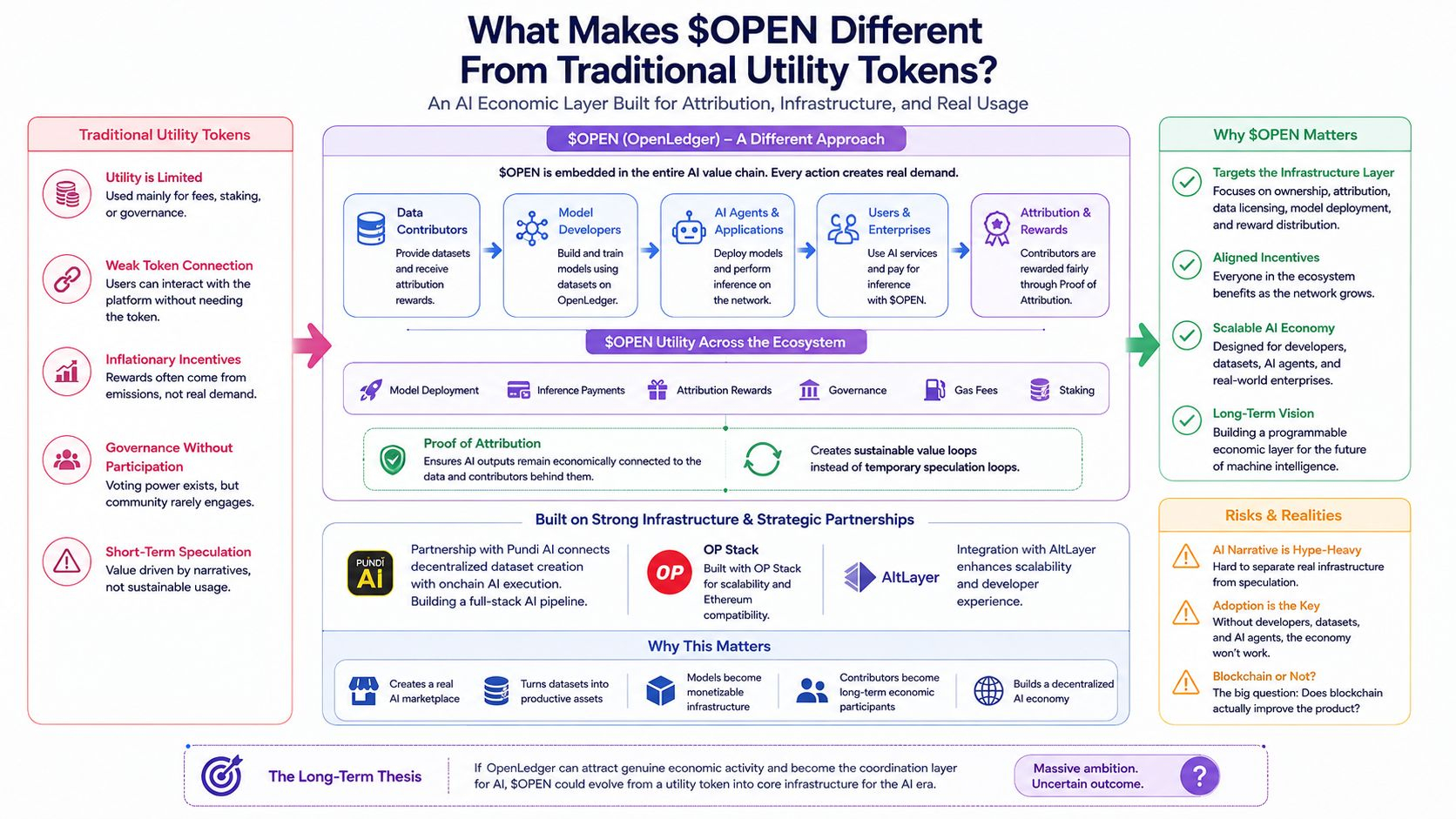
One of the biggest problems in crypto right now is that most “utility tokens” don’t actually have much utility once you look past the surface. A lot of them exist mainly to support speculative demand, governance voting nobody participates in, or staking systems that recycle inflation back to users until the incentives eventually dry up.
That’s why I’ve been paying closer attention to projects trying to tie token value directly to infrastructure usage instead of narrative momentum alone. And honestly, that’s where OPEN starts to get interesting.
OpenLedger isn’t really positioning itself as another AI meme attached to a blockchain. The bigger idea seems to be building an economic layer around AI itself. Data, models, inference, attribution, payments, and rewards are all supposed to flow through the same system. That changes the role of the token completely.
With traditional utility tokens, the token often feels disconnected from the actual product. Users can usually interact with the platform without truly needing the asset long term. But with OPEN, the token appears more embedded into the infrastructure layer itself. Model deployment, inference payments, attribution rewards, governance, gas fees, and staking mechanisms all route back into the same economic system.
The part that stands out most to me is the “Proof of Attribution” idea. In theory, OpenLedger wants AI outputs to remain economically connected to the data and contributors that helped create them. That’s a very different direction compared to the closed AI systems dominating the market today.
Whether that model fully works at scale is still an open question. But conceptually, it solves something crypto has struggled with for years: creating sustainable value loops instead of temporary speculation loops.
A lot of projects talk about decentralization, but most are still heavily dependent on centralized demand sources. OpenLedger seems to be trying to build an actual marketplace around AI coordination. Datasets become productive assets. Models become monetizable infrastructure. Contributors become long-term economic participants instead of disposable users.
That matters more than people think.
If AI keeps expanding, the biggest opportunity may not be another chatbot frontend. It could be the infrastructure layer underneath everything: ownership, attribution, data licensing, model deployment, and transparent reward distribution. That’s the category OpenLedger is trying to enter.
The partnerships also make more sense when viewed from that angle. The collaboration with Pundi AI wasn’t just a marketing announcement. It connected decentralized dataset creation directly into OpenLedger’s onchain AI execution environment. In other words, they’re trying to create a full-stack pipeline where data creation, model training, and AI deployment all exist inside one economic network.
Technically, they’re also leaning into existing Ethereum infrastructure rather than reinventing everything from scratch. The OP Stack integration, Ethereum compatibility, and AltLayer infrastructure partnership probably make adoption easier for developers already familiar with EVM tooling.
That’s important because crypto infrastructure projects usually fail for one simple reason: nobody builds on them.
Good architecture alone means nothing without ecosystem activity. OpenLedger can have all the attribution systems and AI narratives in the world, but if developers, datasets, and AI agents don’t consistently use the network, the token economy won’t matter much.
And honestly, there are still real risks here.
AI is currently the hottest narrative in crypto, which means it’s becoming harder to separate sustainable infrastructure from speculative storytelling. There’s also the usual question every AI x crypto project eventually faces: does blockchain actually improve the product, or does it simply make the pitch more marketable?
I don’t think the answer is fully clear yet.
But I do think OPEN feels structurally different from the average utility token because it’s attempting to sit inside the operational flow of AI itself rather than orbiting around it as a secondary governance asset. That distinction could matter a lot if decentralized AI infrastructure becomes a real sector instead of just a temporary market cycle.
Still, the long-term outcome probably depends less on tokenomics and more on whether OpenLedger can attract genuine economic activity around its ecosystem. If the network becomes a place where developers, datasets, and AI agents consistently interact and generate value together, then the token starts looking less speculative and more infrastructural.
And if that happens, OPEN may end up being remembered less as an AI token and more as an attempt to build a programmable economic layer for machine intelligence itself.
That’s a massive ambition.
Whether the market eventually rewards that ambition is another question entirely.
