
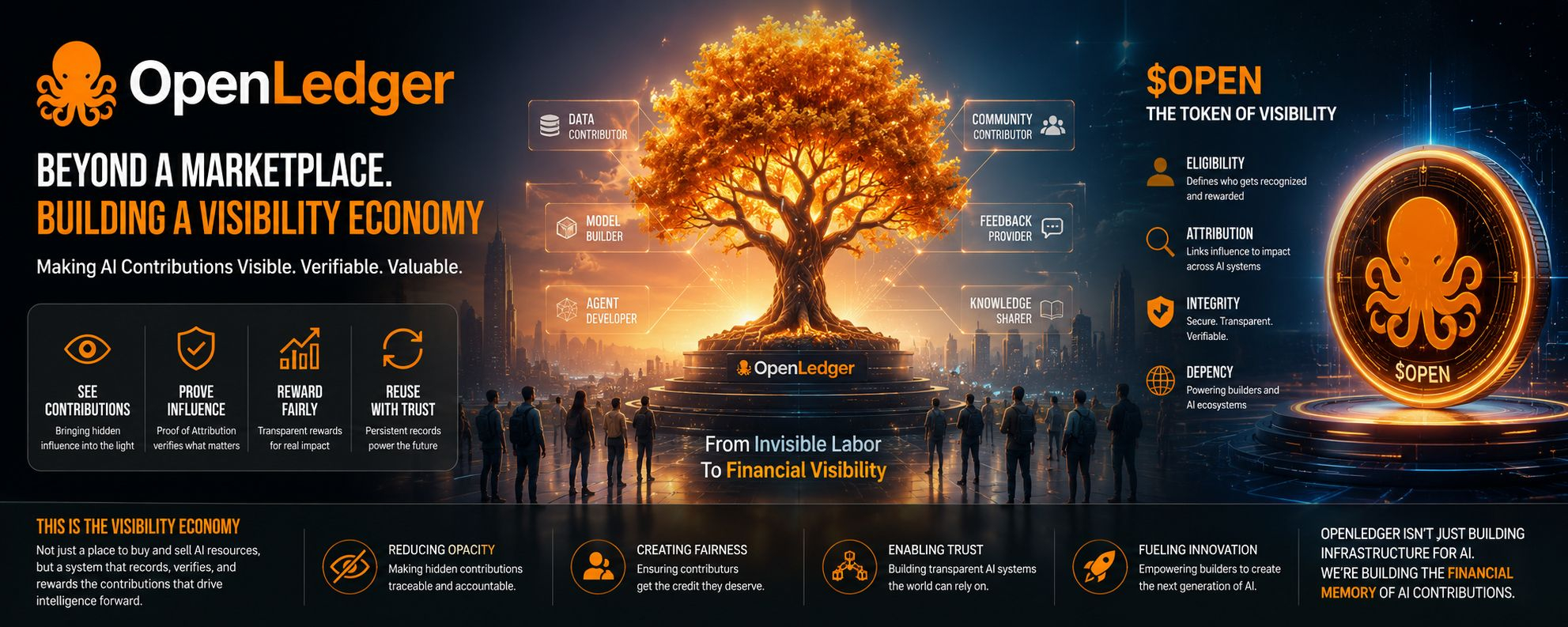
OpenLedger is usually introduced with the kind of language people in crypto have become very familiar with: an AI blockchain designed to monetize data, models, and agents. At first glance, it sounds like another attempt to turn AI into an open marketplace — a place where contributors upload datasets, developers build models, and tokens move value between participants.
But the more you look at OpenLedger’s structure, the harder it becomes to describe it as just a marketplace.
The project talks constantly about attribution, contribution tracking, proof systems, and reusable records of influence. That may sound technical on paper, but underneath it is a much bigger idea: OpenLedger is not simply trying to help people sell AI resources. It is trying to decide how AI contributions become visible enough to deserve payment in the first place.
And that changes the entire conversation around $OPEN.
Because once a network starts defining visibility, it stops behaving like a normal market. It starts behaving more like an accounting system for recognition.
That distinction matters more than people think.
For years, the AI industry has operated on a strange imbalance. Massive models absorb enormous amounts of public information, human interaction, creative work, feedback loops, and behavioral signals, yet most contributors disappear inside the process. Value gets concentrated at the model layer while the origin of influence becomes increasingly impossible to trace.
OpenLedger seems to be built around the assumption that this invisibility is becoming economically unsustainable.
Its “Proof of Attribution” system reflects that directly. Instead of only asking whether a model works, the network asks a more uncomfortable question: who actually helped this output exist? Not just who trained the model at a corporate level, but which datasets, interactions, or contributions materially shaped the result.
That sounds simple until you realize how disruptive the idea actually is.
Traditional AI marketplaces assume the important thing is ownership. You own a dataset. You rent access. Someone pays for usage. End of story.
OpenLedger appears more interested in influence than ownership.
Influence is harder to measure because it moves downstream. A dataset may not matter equally. Some contributions shape outputs heavily while others barely register. Some signals continue affecting models long after they were introduced. Some contributors indirectly improve future systems without ever becoming publicly visible.
This is where OpenLedger becomes more intellectually interesting than the usual “AI + blockchain” narrative.
The protocol is trying to create permanent contribution records — reusable traces showing not only that someone contributed, but that their contribution actually mattered.
That turns AI participation into something closer to financial visibility.
And visibility is different from value.
Most people think markets reward the best work. In reality, markets reward the work they can see clearly enough to price. Entire industries are built around this gap. The internet already runs on invisible labor: moderation, tagging, behavioral feedback, emotional engagement, community maintenance, trend shaping. AI systems inherit the same problem at an even larger scale.
OpenLedger seems to recognize that the next AI economy may not revolve around data scarcity at all. Data is abundant. Models are increasingly abundant too.
What becomes scarce is verified contribution.
The ability to prove influence.
The ability to remain economically visible inside systems designed to absorb and flatten participation.
That may ultimately be what $OPEN represents.
Not simply a payment token, but a mechanism tied to eligibility itself.
Who gets recognized.
Who gets attributed.
Who remains financially legible once AI systems become more autonomous.
The project’s ecosystem incentives quietly reinforce this idea. Even community programs revolve around measurable participation and attributable engagement. Rewards are tied less to passive ownership and more to observable contribution patterns.
That creates both opportunity and risk.
Because once visibility becomes monetized, people inevitably begin optimizing for visibility itself.
This is the part most “data economy” narratives avoid discussing.
Every attribution system creates behavioral pressure.
If contributors know what the network measures, they adapt to the measurement. They start producing contributions designed to maximize attribution scores rather than necessarily maximize usefulness. Builders optimize for detectable influence. Communities optimize for engagement metrics. Participants learn how to remain visible inside the protocol’s reward logic.
Over time, the system can drift toward performance.
Not performance in the technical sense — performance in the social sense.
Visible contribution starts mattering more than quiet contribution.
Traceable behavior becomes more valuable than ambiguous insight.
Things that are easy to measure slowly dominate things that are difficult to measure.
This is not unique to OpenLedger. It happens everywhere metrics become financialized. Social media already turned attention into a market. AI contribution systems could eventually do the same thing with attribution.
And that tension sits quietly underneath OpenLedger’s architecture.
The protocol wants to solve opacity, but solving opacity introduces new forms of strategic behavior. The clearer the reward system becomes, the more people shape themselves around it.
That creates an uncomfortable possibility: future AI economies may become less dependent on raw intelligence and more dependent on contribution legibility.
In other words, the winners may not simply be the best builders. They may be the builders who know how to remain visible inside attribution systems.
That sounds cynical, but it is probably realistic.
Even today, much of the internet already works this way. Visibility often determines opportunity before quality even enters the discussion. Algorithms decide discoverability. Metrics shape funding. Attention filters participation.
OpenLedger may simply be formalizing this process for AI.
And if that interpretation is correct, then the project is much more ambitious than it initially appears.
Because the real infrastructure being built here is not only technical infrastructure.
It is institutional infrastructure.
A framework for determining whose contributions become economically real.
That is also why builder adoption matters so much for OpenLedger. Attribution systems only matter if developers choose to build around them. If applications ignore provenance and contribution tracing, the visibility layer collapses. The protocol needs ecosystems to depend on attribution standards, not merely acknowledge them.
So the long-term importance of $OPEN may have less to do with speculation and more to do with whether OpenLedger becomes embedded deeply enough into AI workflows that contribution tracking stops feeling optional.
If that happens, the token stops behaving like a simple asset attached to a marketplace.
It starts behaving more like infrastructure for recognition itself.
And honestly, that is where OpenLedger becomes difficult to categorize.
It does not fully fit the old Web3 narrative anymore.
This is not just about tokenizing datasets.
It is about building financial memory for AI systems.
A persistent layer where contribution histories survive, remain queryable, and continue carrying economic weight long after the original interaction disappears.
That is a much bigger idea than most people realize when they first hear “AI blockchain.”
Whether OpenLedger succeeds is still uncertain. Attribution at scale is messy. Incentives can distort behavior. Visibility systems can easily become gamified. And AI ecosystems move fast enough that today’s infrastructure assumptions can become irrelevant surprisingly quickly.
But even with those uncertainties, OpenLedger feels important for one reason:
It shifts the conversation away from ownership alone and toward recognition.
And in a future where AI systems increasingly absorb human input at massive scale, recognition may become the most valuable layer of all.
