

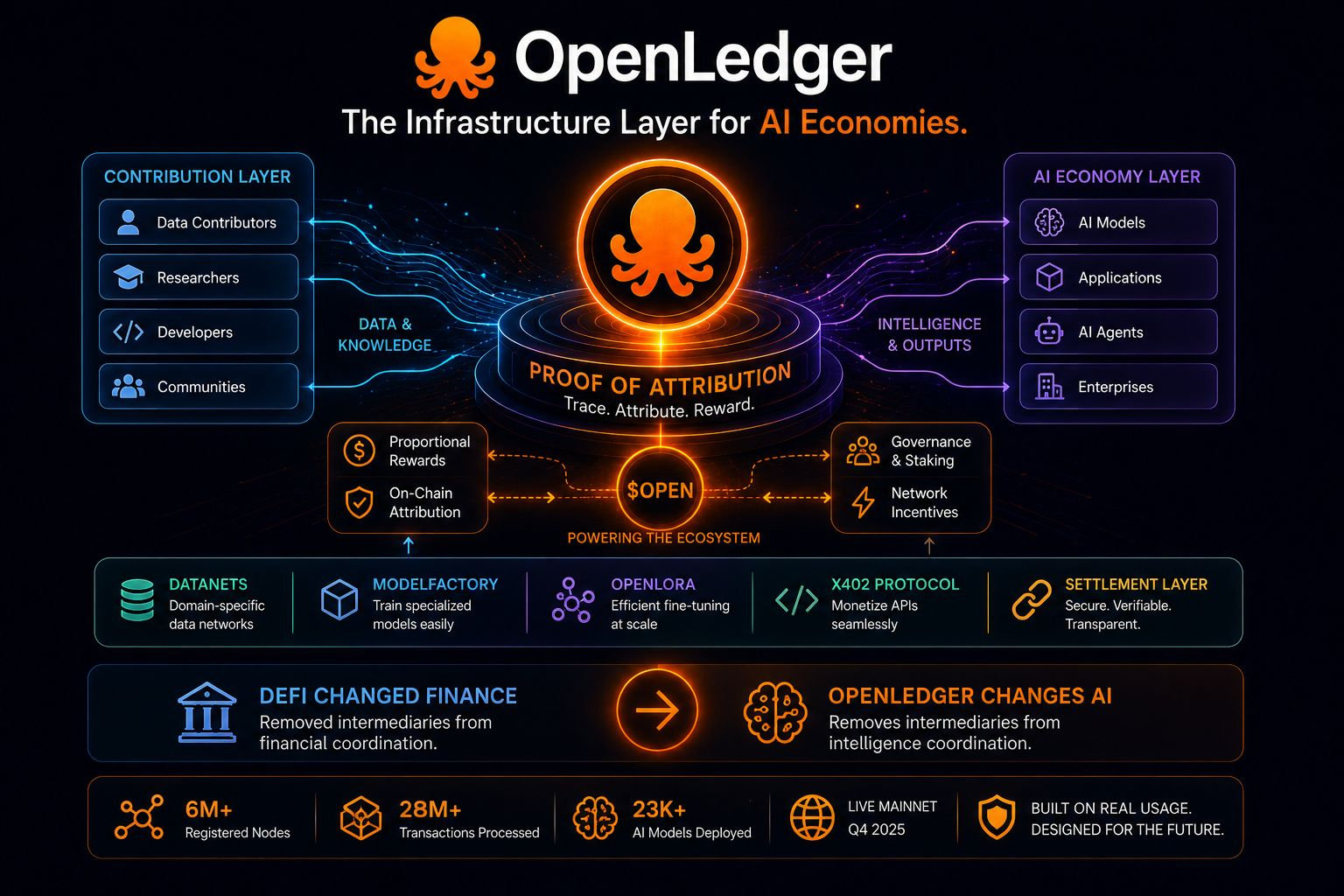
One thing I keep coming back to with OpenLedger is how similar the structure feels to early DeFi before most people realized what DeFi was actually changing.
At the beginning, DeFi didn’t look revolutionary. It looked technical. Just protocols rebuilding lending, exchange, and settlement logic on-chain. But underneath that technical layer was a much bigger shift: once financial coordination became native to infrastructure itself, traditional intermediaries stopped being mandatory.
I think OpenLedger is making a very similar bet around AI.
The protocol’s core idea is surprisingly simple when you strip away the terminology. If attribution, payments, data contribution, and model coordination can exist directly at the protocol layer, then AI systems no longer need centralized entities sitting between contributors and the value created from their work.
That’s where Proof of Attribution becomes more important than people initially realize.
Instead of contributors disappearing into training pipelines invisibly, OpenLedger traces how data influences model outputs and routes rewards back proportionally through the network itself. Smaller models use influence-function approximations, larger systems rely on token matching methods like Infini-gram, but the broader implication matters more than the mechanism.
This starts looking less like a normal blockchain and more like a settlement layer for intelligence production.
And honestly, that’s probably a much larger surface area than DeFi ever had.
DeFi mainly reorganized financial primitives. Lending, borrowing, exchange, collateral. Huge market obviously, but still one category of economic activity. AI infrastructure touches something broader because data and intelligence sit underneath almost every industry simultaneously.
That’s why the rest of the OpenLedger stack matters too.
Datanets organize domain-specific contribution systems around verticals like legal, medical, cybersecurity, or finance. ModelFactory lowers the barrier for specialized model training. OpenLoRA reduces deployment costs for fine-tuned models by hosting thousands of variants efficiently across shared infrastructure. x402 turns APIs into programmable payment surfaces without forcing developers to rebuild monetization layers manually.
The interesting part is not any single component individually.
It’s the composability between them.
A developer building a legal AI tool doesn’t need to recreate data infrastructure, attribution systems, model deployment, and payment coordination independently anymore. They combine primitives already living inside the same ecosystem. That’s almost exactly how DeFi became powerful. Shared infrastructure compressed production costs so aggressively that rebuilding things privately stopped making economic sense.
And the operational numbers around OpenLedger make the whole thing feel less theoretical to me. Millions of registered nodes, tens of millions of transactions processed, thousands of AI models already deployed after mainnet launch. Those are not roadmap projections sitting inside pitch decks. The infrastructure is already handling activity while the broader market is still trying to categorize what the project actually is.
The investor profile reinforces that too. Polychain, Borderless, Sreeram Kannan from EigenLabs, Balaji Srinivasan, Polygon involvement, Story Protocol integrations, OpenCircle funding builders through a $25 million initiative. Infrastructure-focused capital usually pays attention to coordination layers long before retail narratives fully catch up.
And honestly, I think the comparison to DeFi matters because both systems revolve around the same deeper idea.
DeFi asked whether financial coordination required centralized intermediaries.
OpenLedger is asking whether intelligence coordination requires them.
If AI economies keep expanding the way people expect, the infrastructure determining attribution, settlement, ownership, and participation might become more important than the models themselves eventually.
That’s the part that feels much bigger than a normal AI narrative to me.
Because a ledger settling intelligence production at scale doesn’t compete with DeFi conceptually.
It inherits the same logic and applies it to a surface area that is probably much harder to outgrow.