
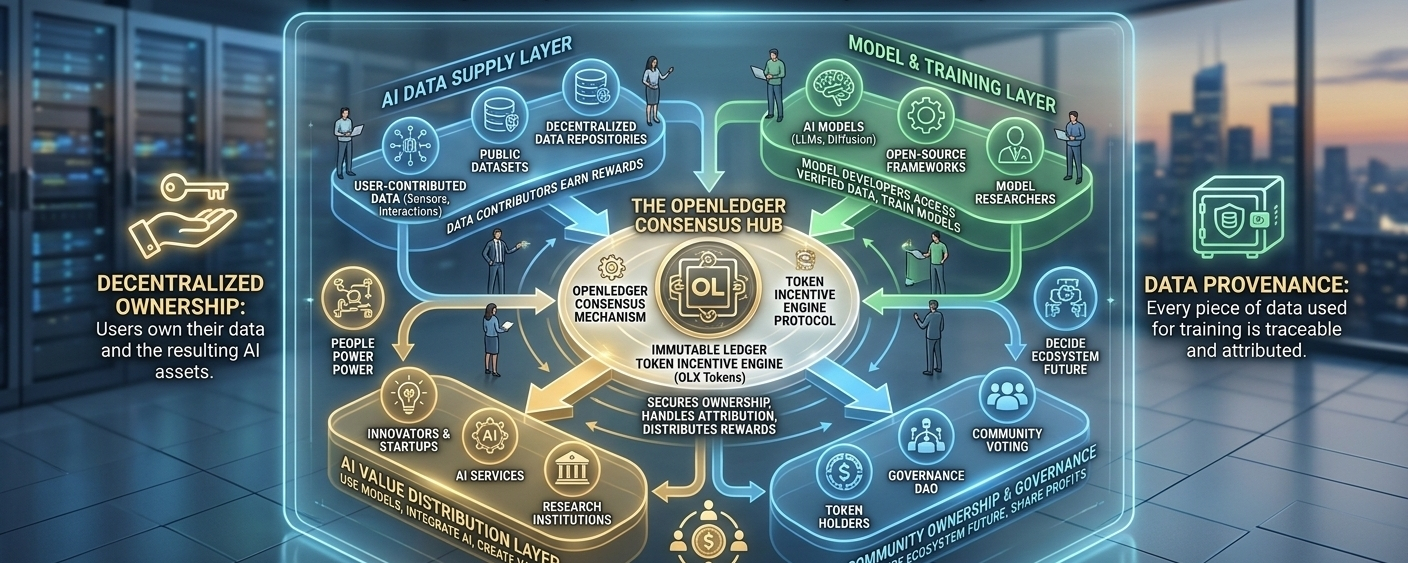
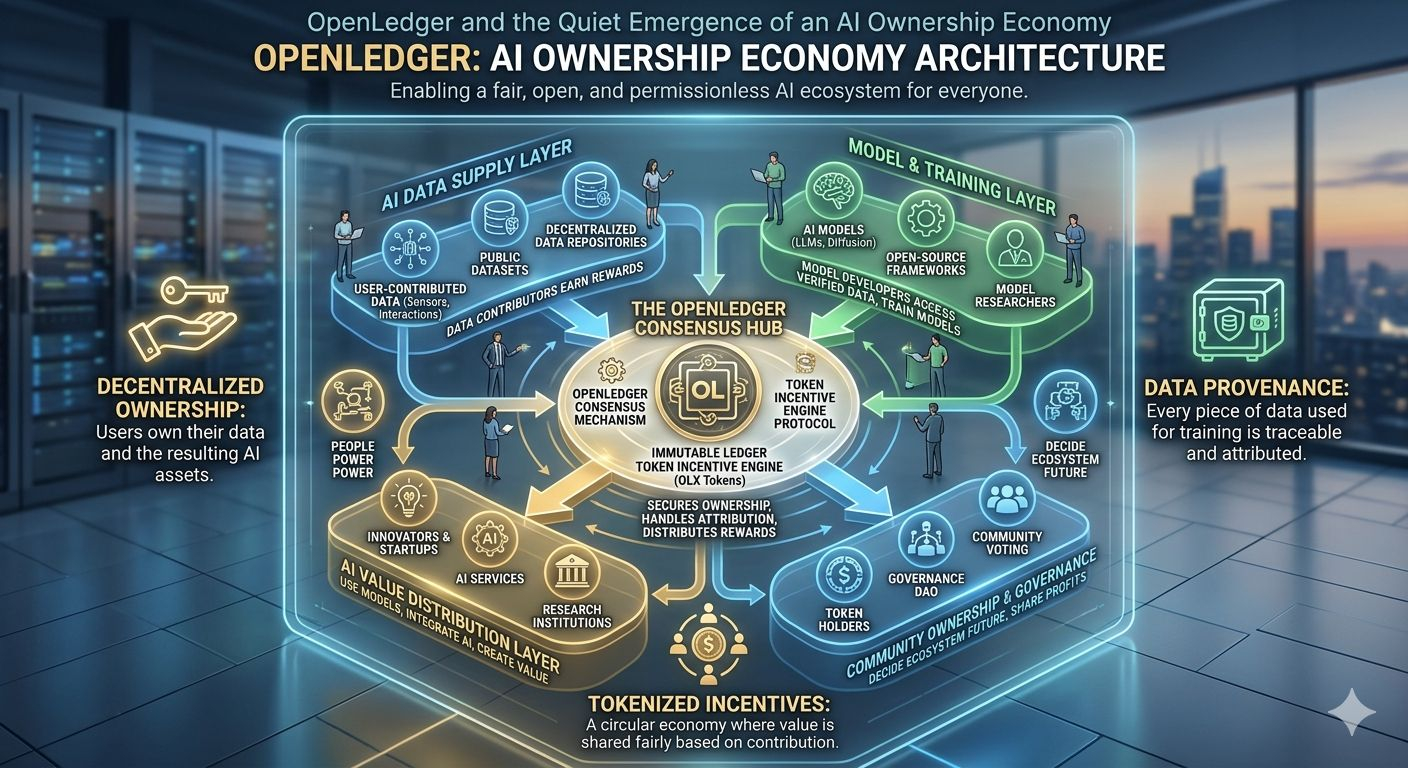
 I kept reopening the same tabs while researching OpenLedger, which is usually a sign that a project is either genuinely interesting or deliberately confusing. Sometimes both. The crypto industry has developed this strange habit of wrapping ordinary infrastructure ideas in apocalyptic language, so when I first saw “AI blockchain” attached to OpenLedger, I expected the usual fog of oversized promises and vague diagrams pretending to explain the future. Instead, what struck me was how much the project seemed obsessed with something far less glamorous: ownership. Not ideological ownership. Economic ownership. Who gets compensated when intelligence itself becomes networked infrastructure rather than isolated software products controlled by a handful of companies.
The current AI landscape feels increasingly uncomfortable once you stop staring at the demos and start tracing where value actually flows. Massive models are trained on oceans of public and private data assembled through invisible labor spread across the internet. Researchers build niche datasets. Open-source developers refine frameworks. Small teams experiment with fine-tuning techniques. Human evaluators spend thousands of hours correcting outputs. Then eventually a polished application layer emerges and most of the financial gravity collapses upward toward a few centralized firms with enough compute, capital, and distribution power to dominate the market. OpenLedger appears to be built around the idea that this imbalance becomes more dangerous as AI systems evolve from passive tools into active economic participants.
That idea sounds abstract until you sit with it for a while. An AI agent that executes trades, analyzes markets, purchases services, coordinates workflows, or generates revenue-producing outputs is behaving differently from traditional software. Not conscious. Not autonomous in the science fiction sense. Just economically active in persistent ways. What I find fascinating about OpenLedger is that it treats these systems less like applications and more like entities interacting inside a broader marketplace of data, models, inference layers, and contributors. The blockchain component almost feels secondary to the coordination problem itself. Provenance, attribution, liquidity, and interoperability keep appearing throughout the project’s architecture discussions because the network seems designed to answer a difficult question most AI companies quietly avoid: how do you measure contribution inside systems built from layered intelligence?
I don’t think most people realize how messy attribution becomes once machine learning ecosystems mature. A valuable AI output may depend on specialized datasets collected years earlier by entirely different contributors who never participate in downstream profits. Existing AI economics barely acknowledge this. Data is extracted once, models are monetized repeatedly, and the economic chain effectively disappears. OpenLedger’s thesis appears to revolve around making those relationships visible enough for contributors to continuously participate in value creation rather than getting erased after the initial transaction. There’s something compelling about that vision even if the practical implementation sounds brutally complicated.
Because complexity is really the shadow hanging over every decentralized AI project right now. Centralization wins for obvious reasons. It’s efficient. Frontier model training requires enormous compute concentration, and the economics naturally favor organizations capable of scaling infrastructure aggressively. Open systems move slower because coordination itself introduces friction. Incentives become gameable. Low-quality data floods marketplaces. Governance spirals into endless disagreements. Speculators arrive before real utility matures. I found myself bouncing between optimism and skepticism every twenty minutes while reading about OpenLedger because the ambition feels intellectually coherent while the execution risks feel enormous.
Still, the project kept pulling me back because the broader direction underneath it feels increasingly difficult to dismiss. AI systems are becoming cumulative and modular at the same time. Specialized datasets matter more. Agent-based workflows are slowly emerging. Intelligence is beginning to operate less like a standalone product and more like a composable economic layer woven through software itself. OpenLedger seems positioned around the assumption that future AI ecosystems may require open transaction rails and attribution systems the same way the early internet eventually required open communication protocols. Maybe that sounds too ambitious. Maybe it is. But history tends to reward infrastructure that appears slightly premature before suddenly becoming necessary.
I also think there’s a psychological reason projects like OpenLedger resonate right now. People are exhausted by extraction models masquerading as innovation. The modern internet increasingly feels like a system where users generate value they never meaningfully own while platforms consolidate power through scale advantages that become almost impossible to challenge. AI risks accelerating that dynamic dramatically because intelligence compounds value faster than previous forms of software ever could. If a small number of firms end up controlling models, compute, data pipelines, and agent ecosystems simultaneously, the concentration effects could become extreme. OpenLedger reads almost like an attempt to interrupt that consolidation process before it fully hardens.
Maybe it succeeds. Maybe it becomes another ambitious protocol swallowed by market cycles and technical reality. I honestly don’t know. But after spending hours digging through the project, I kept returning to one thought that felt larger than OpenLedger itself: we are slowly entering a world where intelligence is no longer just something humans possess or software simulates. Intelligence is becoming infrastructure, and infrastructure eventually forces societies to confront uncomfortable questions about ownership, access, incentives, and power whether they feel ready or not.