
🤕A lot of blockchain announcements sound impressive until you ask one simple question:
Can normal development teams actually use this in the stack they already have?
🤦♂️Because that is where many networks quietly lose.
They may have a good idea.
They may have a working chain.
They may have strong technical primitives.
But then the builder opens the docs and realizes everything is built around one narrow developer path.
▶A JavaScript client here.
▶A separate mobile workaround there.
▶A backend integration that feels like an afterthought.
▶A different SDK with different behavior, different bugs, different update speed.
That is not how serious software teams work.
Real products are not built in one language.
🔹A company may have an iOS app in Swift, an Android app in Kotlin, internal scripts in Python, backend services in Ruby, infrastructure in Rust, and data pipelines running somewhere else entirely.
That is normal.
Crypto often pretends the world is one frontend, one wallet popup, and one developer environment.
✔Mob is $XION moving past that.
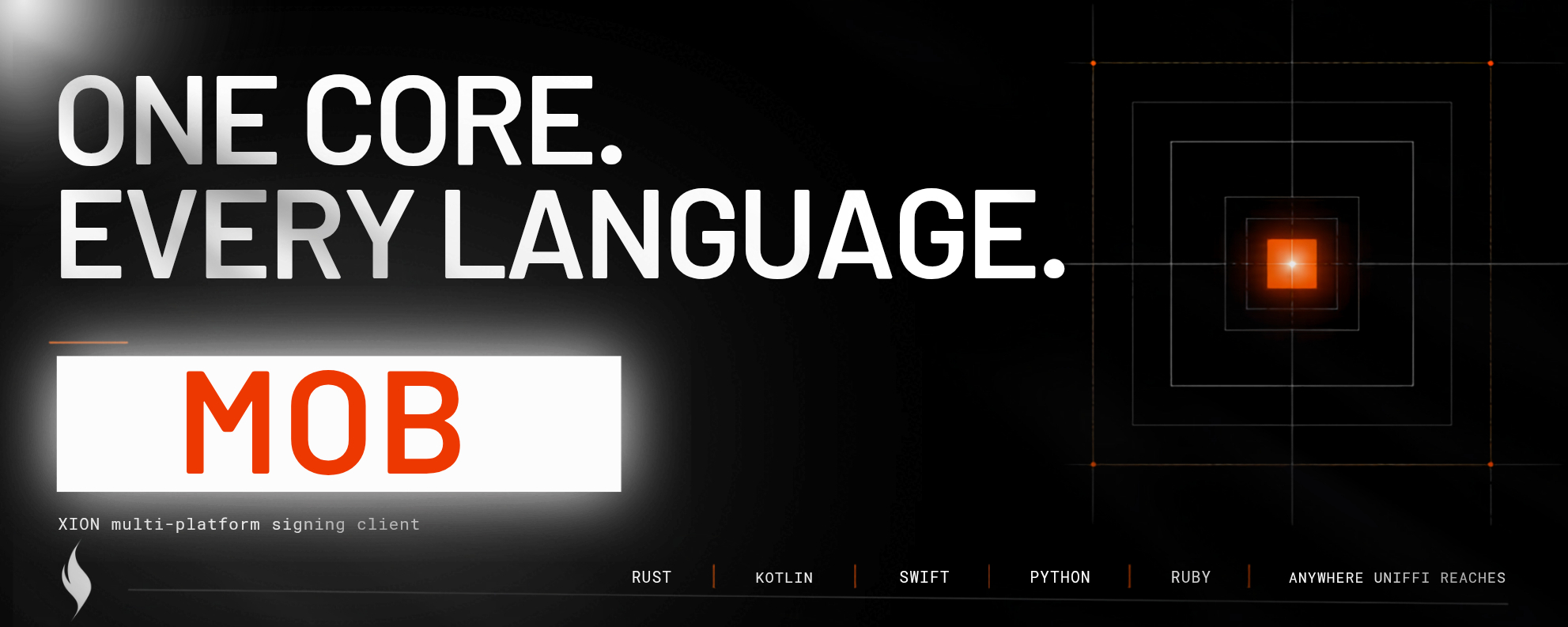
Mob is XION’s multi-platform signing client. It is written with one Rust core and exposed through Mozilla’s UniFFI, giving developers native bindings for Kotlin, Swift, Python, Ruby, Rust, and more.
That sounds technical.
But the simple meaning is this:
A Swift developer building an iOS app can call XION from Swift.
A Kotlin developer building Android can call XION from Kotlin.
A Python team running automation, ETL jobs, payments logic, or reconciliation scripts can call XION from Python.
A Ruby backend can watch events, reconcile state, or trigger downstream actions.
A Rust service or CLI can handle internal infrastructure and treasury operations.
🔹Same core.
🔹Same primitives.
🔹Same experience.
This is what platform-grade infrastructure looks like.
And it matters because Mob is not just “another SDK.”
It carries the full XION abstraction model into the places where real applications already live.
↪Session keys.
↪Meta accounts.
↪Treasury-paid gas.
↪Gasless flows.
↪Transaction signing.
↪Account management.
↪Native app integrations.
↪Backend automation.
↪CLI and service workflows.
All of that becomes reachable from the languages teams already trust.
That is the important part.
A chain becomes a real platform when developers stop having to reshape their product around the chain.
Mob makes XION feel less like a separate crypto environment and more like a normal software surface.
And this connects directly to XION’s bigger thesis: verification.
Verification only matters as infrastructure if developers can actually reach it.
A verification layer that only works for one narrow type of builder is not really a layer of the internet. It is a feature inside a small room.
For verification to become something bigger, it has to reach mobile apps, backend services, internal tools, automation scripts, payment systems, consumer products, and enterprise workflows.
💙That is what Mob expands.
It gives XION a wider developer surface.
Not by forcing every team into a new stack.
Not by making brands rebuild their apps.
Not by asking users to understand wallets, gas, signatures, or chain mechanics.
It brings the XION experience to the places software is already being built.
🌐That matters for adoption.
Because the brands and products that will use XION are not all building the same way.
➡Some have native mobile teams.
➡Some have Python jobs.
➡Some have Ruby services.
➡Some have Rust infrastructure.
➡Some have web apps.
➡Some have internal tools that users will never see.
Mob is for all of them.
This is also why the “one Rust core” detail is more important than it looks.
Most chains ship different SDKs for different languages.
Over time, those SDKs drift.
🔹One has a feature.
Another does not.
🔹One gets updated quickly.
Another falls behind.
🔹One bug is fixed in one language but still exists somewhere else.
That creates fragmentation before users even arrive.
Mob takes a cleaner route.
The real work happens in one Rust core. The language bindings are generated from the same interface definition through UniFFI.
So the experience stays consistent.
A fix in the core benefits every supported language.
An audit of the core strengthens every binding.
The same primitives reach every team at the same time.
That is engineering discipline.
It also reduces one of the biggest hidden costs in Web3 development: integration friction.
Builders should not have to ask, “Which language has the real client?”
They should be able to ask, “What do I want my app to do?”
That shift is subtle, but important.
🤯Because XION’s whole direction has been about making the chain disappear from the user experience while keeping the guarantees that make the chain useful.
Users should not need to care about gas.
Users should not need to manage seed phrases just to touch an app.
Users should not need to know what a session key is.
And now, with Mob, developers also have less reason to treat blockchain as a separate world.
➖A native iOS app can use Swift.
➖A native Android app can use Kotlin.
➖A backend can use Python or Ruby.
➖A service can use Rust.
The chain becomes something the product calls, not something the product bends around.
That is a serious step.
This is also why Mob should not be misunderstood as a mobile SDK.
The name is short for multi-platform, not mobile.
Yes, it helps native mobile apps.
But it also matters for backends, scripts, desktop tools, automation, CLIs, services, treasury operations, reconciliation systems, and any other environment where software teams need to talk to XION.
That is much bigger than mobile.
And it is different from xion.js.
If a team is building a web app or React Native app, xion.js remains the right tool.
Mob is the expansion surface.
It covers everything else.
✔Swift.
✔Kotlin.
✔Python.
✔Ruby.
✔Rust.
👉And wherever UniFFI can take the same core next.
That is the kind of infrastructure decision that does not always create loud headlines, but it compounds.
More languages means more developers.
More developers means more possible applications.
More applications means more on-chain activity.
More activity means more value moving through the network.
No magic.
Just less friction between XION and the real world.
For me, this is the key idea:
XION is not asking the internet to become crypto-native.
It is making crypto infrastructure easier to embed into the internet that already exists.
That is the difference.
Mob makes the XION stack more reachable for builders who do not want to become “crypto developers” first.
They just want to build an app, a service, a payment flow, a loyalty product, a verification system, or an internal tool that works.
And now they can do that with the language they already use.
That is what “Make It Real” should mean.
✍Real users.
✍Real brands.
✍Real revenue.
✍Real development stacks.
Verification becomes infrastructure when it reaches every developer surface.
With Mob, XION just moved much closer to that.