
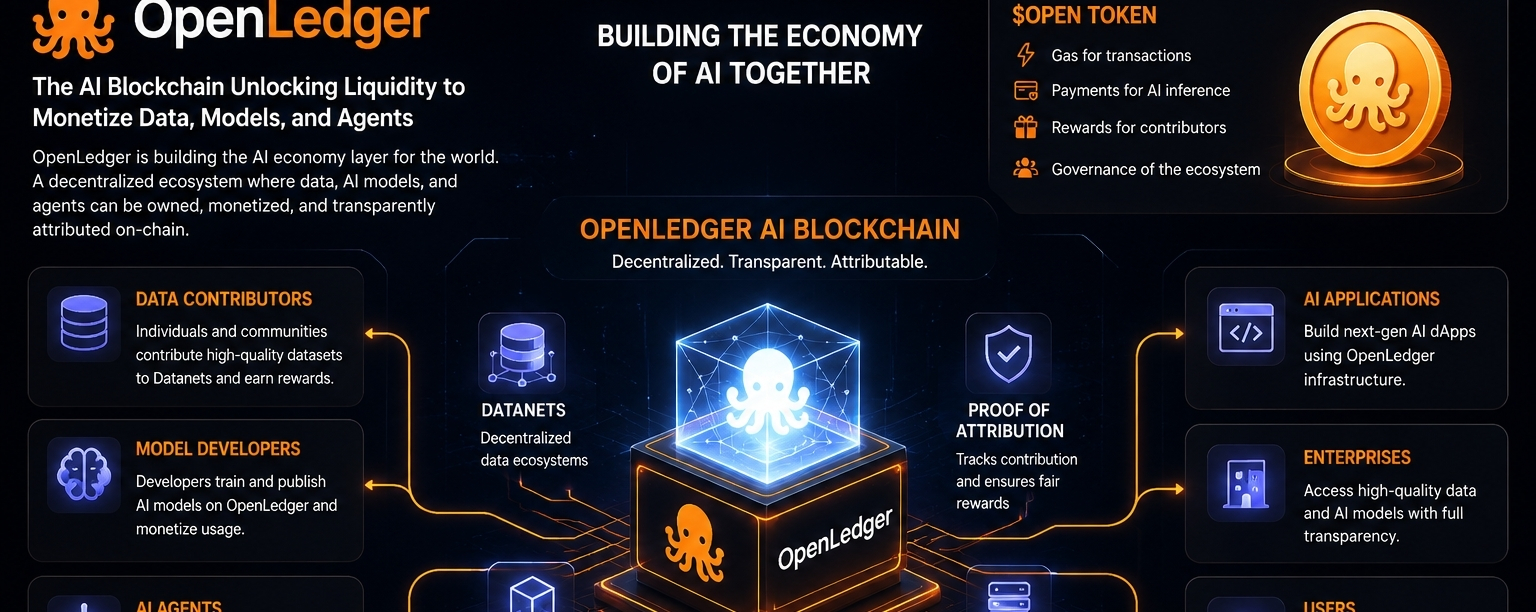
OpenLedger is emerging as one of the most ambitious projects connecting artificial intelligence with blockchain technology. While many crypto projects simply add AI as a trend, OpenLedger was designed from the beginning to build an entire economic system around data, AI models, and autonomous agents. The project is focused on one major idea. The people who contribute data and intelligence to AI systems should also share in the value those systems create.
Today, most AI platforms are controlled by large centralized companies. They collect enormous amounts of user data, train powerful models behind closed systems, and generate billions in value while contributors remain invisible. OpenLedger is trying to change this structure completely. They’re building what can be described as an AI-native blockchain where datasets, machine learning models, and AI agents can all become monetizable digital assets with transparent ownership and attribution.
At the center of the ecosystem is the concept of decentralized AI infrastructure. Instead of depending on one company to own everything, OpenLedger allows communities, developers, and contributors to participate directly in the creation of AI economies. This approach matters because artificial intelligence is becoming one of the most powerful industries in the world. If control remains centralized, only a small group benefits. OpenLedger believes blockchain can distribute that value more fairly.
One of the project’s most important innovations is something called Datanets. These are decentralized data ecosystems where contributors can provide datasets for AI training. The idea is simple but powerful. AI models are only as good as the data they learn from. OpenLedger wants to create an environment where specialized communities build high quality datasets for industries like healthcare, finance, gaming, agriculture, and research. Instead of random internet scraping, models can learn from organized and verified information contributed by real communities.
The reason this design is important comes down to quality and incentives. In traditional AI systems, data contributors are usually ignored after their information is collected. OpenLedger changes this through a mechanism known as Proof of Attribution. This system attempts to track which datasets or contributors influenced a model’s output. If a model becomes successful and generates economic activity, contributors can continue earning rewards over time. We’re seeing an attempt to create royalty-like systems for AI participation.
This creates a completely different economic structure for artificial intelligence. Imagine a future where someone contributes medical research data, language datasets, or financial analysis information, and that contribution continues generating rewards years later because AI systems still rely on it. OpenLedger is trying to transform data from a disposable resource into a productive digital asset.
The network is also designed specifically for AI workloads. Traditional blockchains were mainly built for payments and financial transactions. AI systems require much more scalability because they involve constant inference requests, model updates, attribution tracking, and agent interactions. OpenLedger focuses heavily on scalable infrastructure so these operations can happen efficiently without excessive costs. This is one of the main reasons the project describes itself as an AI blockchain instead of a general blockchain with AI features added later.
Another major part of the ecosystem is OpenLoRA, which focuses on efficient deployment of AI models. Instead of forcing developers to run massive expensive models all the time, OpenLoRA allows smaller specialized models to operate more efficiently. This approach reflects the future direction of AI itself. Rather than one giant universal intelligence handling everything, the industry is moving toward thousands of focused models optimized for specific tasks.
The project also supports AI agents. These are autonomous systems capable of interacting with applications, processing information, and even participating in economic activities. OpenLedger believes AI agents will eventually become a massive digital workforce. If that future arrives, agents will require payment systems, ownership structures, and transparent economic coordination. Blockchain infrastructure naturally fits this environment because it allows programmable transactions and verifiable activity between machines.
The OPEN token connects the entire ecosystem together. It is used for transaction fees, governance participation, AI inference payments, contributor rewards, and ecosystem incentives. The token is designed to support long term network growth rather than short term speculation alone. If adoption grows, the token economy could become closely tied to real AI usage across the platform.
Several important metrics will determine whether OpenLedger succeeds in the future. One key indicator is the amount of active data contribution happening across Datanets. Another is inference demand, which measures how frequently AI models are actually being used. Developer activity is also critical because ecosystems only grow when builders continue launching useful applications. Validator participation, transaction throughput, and AI agent deployment numbers may also become major indicators of network health.
However, the project still faces serious risks. One of the biggest challenges is maintaining data quality. Open systems can attract spam, fake datasets, and low value contributions designed only to farm rewards. If poor quality data enters the ecosystem at scale, AI models could lose reliability very quickly. OpenLedger attempts to solve this through attribution systems and verification mechanisms, but maintaining trust across decentralized environments remains difficult.
Competition is another challenge. The AI industry is evolving extremely fast, and many companies are now trying to combine blockchain with artificial intelligence. OpenLedger must prove that its infrastructure is efficient, scalable, and attractive enough for developers to choose over centralized alternatives.
Still, the long term vision behind OpenLedger is extremely powerful. They’re not simply building another.
