
I keep thinking about how the AI industry may be measuring the wrong thing.
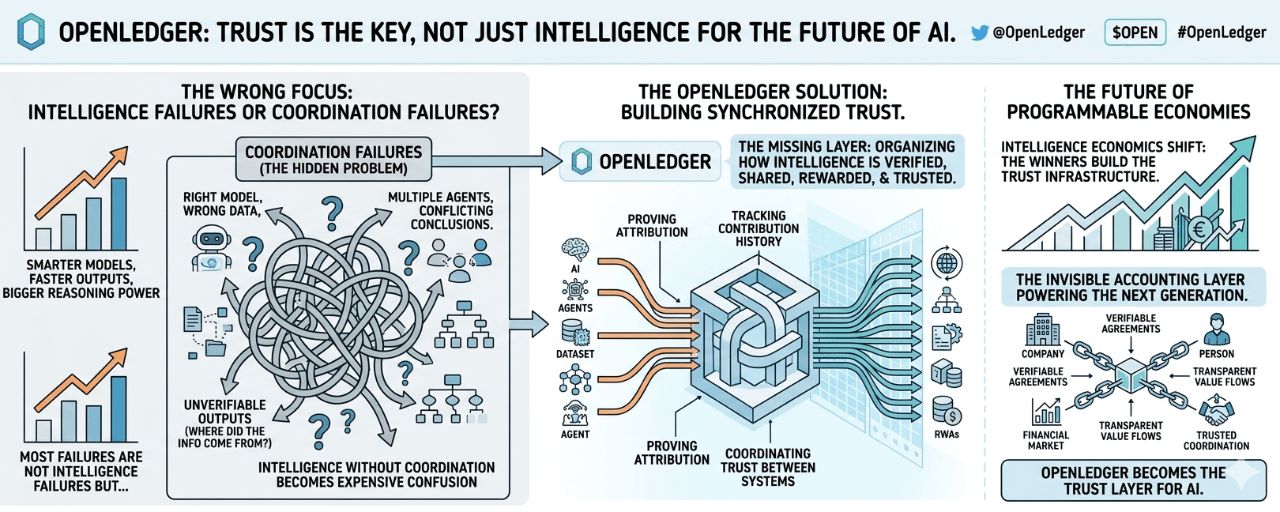
Everyone focuses on smarter models, faster outputs, and bigger reasoning power. But most real failures I see are not intelligence failures. They are coordination failures. The right model gets the wrong data. Multiple AI agents reach different conclusions. Useful outputs become unusable because nobody can verify where the information actually came from.
That is why OpenLedger feels different to me.
I no longer see it as just another AI infrastructure project. I think it is trying to solve the hidden problem behind machine economies: synchronized trust.
As AI systems, agents, datasets, and RWAs become more connected, the biggest challenge may not be creating intelligence. It may be proving attribution, tracking contribution history, and coordinating trust between systems that were never designed to understand each other.
Because intelligence without coordination becomes expensive confusion.
And that changes the economics completely.
The future winners in AI may not only be the companies building the smartest models. They could be the networks organizing how intelligence is verified, shared, rewarded, and trusted across entire ecosystems.
If that shift happens, OpenLedger may end up becoming less about AI tools and more about the invisible accounting layer powering the next generation of programmable economies.