
Everyone's been talking about AI agents lately. Not in a curious way — in a slightly exhausted way. Like we've all heard the pitch enough times that we stopped actually listening.
I was in that headspace today. Skimming through feeds, half-paying attention, when I stumbled across something about @OpenLedger I almost kept scrolling. Glad I didn't.
So I started looking into it — not expecting much, honestly. Just curious what angle they were working. Another AI + blockchain story, right? Agents doing things on-chain, some token involved, a whitepaper with a lot of arrows in the diagrams.
But then something shifted.
The framing they're working with isn't really about AI doing tasks. It's about AI needing somewhere to trust each other. And that's a different problem entirely.
Here's the thing that clicked for me: we've been thinking about AI coordination wrong. The assumption is that the bottleneck is intelligence — smarter agents, better models, more compute. And sure, that matters. But there's a quieter problem underneath that nobody really talks about. When two AI agents from completely different systems need to work together — one trained by some startup in Singapore, one running on a public network, one deployed by a DAO — what's the mechanism that lets them actually coordinate without a central platform mediating it?
Right now, the answer is: there isn't one. Or rather, the answer is always some centralized layer in disguise. A company. An API. A terms of service agreement that technically one AI agent can't even read.
OpenLedger's bet, as far as I can tell, is that permissionless AI coordination needs its own infrastructure — not borrowed infrastructure from Web2, not retrofitted blockchain tooling that wasn't designed for this. Something purpose-built for agents transacting with agents. Settling agreements, sharing data proofs, distributing work — without any of them needing to ask permission from a human intermediary at every step.
What people assume is that coordination is a product feature. Something you bolt on. A dashboard. An SDK.
What OpenLedger seems to be arguing is that coordination is a layer. And whoever builds the canonical layer owns something much bigger than a product.
That's the part that stayed with me.
But here's where I slow down a little.
I'm not fully convinced this holds under pressure. The idea is clean — almost too clean. Because the moment you say "permissionless," you're also saying "no one's responsible when something breaks." And AI agents break in strange ways. They hallucinate. They misinterpret. They execute instructions that made sense at the time and then absolutely didn't.
A permissionless coordination layer for AI agents sounds liberating right up until one agent settles a contract based on bad data and there's no human in the loop to catch it. Who arbitrates that? The chain? The token holders? I genuinely don't know, and I'm not sure the answer exists yet.
There's also just the adoption question. Builders are already deep in their own stacks. Getting them to route AI agent interactions through a shared coordination layer requires a level of ecosystem buy-in that's easy to diagram and hard to actually pull off. I thought about a few projects I know that tried something adjacent to this — not with AI, just with cross-protocol coordination — and most of them stalled not because the idea was wrong but because the timing required everyone to move at once.
That said — if any moment is the right moment for this, it's probably now. The AI agent space is still early enough that patterns aren't locked in. Infrastructure bets work best when they're placed before the market decides what "normal" looks like. After that, switching costs make everything sticky.
So the why-now argument is real. The who-it-affects argument is also real — any developer building multi-agent systems, any protocol that wants AI integration without handing the keys to a single provider. The question is just whether OpenLedger can get to critical mass before the window closes.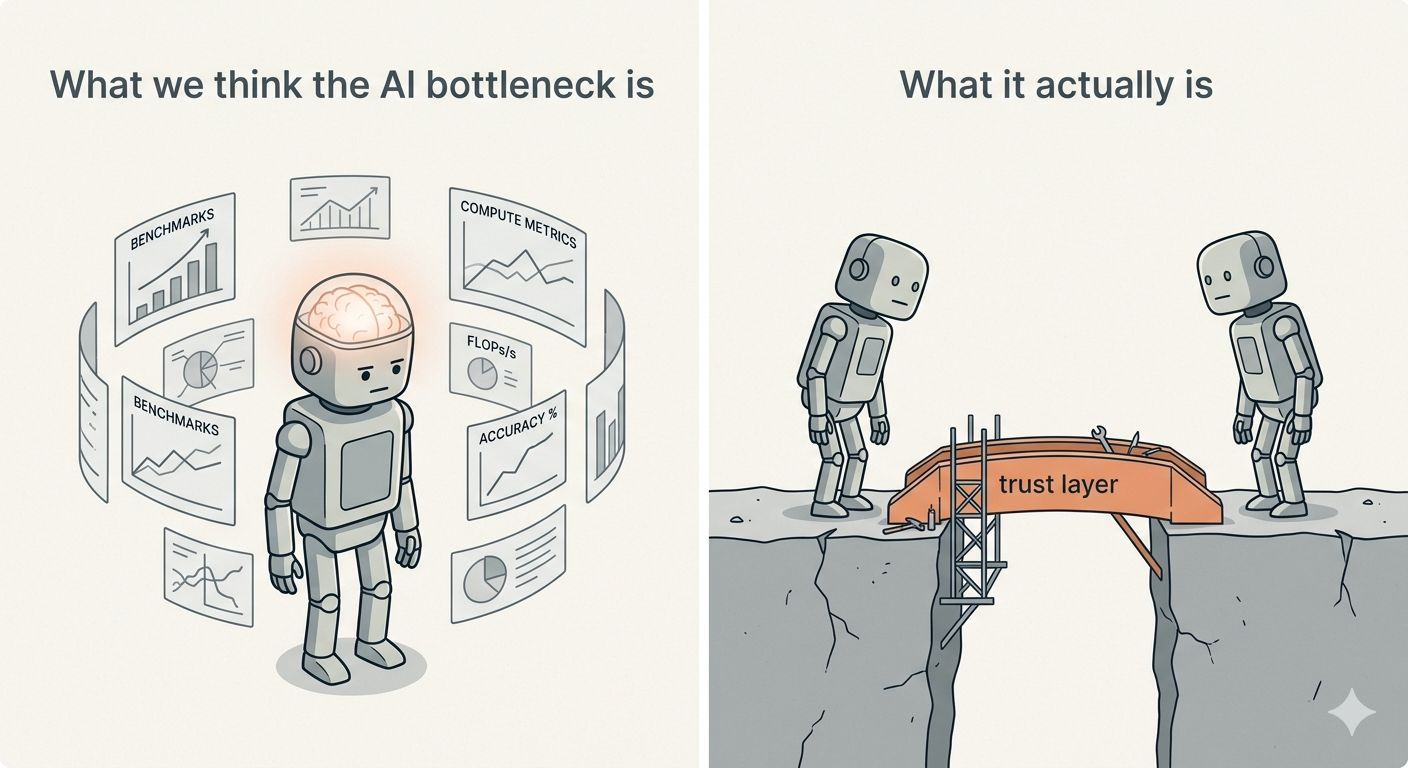
I keep coming back to that framing though. Not AI that does things. AI that can trust things. That's a subtle difference but it's not a small one.
Anyway. Charts still look uncertain out there. I'll probably just keep watching how the agent space shakes out over the next few months. There's a lot of infrastructure being built right now that most people aren't paying attention to — which is usually either a red flag or the whole point.