
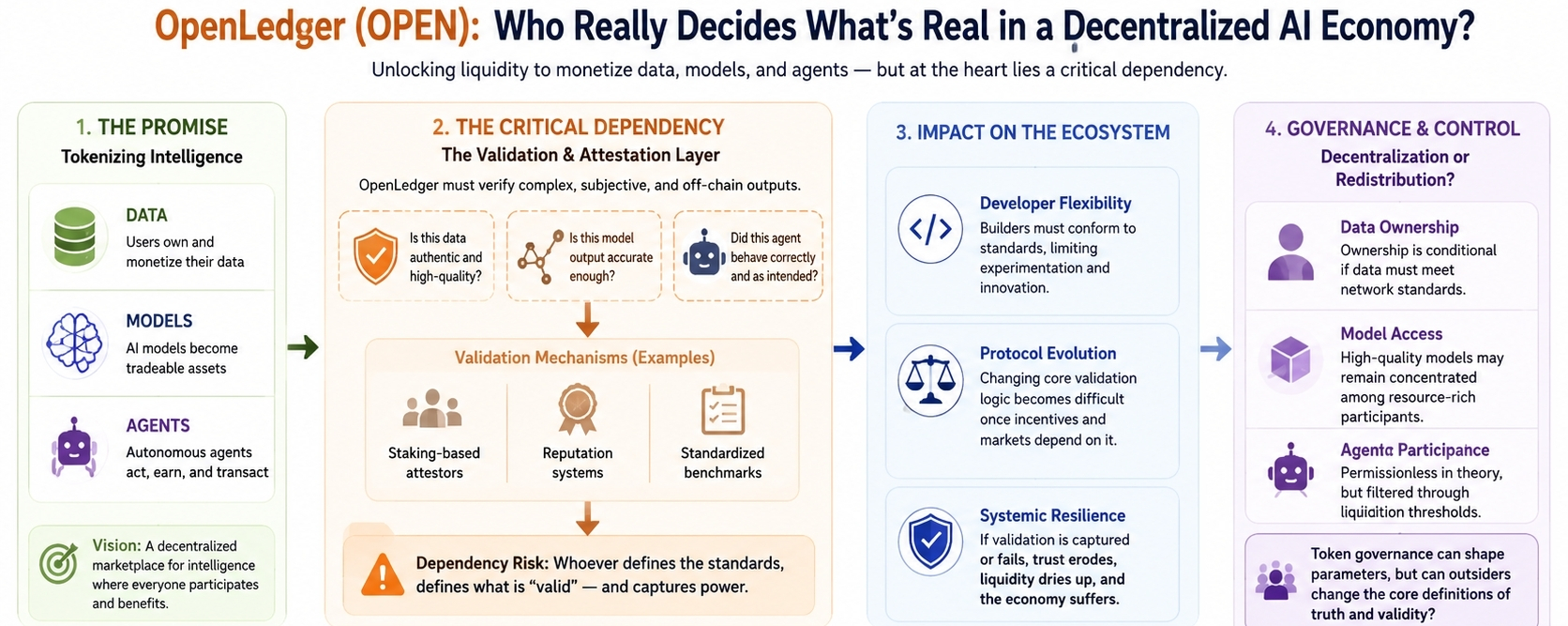
There’s something deeply compelling about what OpenLedger is trying to do. The idea that your data, your models, even your autonomous agents could finally belong to you—and not just belong to you, but work for you—is powerful. It taps into that long-standing promise of decentralization: that value should flow back to the people who create it.
But when you sit with it a little longer, a quieter question starts to emerge. Not about ownership, not about tokens or incentives—but about something more fundamental.
How does a system like this decide what’s real?
Because OpenLedger isn’t just verifying transactions the way Ethereum does. It’s trying to verify things that are far less clear-cut—whether a dataset is trustworthy, whether a model’s output is “good enough,” whether an autonomous agent acted correctly. These aren’t simple yes-or-no questions. They live in grey areas, shaped by interpretation.
And that’s where the tension begins.
Somewhere inside the system, there has to be a way to judge these things. Maybe it’s a group of validators staking tokens, maybe it’s a reputation system, maybe it’s a set of predefined benchmarks. Whatever form it takes, it introduces a quiet dependency: someone, or some mechanism, is deciding what counts as valid.
At first, that doesn’t seem like a problem. Every system needs rules. But over time, those rules start to matter more than the openness around them. Because if you want to participate—if you want your data to be accepted, your model to be used, your agent to operate—you have to align with those standards.
And suddenly, decentralization starts to feel conditional.
We’ve seen versions of this story before. On the surface, things look distributed, open, permissionless. But underneath, there are pressure points. Large parts of the ecosystem quietly depend on a few key actors or assumptions. Even something as widely trusted as Chainlink still raises questions about where its data ultimately comes from and who shapes its trust model. The structure is decentralized—but the definition of truth is harder to spread out.
That’s what makes OpenLedger different, and also more fragile. It’s not just building a financial system or a computation layer. It’s trying to build a marketplace for intelligence itself. And intelligence doesn’t fit neatly into rules. It’s messy. Contextual. Debatable.
So the system has to simplify it. It has to draw lines—this is valid, this isn’t; this is high-quality, this is not. And those lines, once drawn, start to shape everything. They influence what developers build, what data gets used, what models succeed, which agents survive.
You can still participate, of course. But you’re participating inside a framework you didn’t fully define.
And that raises a harder question, one that doesn’t have an easy answer. Even if tokens are distributed, even if validators are many, even if governance exists—who actually has the power to change those underlying definitions? Not vote on surface decisions, but reshape the core logic of how truth is measured?
If that power sits with a small group—whether they’re early builders, major stakeholders, or those controlling key infrastructure—then the system hasn’t eliminated centralization. It’s just moved it somewhere less visible.
That doesn’t make OpenLedger a failure. It just makes it human. Every system, no matter how idealistic, carries the weight of its own assumptions.
The real question is whether those assumptions can be challenged from the outside. Whether someone new—without insider access or outsized influence—can come in and meaningfully reshape how the system works at its core.
Because if they can’t, then ownership might be decentralized, participation might be open, but something deeper remains out of reach.
And in a system built on intelligence, that “something deeper” is everything.