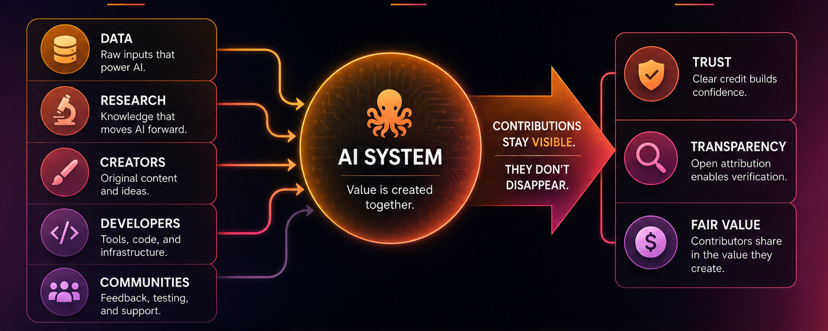
AI right now feels a bit like the California gold rush. Everyone is sprinting toward the shiny stuff — giant models, synthetic voices, AI agents pretending to be your co-worker, your therapist, your girlfriend, your trading assistant. Every week another company appears claiming it has built the machine that changes everything.
But underneath all that noise sits an uglier question nobody seems eager to wrestle with.
Who actually owns the intelligence?
Not the interface. Not the chatbot wrapper. The raw material underneath it. The data. The behavior patterns. The niche expertise. The thousands of invisible human fingerprints quietly training these systems every hour.
That neglected layer is where OpenLedger (OPEN) has decided to camp out.
And honestly? It is a strange place to build. Which is probably why it caught my attention.
Most crypto projects chasing the AI narrative look like they were assembled backward. They start with a token, sprinkle in the phrase “AI infrastructure,” slap a futuristic dashboard on top, then wait for retail speculation to do the heavy lifting. OpenLedger feels more obsessed with plumbing than fireworks.
That sounds boring until you realize plumbing runs cities.
OpenLedger calls itself an AI blockchain designed to monetize data, models, and agents. On paper, that sounds abstract. In practice, the idea is fairly blunt: AI systems are consuming enormous quantities of value while the people and entities supplying that value rarely capture meaningful upside.
The current AI economy resembles a casino where the house keeps rewriting the payout table.
Data contributors hand over information.
Model builders absorb it.
Platforms package it.
Capital captures most of the reward.
Everyone else gets convenience points and a Terms of Service update.
OpenLedger is betting that imbalance eventually becomes impossible to ignore.
The project’s architecture circles around attribution and liquidity. Two words that sound sterile until you translate them into human behavior.
Attribution means figuring out who contributed what.
Liquidity means making those contributions tradable instead of trapped.
Think of it like this: right now, AI training data behaves like unpaid overtime. It disappears into massive systems, gets blended into statistical soup, and comes back out as billion-dollar products with almost no transparent accounting for the people or entities who fed the machine in the first place.
OpenLedger wants receipts.
Not symbolic ones. Economic ones.
The blockchain layer matters here because traditional databases are terrible neighborhood witnesses. Records get edited. Permissions shift. Incentives drift. A distributed ledger, at least in theory, behaves more like a stubborn public notebook taped to a streetlight. Everyone can inspect it. Nobody quietly swaps pages at midnight.
That becomes especially relevant once AI agents start interacting economically with one another.
And that future is arriving faster than people think.
We are already watching the internet mutate from a network of humans into a crowded bazaar of semi-autonomous software entities. Agents writing code. Agents negotiating prices. Agents generating media. Agents training smaller agents. The entire thing has started to resemble an ant colony that accidentally discovered venture capital.
Now ask the uncomfortable question:
If an AI agent creates value using datasets from five sources, a model from another provider, and inference infrastructure from somewhere else, who gets paid?
Right now the answer is usually: whoever owns the platform.
OpenLedger is trying to build a different answer.
The interesting part is not the branding around “AI blockchain.” We have seen enough buzzword collisions to last a decade. The interesting part is the attempt to create a permissionless accounting system for intelligence itself — a market where datasets, models, and agents behave less like static software and more like productive digital assets.
That creates weird possibilities.
A specialized medical dataset could generate recurring revenue every time it improves inference quality.
A niche language model trained on regional dialects could become licensable infrastructure.
An autonomous agent could theoretically earn, spend, and reinvest capital without a human manually touching the transaction flow.
Messy? Absolutely.
But economically fascinating.
The broader market still underestimates how violent the collision between AI and ownership structures could become. Most people are focused on capability curves — which model is smarter, faster, cheaper. Fewer people are looking at the economic scaffolding underneath those capabilities.
That scaffolding matters.
History usually rewards whoever controls the rails, not whoever merely rides the train.
And right now the rails of AI look unfinished. Data provenance remains murky. Attribution systems barely exist. Compensation mechanisms are primitive. Entire industries are feeding machine learning systems while hoping lawsuits eventually sort things out afterward.
That is not infrastructure. That is improvisation wearing a suit.
OpenLedger’s bet is that intelligence itself becomes an asset class. Traceable. Tradable. Monetizable.
If that sounds slightly dystopian, good. It probably should.
Because once intelligence becomes programmable capital, the fight stops being about building smarter machines. The fight becomes about ownership rights inside synthetic economies.
That is where things get volatile.
And that is probably where the real money eventually moves.