
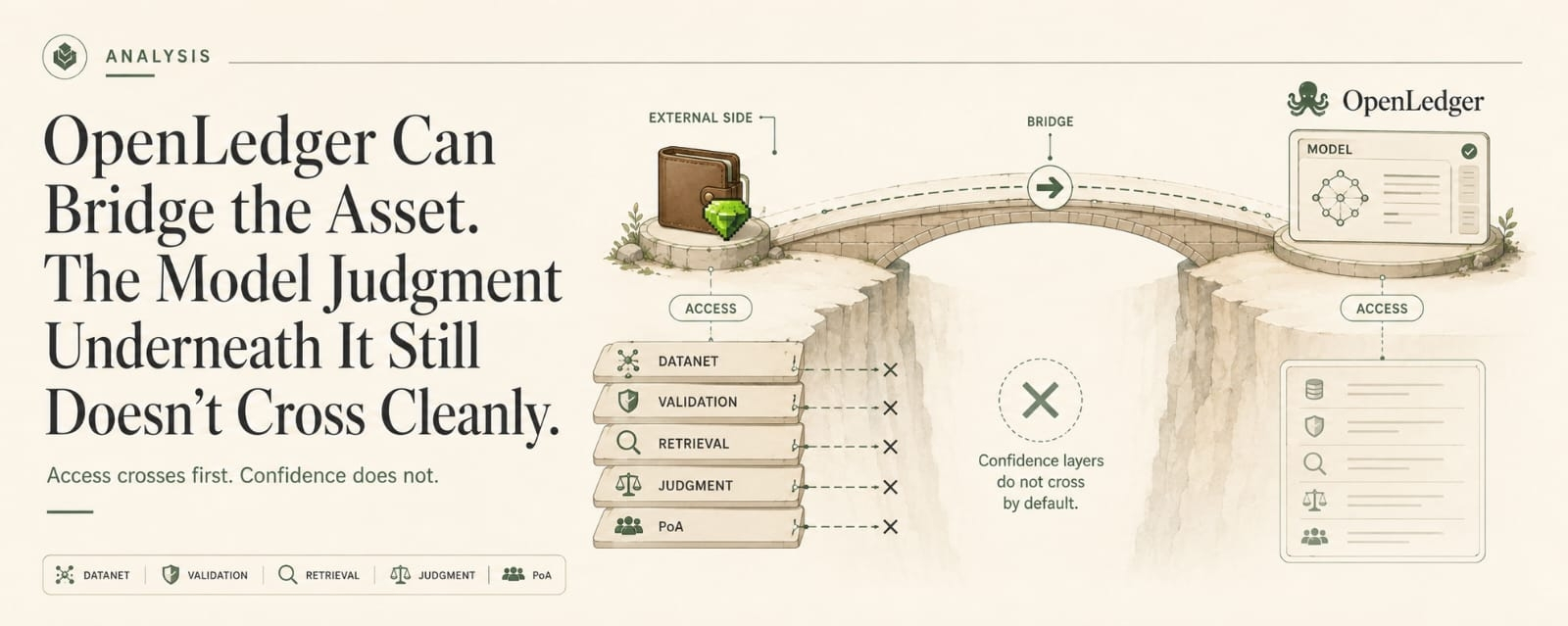
What keeps bothering me on OpenLedger isn’t the bridge itself.
That part is almost insultingly straightforward. Token crosses. Wallet connects. Route works. Great. Everyone relaxes five minutes too early.
It didn't.
What keeps dragging me back is the part that doesn't cross with the token.
... model judgment.
That's the uglier OpenLedger handoff.
Say somebody comes in from the outside. Bridges over. Brings capital, or workflow, or just attention. Doesn’t matter. They hit an OpenLedger-native model route, maybe through a clean interface, maybe through an agent flow later, maybe just a straight model call that looks civilized enough to trust for five minutes. $OPEN moved. The route worked. The chain side did its job. Nice.
And still they are now standing inside a model they never watched get made.
Thats the part.
Because the OpenLedger bridge can move access cleanly before it moves any of the ugly context underneath it. The external user sees compatibility. Route open. Wallet fine. call succeeded. maybe retrieval populated. maybe an inference trace exists if somebody bothers later. Still doesn’t mean they inherited the model’s actual construction history in any useful way.
They did not see the Datanet getting cleaned.
Didn't see validation push out ugly rows with weak provenance either. Didn’t see one contributor band on OpenLedger getting cleaner and more dominant than the rest.
Did not see what validation threw out.
Did not see the ugly source that got excluded because the provenance looked embarrassing.
Did not see contributor concentration forming around one narrow slice of the dataset.
Did not see the builder picking a cleaner training surface in ModelFactory because it looked safer than the messy thing that might have taught the model something real.
The token crosses first.
...judgment doesn’t.
That asymmetry is very OpenLedger, honestly. Because the clean version of the project says okay, fine, data is traceable, models are attributable, Datanets are structured, Proof of Attribution can track contribution later, OpenLoRA can serve specialization efficiently, OPEN handles fees and settlement, EVM rails keep access practical. Good stack. Useful stack. Still not the same thing as a clean trust handoff.
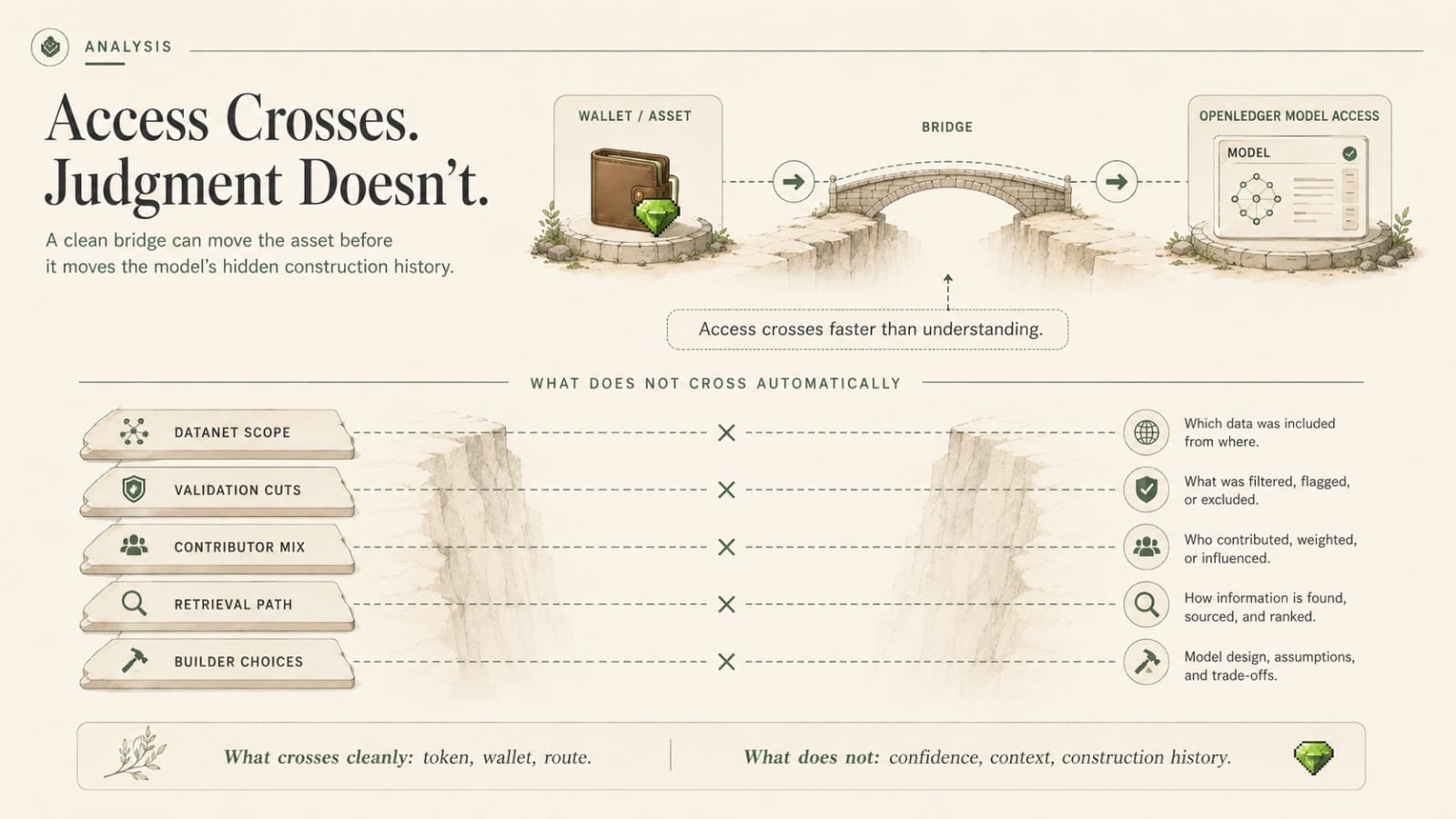
A clean access route isn’t the same thing as confidence crossing with it.
And I don’t think people say that plainly enough.
Say a treasury desk, a team, a builder from outside, whatever, bridges in because the route is there and the OpenLedger model surface is reachable enough to matter now. Maybe they touch a specialized model. Maybe they rely on an agent flow sitting on top of it. Maybe it’s some OctoClaw-adjacent workflow later and now the output isn’t just text, it’s sitting under an action trail. They didn’t arrive through some shady side door. They used the intended path. Bridge worked. Asset there. Call live. Good little civilized system.
Now tell me what exactly they inherited.
Because what crossed was access.
Not the validator’s doubt.
Not the builder’s shortcut from two nights earlier.
Not the retrieval thinness.
Not the quiet fact that one contributor cluster is doing more of the work than the clean surface suggests.
Not the earlier Datanet judgment that decided what kind of model was allowed to exist before any outsider even showed up.
That's not really a bridge problem. Worse than that. The bridge works.
I keep picturing the stupid version because it’s always the stupid version that matters. Somebody bridges in, sees a live model surface, maybe a clean interface, maybe a nice little agent wrapper on top, and assumes continuity. Of course they do. That’s what clean access does to the human brain. It whispers that the underlying thing has been made legible enough to deserve this level of reach.
Maybe it has.
Or maybe the only thing that really crossed cleanly was the token.
Everything else is downstream guesswork wrapped in better tooling.
And OpenLedger makes it harder to ignore because the whole thing is built to leave more of the trail behind. That’s the irony. The system can show more of the chain after the fact. Datanet. validation history. inference trace. retrieval path. contributor effect. Proof of Attribution. reward split. all the good forensic surfaces. Better than the usual AI slop where the answer appears and everyone pretends opacity is just technical depth wearing a nice jacket.
Seeing the trail later isn’t the same as carrying real confidence in with you at the start.
Thats the mismatch.
A user can enter through an OpenLedger EVM route and touch something whose actual model judgment was shaped three layers earlier by people they never saw and criteria they never approved. The bridge didn’t move that context. It moved access faster than understanding.
Good.
That’s useful right up until someone starts treating the clean crossing as proof that the model underneath is trustworthy in the same neat way.
Say the external user keeps going. Queries come in. Maybe the model behaves fine most of the time. Maybe too fine. Maybe retrieval keeps leaning on the same kind of source and nobody notices because the output is polished enough. Maybe inference trace later shows the same narrow pattern. Maybe payout rows start clustering around the same contributor band. Maybe PoA explains the output just fine later and still leaves the outsider staring at a model they never would’ve trusted this quickly if they’d watched the Datanet get shaped. Maybe OpenLedger Proof of Attribution does exactly what it’s supposed to do and backtracks contribution cleanly. Great.
Now what.
Now somebody has to explain whether the model they accessed through a clean route was actually broad enough to deserve the confidence that clean route gave it.
And that explanation never crosses with the asset by default.
That’s the part I can’t stop staring at.
Because in a lot of systems, access friction used to accidentally protect people from this. Not elegantly. Just badly. If it was hard to reach, hard to integrate, hard to settle, fewer people inherited the hidden judgment underneath it. OpenLedger is trying to reduce that kind of useless friction. Good. It should. Otherwise the whole thing stays a demo with better nouns.
But once the route gets smoother, the buried judgment matters more, not less.
Now more people can inherit it.
Now more capital can sit near it.
Now more workflows can route through it.
Now an agent can touch it and leave an action receipt that looks much cleaner than the model judgment that fed it.
Thats meaner than people think.
And it’s not some abstract interoperability sermon either. This is simple. If I bridge into a system and touch a model I didn’t build, what exactly am I trusting? The chain route? The settlement? The Datanet? The validation layer? The builder’s restraint? The retrieval path? The fact that Proof of Attribution can explain parts of it later? Which part is supposed to make me feel better, exactly.
Because “it’s reachable” is not the same as “it came from a process you would’ve signed off on if you’d been there earlier.”
That gap matters more on OpenLedger because the architecture is good enough to make the later route feel official. ModelFactory gives you a build path. Datanets give you organized supply. OpenLoRA keeps specialization cheap enough to serve. Proof of Attribution gives the outputs a later trail. OPEN gives the whole thing a settlement language once value starts moving. The bridge makes access boring, which is exactly what good infrastructure does.
Fine.
The access can feel boring and normal while the judgment underneath it is still weird as hell.
Actually that’s the whole problem.
Say some outside team starts relying on a specialized model that reached them through a very normal-looking route. Then later the model leans weird on edge cases, or retrieval collapses into a narrow source pattern, or contributor influence looks much thinner than expected once someone opens the traces. Now the room gets dumb fast. Was that a bridge issue? No. An inference issue? Maybe. A Datanet issue? A validator cut? A builder decision made in ModelFactory because the cleaner path felt safer? Who’s even holding that explanation by then.
Not the bridge.
The bridge already did its job and left the room.
Thats what makes this one stick.
...easiest thing to move across ecosystems is the token.
The harder thing is the confidence people accidentally attach to the model once the route gets clean enough to use without thinking too hard.
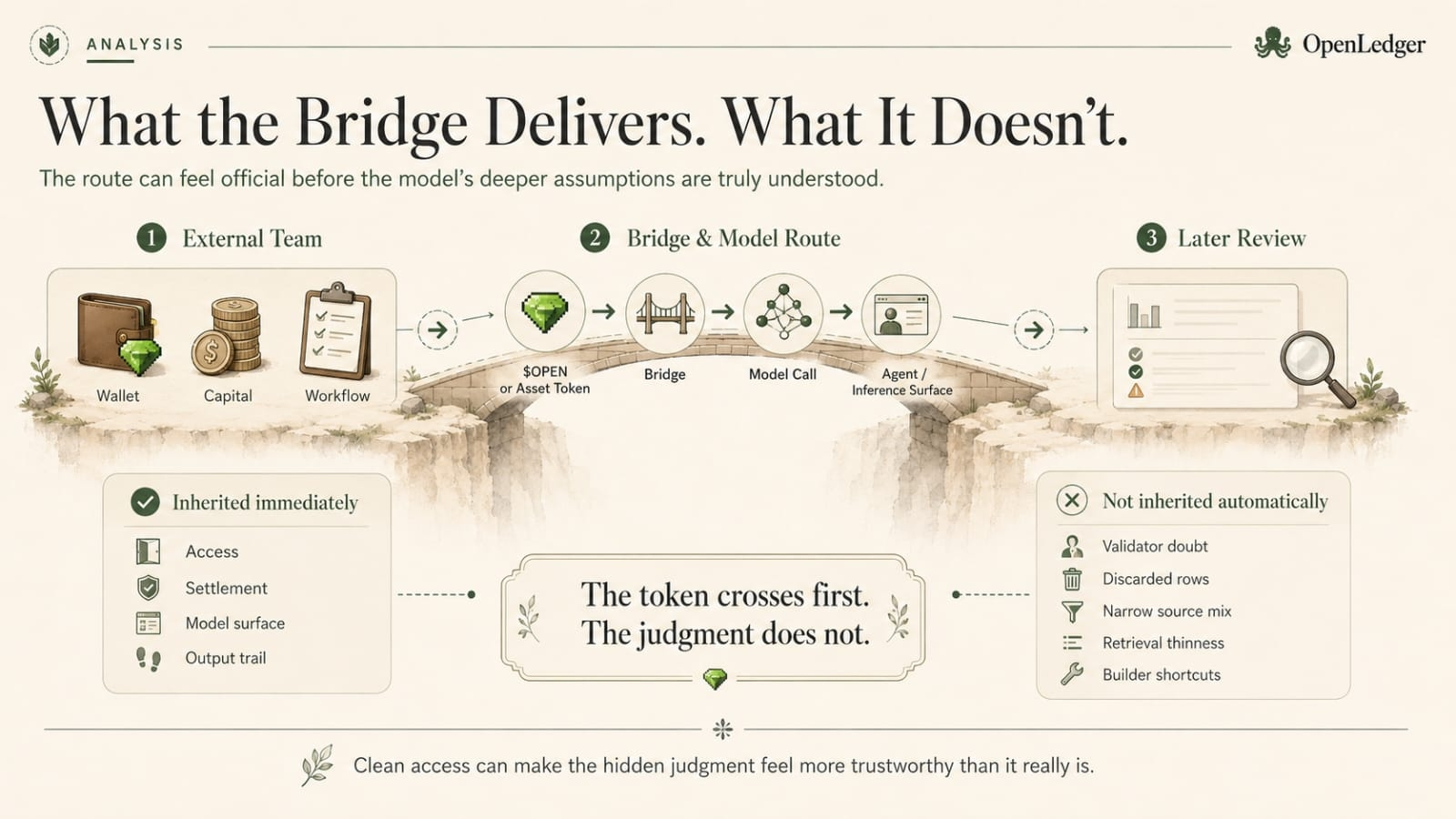
And if OpenLedger keeps making access easier from the outside, which it should, then the worse question doesn’t go away. It gets closer.
When an external user or workflow crosses into a model they never watched get built, what exactly has OpenLedger bridged for them.
Access.
Or trust they haven’t actually earned yet.