
Most discussions around AI infrastructure still begin with the same assumption: data is the asset, and marketplaces are the mechanism that unlock its value.
This framing has become so common that nearly every new AI protocol now describes itself through some variation of the “data economy” thesis. More data, better models. Better models, more value creation. Tokens become coordination layers for datasets, compute, storage, or access rights. The logic feels intuitive because it mirrors the industrial structure of earlier internet platforms: collect information, aggregate it, monetize it.
But the deeper problem emerging inside AI is no longer simply about owning data.
It is about proving contribution.
That distinction matters more than it first appears.
As AI systems become increasingly compositional — built from fragmented datasets, layered models, fine-tuned agents, synthetic outputs, reinforcement loops, human feedback systems, and continuously evolving inference behaviors — the difficulty is no longer generating intelligence. The difficulty is determining who meaningfully contributed to it, under what conditions, and with what lasting economic entitlement.
This is where OpenLedger and the $OPEN token become more interesting than their surface-level positioning suggests.
At first glance, OpenLedger appears to fit neatly into the familiar category of decentralized AI infrastructure. A protocol attempting to create economic coordination around AI contributions, datasets, models, and agents. Another attempt to decentralize ownership away from centralized labs and platform monopolies.
But that interpretation may actually undersell what is being constructed.
Because OpenLedger does not merely appear concerned with contribution itself. It appears concerned with contribution visibility.
And visibility, in digital systems, is often more economically important than the underlying asset.
The modern internet already operates this way. Visibility determines discoverability. Discoverability determines distribution. Distribution determines monetization. Entire industries have emerged not around producing the best work, but around increasing the probability that work becomes legible to ranking systems, recommendation engines, and platform algorithms.
AI may be entering a similar phase.
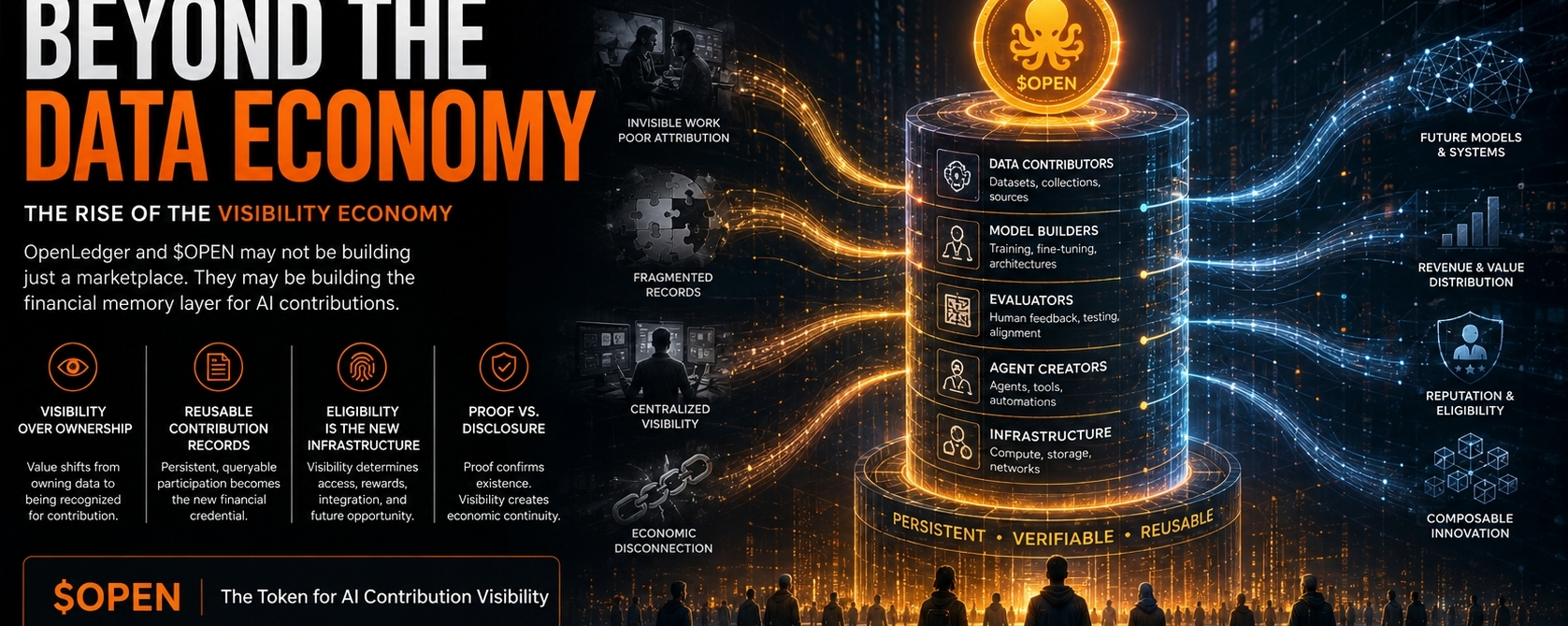
The unresolved tension inside the current AI ecosystem is not that contributors are absent. It is that contribution records are fragmented, temporary, unverifiable, or economically disconnected from downstream reuse. A dataset creator may influence thousands of outputs without attribution. A model contributor may shape behaviors that later become embedded into derivative systems. Human evaluators may train alignment layers whose effects persist indefinitely while their participation disappears entirely from economic memory.
Traditional AI marketplaces attempt to solve this through exchange mechanics. Upload datasets. Sell access. Share compute. Monetize APIs.
But marketplaces assume transactions are the core economic primitive.
OpenLedger seems to operate closer to a different assumption: that persistent visibility may become the actual primitive.
That subtle shift changes the architecture entirely.
Instead of asking, “How do we buy and sell AI resources?” the system begins asking, “How do contributions remain visible across reuse cycles, derivative systems, and future economic activity?”
This is not simply an accounting problem.
It is an eligibility problem.
And eligibility may become one of the defining financial structures of AI economies.
In most digital systems today, rewards are distributed through opaque eligibility logic. Recommendation algorithms decide who gets attention. Platform policies decide who gets monetized. Funding mechanisms decide which builders qualify for grants, traffic, integration, or exposure. In AI specifically, attribution remains extraordinarily shallow relative to actual contribution depth.
The result is a strange asymmetry: systems become increasingly dependent on collective intelligence while economic recognition becomes increasingly concentrated.
OpenLedger appears to recognize this imbalance.
The significance of reusable contribution records is not merely historical tracking. It is the possibility that contribution itself becomes financially queryable. Once participation is persistently indexed, future systems can reference it repeatedly. Contributions stop behaving like isolated labor events and start behaving more like reusable financial credentials.
That may ultimately be what $OPEN is pricing exposure toward.
Not simply access to AI infrastructure, but exposure to the visibility layer governing AI participation.
There is an important difference between proof and disclosure here.
Most blockchain systems are obsessed with proof. Proof of stake. Proof of ownership. Proof of execution. Proof that something happened.
But AI economies increasingly require disclosure structures rather than isolated proofs. Not merely verification that a contribution occurred, but contextual visibility into how that contribution influenced downstream outcomes, derivative systems, model behaviors, or future utility.
A proof confirms existence.
Visibility creates economic continuity.
Without continuity, contributors remain disposable.
This is where the “visibility economy” framing becomes more compelling than the standard marketplace narrative. OpenLedger may not primarily be building a venue for AI commerce. It may be constructing financial memory for AI ecosystems.
That concept sounds abstract until viewed through the lens of dependency.
Modern AI systems are profoundly dependent on invisible labor. Annotators, evaluators, open-source contributors, model tuners, synthetic dataset curators, inference optimizers, prompt engineers, behavioral testers — entire layers of intelligence production exist beneath the surface of polished AI products. Yet most of these contributions dissolve into infrastructure anonymity.
The paradox is that AI companies increasingly rely on decentralized contribution while retaining centralized visibility.
OpenLedger appears to challenge that asymmetry by attempting to make participation economically persistent rather than operationally temporary.
Whether it succeeds is another question entirely.
Because visibility systems introduce their own distortions.
Every metricized environment eventually changes participant behavior. Once contribution visibility becomes financially meaningful, optimization pressure follows immediately. Builders stop contributing naturally and begin contributing legibly. Incentives shape output toward what systems can recognize rather than what ecosystems genuinely need.
This already happened across social media, creator economies, SEO ecosystems, and even open-source development itself. Visibility rewards often collapse nuanced contribution into measurable performance indicators. Participants adapt to metrics. Metrics reshape behavior. Systems become flooded with performative activity designed primarily to maintain eligibility.
OpenLedger is unlikely to escape this dynamic completely.
In fact, the protocol’s long-term credibility may depend less on scaling participation and more on resisting incentive degradation.
Because contribution systems become fragile the moment visibility becomes gamifiable.
If low-quality participation can mimic high-value contribution, financial visibility loses meaning. And once visibility loses meaning, the economic layer built on top of it weakens as well.
This creates an unusually difficult balancing act for OpenLedger.
The protocol must simultaneously encourage participation while preserving contribution integrity. It must expand visibility without collapsing into spam economics. It must create reusable records without allowing those records to become empty status artifacts detached from actual utility.
That challenge is much harder than launching a marketplace.
Marketplaces only need transactions.
Visibility economies require credibility.
And credibility compounds slowly.
There is also a more uncomfortable implication beneath all of this: OpenLedger may inadvertently reveal how much future AI ecosystems depend on persistent behavioral indexing.
Because once contribution histories become economically relevant, identity itself changes shape. Builders, datasets, agents, and evaluators begin accumulating machine-readable reputational layers that influence future access, monetization, and participation rights.
The line between contribution infrastructure and reputation infrastructure becomes extremely thin.
That transition could become financially powerful.
It could also become deeply extractive if mishandled.
History suggests that systems designed to “reward contributors” often evolve into systems that quietly standardize contributor behavior. Visibility creates incentives, but incentives also create conformity. Participants eventually optimize for institutional legibility rather than experimentation.
The danger is not merely centralization.
It is behavioral compression.
A visibility economy can empower contributors while simultaneously narrowing the range of acceptable contribution patterns.
This is why OpenLedger deserves cautious attention rather than celebratory hype.
The project becomes intellectually interesting not because it promises decentralized AI, but because it exposes a larger structural shift already happening across AI ecosystems: value is moving away from static ownership and toward persistent visibility.
The future financial layer of AI may not revolve around who owns intelligence.
It may revolve around who remains visible inside intelligence production.
And visibility, once financialized, rarely stays neutral.
That is the deeper question surrounding $OPEN.
Not whether it powers an AI marketplace.
But whether it becomes infrastructure for determining whose contributions continue to matter after the model is already built.#OpenLedger #openLedger $OPEN
