
OpenLedger (OPEN) feels like the kind of project that appears after people spend too much time watching value disappear into places they can’t see anymore.
Not suddenly. Slowly.
For years the internet trained people to hand over pieces of themselves without thinking twice about it. Little habits. Search patterns. Corrections. Opinions. Conversations. The strange thing is none of it looked valuable while it was happening. It just felt like normal internet behavior. Scroll, type, upload, react, move on.
Then AI arrived and changed the atmosphere around all of it.
Now every interaction suddenly looks extractable. Every sentence feels like training material for something larger sitting quietly in the background. And once people notice that shift, it becomes difficult to unsee it. You start realizing how much of modern AI depends on invisible human participation that nobody really talks about honestly.
That’s the part OpenLedger keeps circling around.
Not in the loud, dramatic way crypto projects usually do. More like a system built from accumulated irritation. Almost like the people behind it spent enough time watching the same imbalance repeat itself and eventually decided the infrastructure itself needed to change.
Because the current arrangement feels strange when you sit with it long enough.
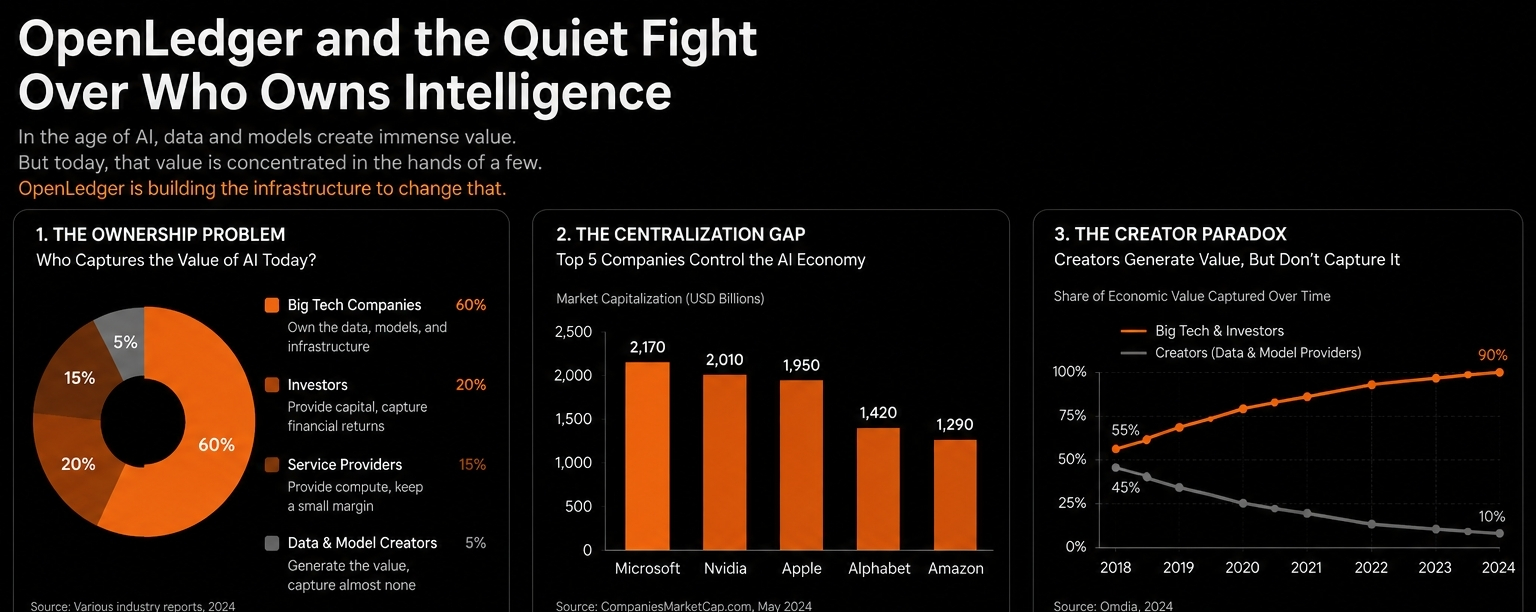
Millions of people constantly generate useful information online while a relatively small number of platforms absorb most of the long-term value from it. AI only accelerated that imbalance. Suddenly the internet doesn’t just collect behavior anymore. It learns from it. Refines itself through it. Builds businesses from it.
Meanwhile the people producing the raw material mostly remain invisible.
The industry likes to call this innovation. Sometimes it just looks like cleaner extraction.
That’s why OpenLedger caught attention in the first place. Not because “AI blockchain” sounds exciting anymore. Honestly those words barely register now. Every cycle creates a new phrase everyone repeats until it loses meaning completely. But underneath the branding there’s a real tension hiding there.
Who owns intelligence once intelligence becomes economic infrastructure?
That question keeps getting larger.
Especially now, when models, agents, datasets, and automated systems are starting to behave less like software products and more like entire economies forming around invisible labor. The strange part is most people contributing to these systems still don’t fully realize they’re participating in an economy at all.
They think they’re using platforms.
The platforms think they’re collecting fuel.
And somewhere between those two realities, projects like OpenLedger start appearing.
Still, experience makes it difficult to look at these systems without skepticism.
Crypto has this habit of believing incentives automatically solve coordination problems. Attach rewards to behavior and supposedly decentralized ecosystems emerge naturally from the chaos. But real human systems rarely stay clean once financial pressure enters the room. The moment contribution becomes profitable, behavior changes immediately.
People stop acting naturally.
Quality drops.
Spam rises.
Bots multiply.
Communities turn performative.
Everything slowly bends toward optimization instead of usefulness.
It happens every single time.
That’s why the hardest part of projects like OpenLedger probably has nothing to do with AI itself. The technical side almost feels secondary compared to the social side. Building systems where people contribute honestly without turning the environment into a reward farm is incredibly difficult. Most networks underestimate how quickly incentives distort behavior.
Especially online.
Because humans adapt fast once systems become measurable.
And AI ecosystems make this even stranger. Data sounds abstract until money starts flowing around it. Then suddenly every interaction gains weight. Every contribution becomes something people want to monetize, automate, replicate, or control at scale.
That creates pressure.
Not theoretical pressure. Real pressure.
The kind that exposes whether infrastructure actually works once thousands of opportunistic actors enter the system at once. That’s usually where idealistic narratives start collapsing. Governance becomes messy. Power centralizes quietly. Larger participants gain leverage. Smaller contributors lose visibility again.
Crypto keeps promising to eliminate gatekeepers while accidentally creating new ones in different forms.
OpenLedger doesn’t fully escape that concern either.
If anything, projects trying to build marketplaces around intelligence and data may eventually face even stronger gravitational pull toward centralization. Compute power centralizes naturally. Distribution centralizes naturally. Attention centralizes naturally. The internet has been moving in that direction for years despite all the decentralization rhetoric layered on top of it.
That’s why the most interesting thing about OpenLedger isn’t whether it succeeds immediately. It’s that the project exists at all.
Because it reflects a growing discomfort people are starting to feel around AI infrastructure itself.
A few years ago most users barely questioned where models came from or what fueled them. Now there’s visible tension around ownership, compensation, attribution, authenticity. The internet suddenly feels less innocent than it used to. People recognize that their behavior has economic value now, even if they can’t fully measure it.
And once people recognize that, systems built around invisible extraction start attracting more scrutiny.
You can already feel the shift happening.
Creators becoming protective.
Communities becoming suspicious.
Developers becoming territorial.
Platforms becoming defensive.
Everyone senses that the next phase of the internet will revolve around ownership of intelligence in some form, even if nobody fully understands what that ownership should look like yet.
OpenLedger feels like one attempt to answer that uncertainty.
Not a perfect answer. Maybe not even a lasting one.
But the project seems to come from a real frustration instead of pure trend-chasing, and honestly that alone makes it more interesting than most things floating through the AI-crypto space right now.
Because the projects that survive usually aren’t the ones built from hype. They’re the ones built from pressure. From unresolved problems people keep running into over and over again until somebody finally tries restructuring the system underneath.
The internet created a world where people constantly produce valuable intelligence without seeing where most of the value goes afterward.
Now the infrastructure layer is trying to reorganize itself around that reality before the imbalance becomes impossible to ignore completely.