

OpenLedger was not a project I understood properly the first time I saw it.
At first, it felt like another crypto project trying to attach itself to AI. That was my honest reaction. The description had all the familiar words: data, models, agents, blockchain, monetization. I have seen enough of those combinations to be careful. Sometimes there is a real idea underneath. Sometimes the idea is only there to make the token sound more important than it is.
So I did not take it seriously immediately.
But after spending more time with it, the project became harder to dismiss. Not because every part convinced me, but because the problem it is trying to deal with is real. AI has a strange value chain. A lot of people contribute to it indirectly: people who create data, clean it, label it, organize it, build small models, test outputs, improve prompts, maintain communities, and produce domain knowledge. But when the final AI product becomes valuable, most of those people disappear from the economic picture.
The value moves upward. The contribution stays invisible.
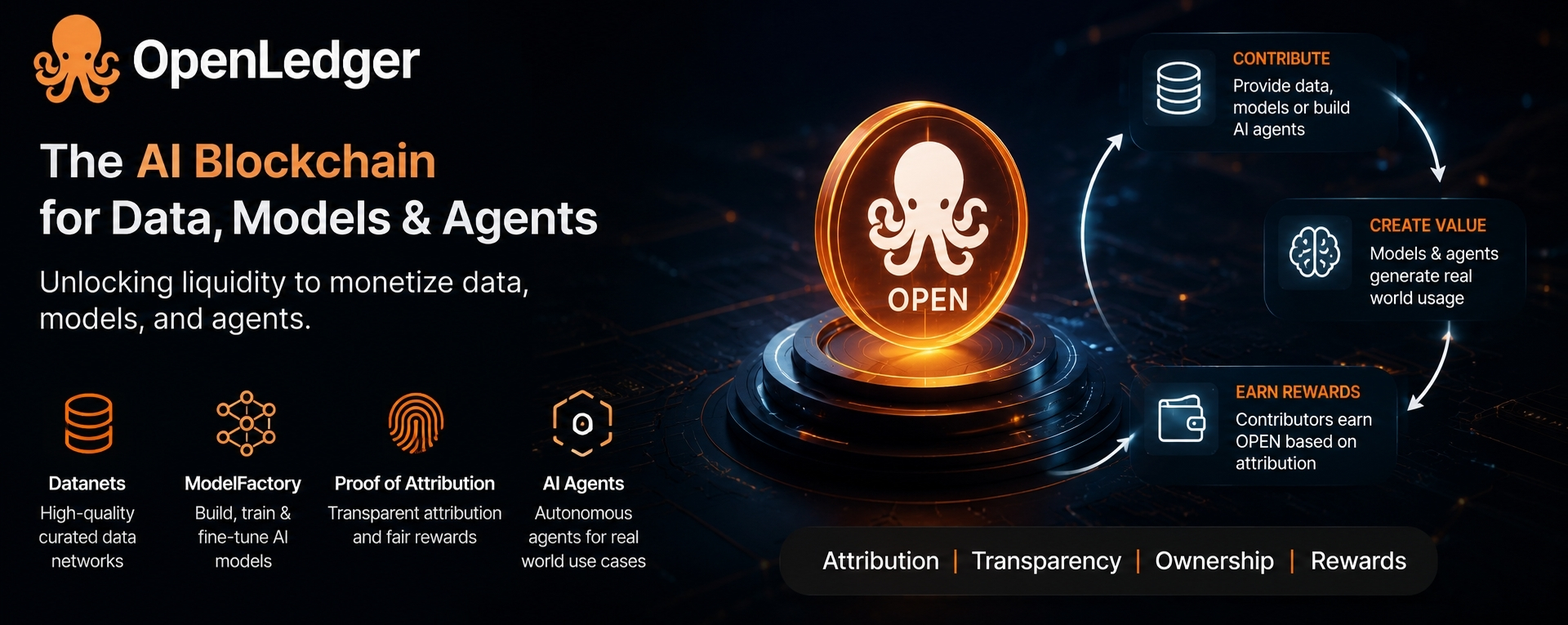
That is the part of OpenLedger that started to make sense to me. It is trying to create a system where data, models, and AI agents can be connected to ownership, usage, and rewards. Not just in a vague “users own their data” way, but through something more structured: Datanets, attribution, model training tools, staking, and the OPEN token.
Still, the project is easier to describe than it is to believe.
OpenLedger’s basic idea is that contributors should be rewarded when their data or models help create useful AI outputs. A person or community contributes data. That data becomes part of a Datanet. A model uses that Datanet for training or improvement. Later, if the model is used and creates value, the system tries to trace some of that value back to the original contributors.
On paper, that is a good loop.
In practice, every part of it raises questions.
The Datanet idea is probably the most understandable part. Instead of treating data as one giant pile, OpenLedger tries to organize it into focused networks around specific use cases. A Datanet could be built around finance, law, health, gaming, local languages, research, agent workflows, or any other area where specialized data matters.
I like this idea because useful AI usually depends on useful data. Not just more data. Better data. Data with context. Data that has been cleaned, checked, structured, and maintained by people who understand the topic.
That kind of work is usually ignored.
OpenLedger is trying to make it visible.
But this is also where the first problem appears. If people are rewarded for contributing data, many will contribute whatever they can. Some of it may be useful. Some of it may be copied, low quality, duplicated, scraped, or uploaded only because there is a reward attached. That is not a small issue. It is one of the main risks of the whole system.
A data network is only valuable if the data inside it is valuable. If Datanets become farming zones, where people upload content only to qualify for rewards, the quality of the system weakens from the bottom. A blockchain record does not make bad data useful. It only makes the bad contribution easier to trace.
That sounds harsh, but it matters.
OpenLedger talks about validation, reputation, attribution, penalties, and quality control. Those things are necessary. But saying they exist is not the same as proving they work under pressure. The real test will come when incentives are large enough for people to try gaming the system. That is when the design either holds or starts bending.
The most important part of OpenLedger is Proof of Attribution. It is also the part I am most careful with.
The idea is simple enough: if data helps a model, the contributor should receive credit. If the model later earns fees or creates usage, rewards should flow back according to contribution. This is the part that gives OpenLedger its moral argument. It is trying to fix the unfairness of AI systems that consume huge amounts of human-created value without giving much back.
I agree with the problem.
I am less sure about how clean the solution can be.
Attribution in AI is not like sending tokens from one wallet to another. A token transaction is clear. One address sends. Another receives. The amount is visible. The record is simple.
AI does not work that way.
When a model gives a good answer, what exactly caused it? Was it the original base model? The fine-tuning data? One specific example inside a dataset? A retrieval document? The prompt? A human evaluator? A cleaned data sample that removed noise? The system instruction? The model architecture?
Usually, it is many things at once.
That is why I do not think Proof of Attribution should be understood as some perfect truth machine. It is better to see it as an attempt to make contribution more measurable than it is today. That can still be valuable. Even imperfect attribution may be better than complete opacity.
But the difference matters.
Putting attribution records on-chain does not automatically make them fair. The fairness depends on how influence is measured before it reaches the chain. If that method is weak, biased, or too easy to manipulate, the blockchain only preserves the weakness more permanently.
This is where I would like to see OpenLedger become more concrete over time. Real examples would help. Not diagrams. Not broad explanations. Actual cases where a Datanet was used, a model was trained, usage happened, rewards were calculated, and outside observers could understand why the rewards went where they did.
That would make the project feel much more real.
The product side also matters more than the narrative. OpenLedger has ModelFactory, which is meant to make model creation and fine-tuning easier. This part is important because developers already have many tools. They are not sitting around waiting for a blockchain to give them permission to build AI products.
A builder can already use Hugging Face, OpenAI, Anthropic, Replicate, Together, cloud GPUs, LangChain, LlamaIndex, private datasets, and custom training pipelines. These workflows may be messy, but they exist. For OpenLedger to become useful, it has to offer something better than ideology.
It has to save time. Or reduce cost. Or provide better datasets. Or create a revenue stream. Or solve a compliance problem. Or make attribution and licensing easier in a way developers actually care about.
Fairness alone may not be enough to change behavior.
This is why the user experience is not a side issue. If ModelFactory feels simple, clear, and genuinely useful, OpenLedger becomes easier to take seriously. If it feels like a normal AI interface with token mechanics attached, then the project becomes much less convincing.
The same applies to non-technical users. If OpenLedger wants communities to contribute data, the onboarding has to be understandable. But if it becomes too easy to upload anything, quality may suffer. That balance is difficult. Good contribution should feel accessible, but not careless.
The token design creates another layer of complexity.
OPEN is used for fees, rewards, staking, governance, and network activity. That makes sense in the project’s internal economy. If the system works, contributors earn OPEN when their data or models are useful. Builders use OPEN to access services. Stakers help support the network. Governance uses OPEN to make decisions.
The clean version of this economy is attractive.
Useful data improves models. Better models attract usage. Usage creates fees. Fees reward contributors. Rewards attract better contributors. The loop strengthens.
But there is a weaker version too.
People contribute data because they expect rewards. Activity rises because users are farming. Staking becomes attractive because of yield. The token gets attention because of exchange listings and speculation. The ecosystem looks active, but the actual demand for AI models, Datanets, and agents remains thin.
That is the version OpenLedger has to avoid.
Many crypto projects struggle here. Incentives are useful at the beginning, but they can also create fake motion. The system can look alive because people are chasing rewards, not because the product has found real demand.
So when looking at OpenLedger, I would not focus too much on community size or short-term token activity. I would look at whether builders are using the system when they are not being pushed by campaigns. I would look at whether Datanets are maintained after the initial excitement fades. I would look at whether models built through OpenLedger are useful enough that someone wants to pay for them.
That is the difference between an ecosystem and a reward machine.
Staking is another part I have mixed feelings about. It gives token holders a way to participate, and it can help align people with the network. But I would want staking to connect directly to responsibility. If staking helps secure the network, validate attribution, support data quality, or punish harmful behavior, then it has a real role.
If it mostly exists to give holders yield, then it feels less connected to the AI side of the project.
That does not mean staking is bad. It just means the strongest version of OpenLedger would make staking part of the system’s trust and quality layer, not just a financial feature beside it.
One direction that feels more practical is OpenLedger’s focus on rights-aware AI and IP-related use cases. AI training has created serious questions around ownership, licensing, and payment. Creators and data owners often do not know when their work is being used. Developers also face uncertainty around what data they can safely train on.
If OpenLedger can help connect licensed data, model training, usage, and payments, that could become a real use case. This is one area where blockchain makes some sense: provenance, records, settlement, and multi-party coordination.
But even here, it is not simple. Rights have to be verified. Licenses have to be clear. Developers have to care enough to use compliant data instead of cheaper alternatives. The system has to be easier than ignoring the problem.
Still, this part of OpenLedger feels more grounded than broad talk about “decentralized AI.” It points to a specific pain point where traceability and payment flows may actually matter.
The community side is also important, maybe more important than people realize. OpenLedger’s community is not supposed to be only a group of token holders. In theory, it should include data contributors, model builders, curators, validators, agent developers, and governance participants.
That is a much higher standard than a normal crypto community.
If the community mostly talks about price, rewards, airdrops, and listings, then it may help attention but not the actual product. If people are discussing data quality, use cases, licensing, model performance, and real experiments, then the network becomes more interesting.
A project like this needs maintainers, not just followers.
That is not exciting language, but it is true. Datanets will not stay useful by themselves. Models will not improve by themselves. Attribution disputes will not resolve themselves. Communities need people who care about boring details.
The more I looked at OpenLedger, the more I felt that its future depends on boring details.
Not the grand AI narrative.
Boring things like dataset standards. Contribution rules. Quality review. Clear reward calculation. Useful documentation. Honest explanations of what is on-chain and what is off-chain. Builder support. Real model performance. Actual fee demand. Dispute handling. Governance that matters.
Those things will decide more than the slogan.
What feels real about OpenLedger is the problem. AI contribution is not rewarded well. Data provenance is messy. Specialized datasets are valuable. Model ownership is unclear. Communities need better ways to turn knowledge into economic value. OpenLedger is aimed at those issues, and that gives it a stronger foundation than many AI-token projects.
What still feels unresolved is the execution.
Can it measure contribution fairly enough?
Can it stop low-quality data from flooding Datanets?
Can it attract serious builders?
Can it make attribution understandable?
Can it create real demand for models and agents?
Can it avoid becoming mostly a token incentive loop?
Can governance become meaningful rather than decorative?
These questions are not small. They are the project.
I started out thinking OpenLedger might be mostly another AI narrative wrapped around a token. After looking closer, I think that was too simple. There is a serious idea here. The project is trying to build economic infrastructure for data and AI contribution, and that is worth paying attention to.
But I would still be careful.
OpenLedger is not proven just because the idea is good. A project can point at a real problem and still fail to solve it. In this case, the hardest parts are not the phrases on the website. They are the messy parts underneath: attribution, incentives, quality control, builder adoption, legal rights, and actual usage.
For now, I see OpenLedger as an interesting attempt at a difficult problem. Not empty. Not guaranteed. Somewhere in between.
It is trying to make AI contribution visible and payable.
That is a meaningful goal.
Whether the system can do that in a way people trust, use, and keep using is still the question.