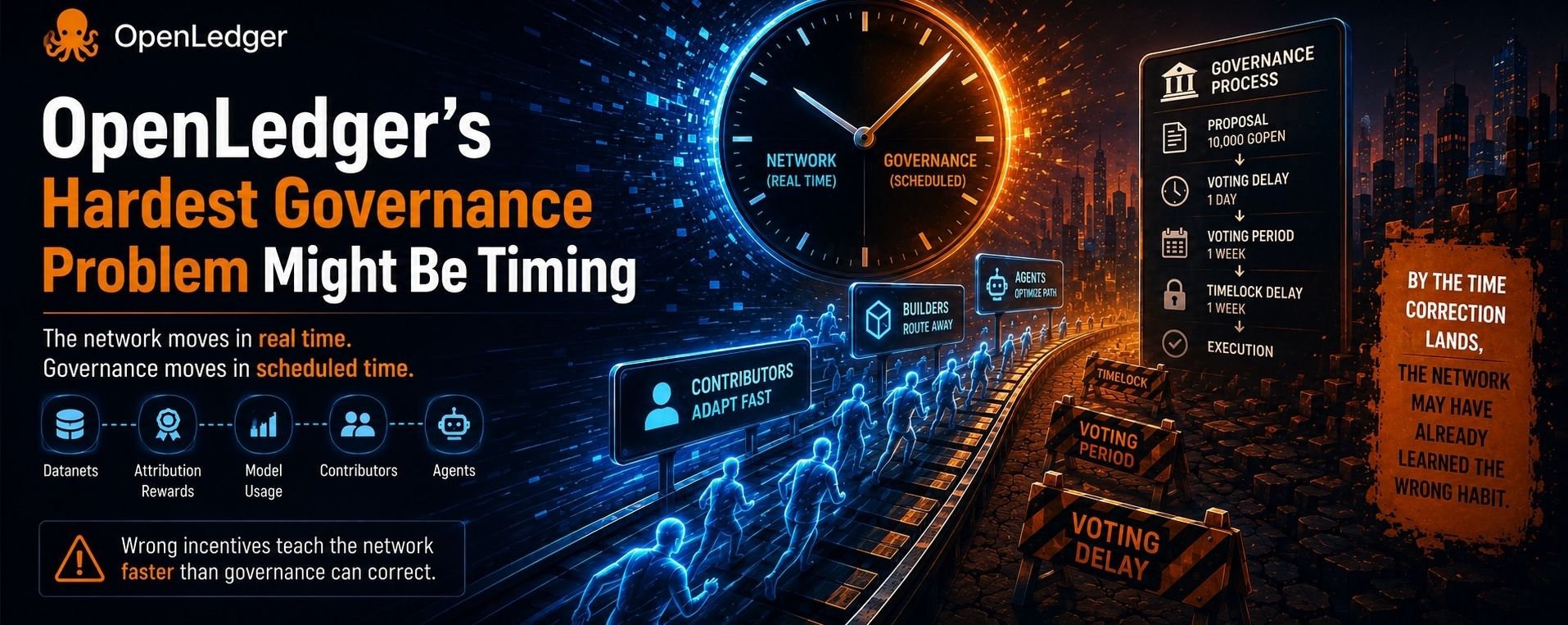
What keeps bothering me about @OpenLedger is not whether governance exists.
It’s whether governance can move fast enough for the kind of economy it is trying to control.
Because OpenLedger is not governing a static protocol. It is governing a live system where Datanets, attribution rewards, model usage, contributors, and agents are all reacting to incentives in real time.
And real-time systems do not wait for governance windows.
Imagine a Datanet slowly drifting toward the wrong incentives. Not obvious spam. Something worse. Data that is technically valid but shallow starts earning more often because it fits the current reward structure better. Contributors notice quickly. The easiest format begins outperforming the most useful one.
That is where the network starts teaching itself the wrong habit.
The dangerous part is how quietly this happens.
One contributor sees low-effort data clearing faster and sends more of it. Another stops contributing higher-quality material because it takes longer and pays less. Builders begin noticing that the most active Datanet no longer feels like the most trustworthy one. Agents route toward whatever source still looks economically efficient.
The behavior changes before governance even starts discussing the problem.
That is the mismatch I cannot stop thinking about.
On paper, OpenLedger governance looks responsible enough. Proposal thresholds. Voting periods. Timelocks. Structured delays. Everything designed to prevent reckless decisions.
But the network underneath those rules is moving on a completely different clock.
The economy reacts daily.
Governance reacts eventually.
And that gap matters more than people admit.
Because by the time a proposal moves through delays, voting windows, and execution periods, contributors have already adapted to the existing incentive structure. Builders have already rerouted workflows. Agents have already learned which economic path is rewarded most efficiently.
The correction arrives after the network behavior has already shifted.
That is why #OpenLedger becomes interesting in a very uncomfortable way.
Proof of Attribution makes influence visible. Datanets expose contribution patterns. ModelFactory accelerates deployment around whatever data economy currently exists. OpenLoRA makes specialization and switching faster. The stack increases transparency and speed at the same time.
Which means distortions become easier to see but they also spread faster.
A slow opaque system can hide its mistakes.
OpenLedger cannot.
If incentives drift in the wrong direction, the payout flows, attribution trails, and usage patterns expose the distortion in public. Everyone can watch the network learning the wrong lesson in real time while governance is still moving through formal procedure.
And the most dangerous version of this problem is not a dramatic exploit.
It is a quiet economic bend.
Low-value data earning slightly too much.
High-effort contributors slowly disengaging.
Builders trusting active Datanets less over time.
Agents optimizing for cheaper behavior instead of better behavior.
Nothing catastrophic enough for emergency intervention.
Just enough to slowly retrain the ecosystem around weaker incentives.
That kind of damage compounds quietly.
Because users adapt faster than governance reacts.
A contributor who feels underpaid today will not wait two weeks for a proposal to maybe fix the issue. They either leave, reduce effort, or optimize for the metric instead of the outcome. Builders do the same thing. Agents do too.
The network keeps moving while governance is still organizing the meeting.
That is the part many governance systems misunderstand. The vote is usually not the center of the organism.
Behavior is.
Behavior teaches the lesson first.
Governance often arrives later to formalize it.
And OpenLedger makes this tension more visible than most systems because the entire stack is designed around attribution, incentives, and live AI economics.
Which leads to the uncomfortable question underneath all of this:
If the network starts learning the wrong habit on Monday, can governance realistically correct it before contributors, builders, and agents have already adapted by Tuesday?
Because if the answer is no, then governance stops looking like the steering wheel.
It starts looking like documentation written after the turn already happened.