I’ve started trusting quieter technology more than ambitious technology.
Not because quieter systems are always better, but because the loudest products usually spend too much energy convincing people they are revolutionary before proving they can survive ordinary use. The tools that actually last tend to behave differently. They fade into routine. They reduce friction without constantly reminding you they exist.
That is probably why OpenLedger keeps sitting somewhere in the back of my mind.
At first glance, it sounds like another familiar Web3 promise wrapped around AI infrastructure. An “AI blockchain.” A liquidity layer for data, models, and agents. A system built around something it calls Proof of Attribution, where contributions can supposedly be tracked, verified, and rewarded instead of disappearing into opaque machine pipelines.
I’ve heard variations of that idea before.
Every market cycle eventually produces projects that promise to fix ownership on the internet. Sometimes it is creator economies. Sometimes decentralized storage. Sometimes data marketplaces. Now it is AI contribution itself. The language changes, but the emotional core usually stays the same: people want proof that the systems extracting value from them are capable of giving something back.
Most of those projects struggle once theory collides with behavior.
That is partly why I’ve been watching OpenLedger with a mixture of curiosity and distance instead of excitement. I’m old enough in crypto terms to know that elegant architecture means very little if the surrounding incentives begin attracting the wrong type of activity. Markets rarely break because the technical vision is impossible. They break because users optimize around rewards faster than teams optimize around quality.
Still, OpenLedger feels slightly more grounded than many AI-crypto projects I’ve looked at recently.
There is at least an attempt to build visible infrastructure around the narrative instead of relying entirely on speculation. AI Studio, ecosystem tooling, builder programs, live AI agent products, attribution systems tied to datasets and models — these are tangible surfaces, even if they are still early. The partnership discussions around Trust Wallet also caught my attention more than price action ever could. I’ve learned to pay closer attention to product integrations than social sentiment. Narratives are cheap in this industry. Operational relationships are harder to manufacture.
But I also think the timing matters.
OpenLedger no longer feels like a fresh launch living entirely on optimism. It feels like a project entering the more difficult stage where users begin asking uncomfortable questions. Not just “what could this become?” but “what does this actually feel like to use over time?”
That distinction changes everything.
Because retention in crypto is rarely about technology alone. People stay where systems make them feel visible, useful, or economically relevant. And they leave the moment participation begins feeling extractive or performative.
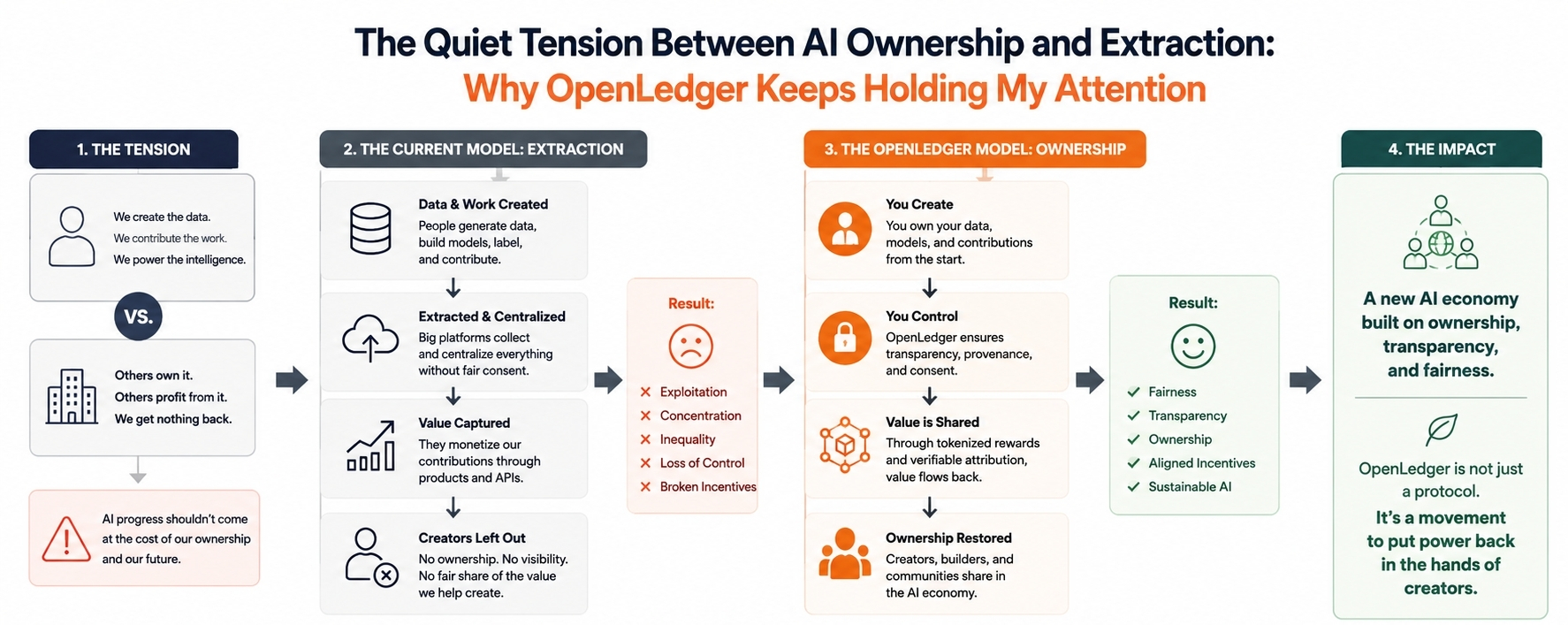
OpenLedger is attempting something psychologically interesting here. It is trying to convince users that their contributions to AI systems — data, behavior, models, interactions — should remain traceable instead of dissolving into black-box infrastructure. There is something emotionally compelling about that idea because modern AI increasingly feels detached from the humans feeding it. Most people contribute constantly to digital systems while receiving almost no visibility into how that value circulates afterward.
OpenLedger seems to recognize that tension.
The problem is that recognition alone does not solve anything.
A system designed to reward contribution can still become transactional in the worst ways. Attribution can become bureaucracy. Incentives can distort behavior. Communities built around fairness can quietly evolve into economies dominated by optimization and farming. I’ve seen enough token ecosystems to know how quickly idealism changes once liquidity becomes the center of gravity.
That is where my uncertainty sits.
I can understand the appeal of OpenLedger’s vision without fully believing the model has escaped the deeper patterns that damage most crypto infrastructure over time. The market eventually pressures every project into proving whether users genuinely value the product itself or simply the possibility of financial upside attached to it.
And honestly, I’m not sure anyone knows the answer yet.
The AI sector is already moving toward extraction at massive scale. Web3 keeps trying to respond with ownership, transparency, and incentive alignment. OpenLedger exists somewhere in between those two forces. Not fully infrastructure. Not fully ideology. More like an experiment asking whether AI systems can become economically accountable to the people feeding them.
Maybe they can.
Or maybe the industry simply keeps reinventing new ways to package the same imbalance.
I can’t tell yet.
That uncertainty is probably why I keep coming back to the project in the first place. Not because I’m convinced, but because I’m still trying to figure out whether this becomes real infrastructure or just another intelligent narrative built for a market that desperately wants to believe contribution still matters.