
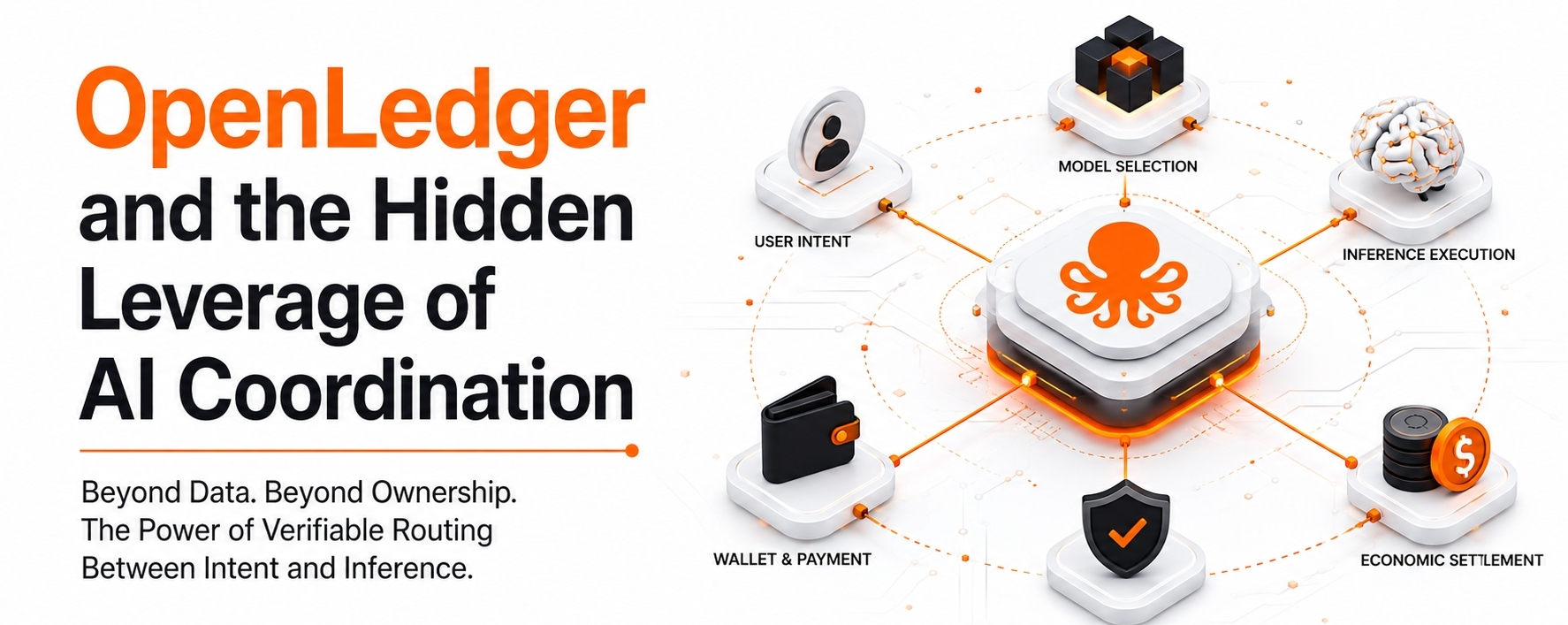

I started noticing that the conversation around AI data was quietly changing. People still talked about datasets constantly but the behavior underneath felt different. The attention was no longer fully on who owned the data. It started drifting toward who controlled the path between demand and execution.
That distinction matters more than it sounds. At first most AI networks treated data contribution as the core economic layer. Upload enough useful information and eventually value flows back to contributors. Simple idea. Very crypto native. Open participation creates open ownership.
But after watching OpenLedger more closely, I think the more important layer may sit somewhere else entirely.
The real asymmetry might not be between contributors and non contributors. It might exist between people supplying data and the entities controlling verifiable routing between user intent and inference itself.
I keep thinking about that. Because once AI interactions move on chain, routing stops being invisible infrastructure. It becomes part of the economic system. Someone decides which model handles a request. Someone coordinates how inference is verified. Someone captures the flow connecting wallets, applications, agents, and compute.
Inside OpenLedger, this coordination layer feels more important every time I revisit the architecture.
Most people still focus on the visible side of the network. Contributor rewards. Dataset uploads. AI models becoming liquid assets. Those are easier to understand because the incentives are direct. Upload data. Earn attribution. Potentially receive future inference revenue.
But infrastructure tends to accumulate power quietly.
OpenLedger’s blockchain design seems built around this idea that AI participation itself needs verifiable coordination. Not just ownership records. Actual economic routing between intent and execution. That is where things start becoming interesting.
Especially because AI markets are moving toward agent-driven behavior faster than many expected.
Agents do not just need data. They need access to inference. They need wallet connectivity. Smart contract integration. Payment coordination. Reputation systems. Model selection. In many cases they need routing logic deciding which model processes which intent under which economic conditions.
That routing layer eventually becomes valuable on its own.
I think this is why OpenLedger feels structurally different from projects simply tokenizing datasets and calling it decentralization. The network appears more focused on creating an environment where AI interactions themselves become economically trackable and coordinated on-chain. That changes who captures value over time.
Data contributors still matter of course. Without useful data, the network weakens immediately. But history usually shows that infrastructure controlling flow often captures more durable leverage than raw supply alone.
You can already see early versions of this across crypto itself.
Liquidity providers matter. But routing layers became massive businesses. Validators matter. But execution flow and coordination layers accumulated enormous influence around them. I suspect AI networks may evolve similarly.
OpenLedger seems positioned directly inside that transition.
What makes this more complicated is that most users probably do not care about routing at all right now. They care about rewards. Airdrops. Participation incentives. Quick monetization. Even many contributors uploading datasets are probably optimizing around emissions instead of long term inference demand.
I do not even say that critically. Incentives shape behavior everywhere.
Still I wonder what happens later if a small number of entities become dominant coordinators between AI demand and model execution inside these networks. Open systems often start decentralized at the edges while coordination slowly centralizes underneath. That risk feels very real to me.
OpenLedger’s incentive structure tries to balance this by keeping participation economically visible across the network. Attribution matters. Wallet linked ownership matters. Verifiable contribution records matter. Ethereum compatibility matters too because identity, liquidity, and contract coordination already exist there naturally.
But sustainable decentralization is harder than early architectures make it appear.
I also question whether contributors fully understand what they are actually building toward. Many still think in terms of immediate rewards for uploading data. Yet the longer-term value inside OpenLedger may eventually sit in controlling inference pathways, agent coordination, and economic routing logic.
That is a completely different layer of ownership.
And honestly, I am not sure the market has fully priced that distinction yet.
There is also the speculation problem hanging over everything related to AI right now. AI narratives move so fast that infrastructure discussions often get flattened into token excitement. Sometimes it becomes difficult to separate genuine long term coordination systems from short-term market storytelling.
OpenLedger survives that scrutiny better than most projects I have looked at because the architecture feels tied to actual network behavior not just surface narratives around autonomous AI.
Still sustainability remains an open question.
Can data quality truly hold up when incentives scale? Can routing remain decentralized once inference demand becomes economically meaningful? Will contributors capture enough long term value to stay aligned with the network? Or does coordination power naturally compress toward whoever controls execution flow most efficiently?
I do not think those questions have clean answers yet.
But I keep returning to the same thought every time I study OpenLedger deeper. Maybe the real value inside these AI economies was never only about owning the data itself.
Maybe it was always about owning the verified pathways connecting human intent, model execution, and economic settlement together.
And if that is true, then OpenLedger may be arriving at a very strange moment. Early enough that most people still see data rewards on the surface but not yet late enough to recognize where coordination power might eventually settle underneath.