
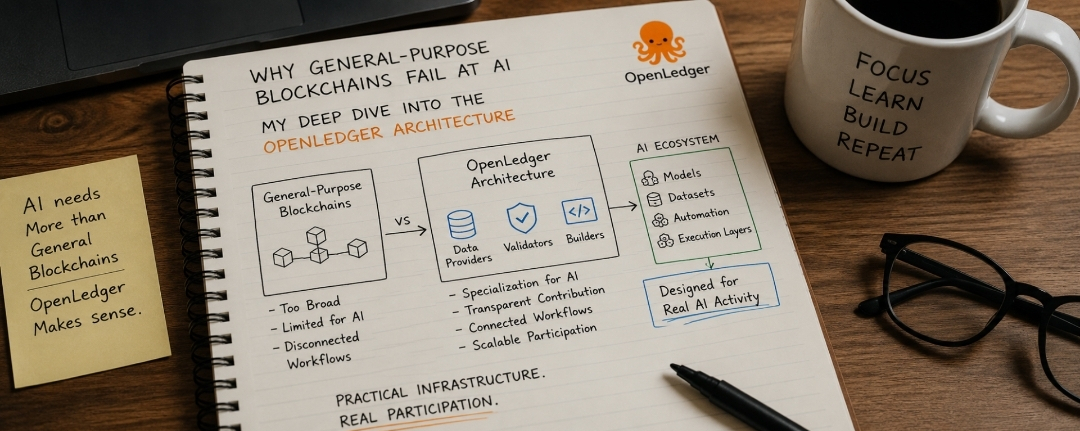

I was reading about different AI and blockchain systems late at night when one thought suddenly stayed in my mind. I remember putting my phone down for a minute and honestly wondering why so many general purpose blockchains keep talking about AI while still feeling disconnected from how AI actually works in real life.
That question stayed with me much longer than I expected.
Most blockchain networks today are designed to support many different kinds of activity at once. Payments and NFTs and gaming and smart contracts all exist inside the same environment. At first I thought that flexibility sounded impressive. But the deeper I looked into AI systems the more I realized they usually need much more specialized infrastructure than general blockchains are built for.
That started making more sense to me over time.
AI models depend on constant data movement and coordination and automation. They need systems that can process activity efficiently while also tracking contributions and workflows clearly. A lot of general purpose chains feel too broad because they are trying to support everything equally instead of focusing on what AI ecosystems specifically need.
After a while many of those systems started feeling disconnected from practical AI activity to me.
That is why OpenLedger stood out differently in my mind.
I came across the project while randomly reading about AI infrastructure one evening and somehow ended up spending hours exploring the architecture. What genuinely interested me was how the ecosystem seemed designed around AI participation itself instead of simply attaching AI language onto a traditional blockchain structure.
That difference honestly felt refreshing.
One thing I noticed quickly was the focus on transparent contribution systems and connected workflows. Instead of treating AI like a separate layer added afterward the architecture seems more focused on how data providers and validators and builders interact inside the same environment.
That gave the whole system a clearer direction in my opinion.
I think many blockchain ecosystems struggle with AI because they still treat it like another application category instead of understanding how demanding AI systems actually become over time. AI models constantly rely on datasets and automation layers and execution systems all working together smoothly.
General purpose chains often feel too generic for that level of coordination.
The more I read about OpenLedger the more it felt focused on infrastructure connected specifically to those interactions. The architecture appears designed around visibility and attribution and scalable AI participation instead of only transaction speed or temporary narratives.
Personally that approach feels more realistic to me.
I also found the workflow discussions surprisingly interesting because they connect directly to how AI economies might actually function later. Builders create models and applications. Contributors provide information and activity. Validators secure the environment. Researchers improve systems and execution logic.
I kept thinking about how many ecosystems still fail to connect those layers properly.
OpenLedger seems more aware of that issue. The platform feels structured around participation between different roles instead of separating every part of the system into isolated activity.
That creates a more connected feeling overall.
Another thing I personally liked was how the architecture discussions often focus on usability instead of only technical marketing. I have noticed that a lot of blockchain projects become obsessed with performance numbers while forgetting that systems only grow if developers and communities can comfortably work inside them.
OpenLedger feels more focused on balancing infrastructure with practical participation.
I also think AI completely changes scalability requirements. General purpose chains were never originally built around massive AI driven coordination and continuous data activity. As AI ecosystems expand the infrastructure underneath them probably needs to become more specialized and adaptive too.
That is where OpenLedger started making much more sense to me personally.
The architecture feels connected to long term AI activity instead of only temporary blockchain excitement. Conversations around attribution and automation and execution layers all feel tied to practical system behavior instead of disconnected concepts.
That gives the project more realism in my eyes.
I noticed something else too while reading about the platform. A lot of AI blockchain discussions today still sound extremely abstract. Projects constantly mention agents and automation but rarely explain how those systems actually operate inside a functioning economy.
OpenLedger seems more focused on showing those relationships clearly.
I think that matters because people eventually stop trusting ecosystems that only rely on narratives without practical structure underneath them. The projects that survive longer are usually the ones that explain how value and participation actually move through the system.
Personally I think OpenLedger understands that better than many projects right now.
The market around AI related blockchain systems has also become more active again recently. Community discussions feel stronger compared to earlier months and infrastructure focused ecosystems are receiving more attention across crypto conversations. OpenLedger has also been appearing more often inside AI blockchain discussions lately. Price movement across the sector has been positive overall although activity still slows down during uncertain periods.
Nothing feels completely stable yet and sentiment still changes quickly. That part honestly feels normal in crypto now.
Even with that uncertainty I think specialized AI infrastructure may become more important over time than broad blockchain systems trying to support every trend equally. AI economies will probably require stronger coordination and clearer participation models as adoption grows.
That is where OpenLedger keeps standing out to me personally.
I do not look at the project as some guaranteed future leader because this space still changes constantly and many ecosystems are experimenting with similar ideas. But I genuinely think OpenLedger feels more connected to how real AI driven systems may actually function later instead of simply reacting to temporary narratives.
After spending time exploring the architecture I mostly came away feeling thoughtful instead of overly excited. In a market where many projects still feel directionless it honestly feels refreshing to see a platform trying to build around practical AI coordination and transparent participation from the beginning.