
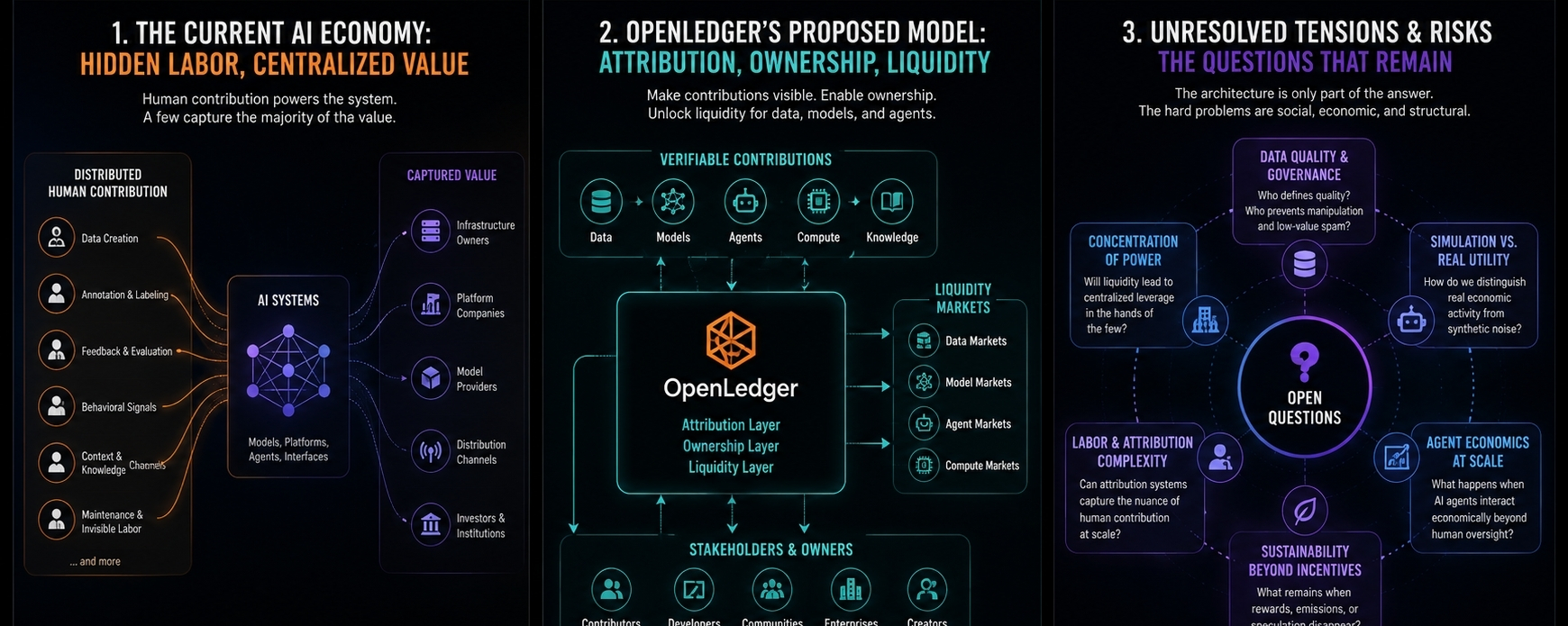

I have spent enough time around crypto to recognize how quickly a compelling narrative can become a substitute for actual utility. Every cycle seems to produce a new language for the same underlying promise: participation will finally become ownership, contribution will finally become compensation, and the invisible labor powering digital systems will finally be acknowledged instead of extracted quietly in the background. The vocabulary changes. The architecture changes. The marketing becomes cleaner, more sophisticated, more psychologically aware. But the underlying tension rarely disappears.
What interests me is how often crypto confuses motion for progress.
A network becomes active before it becomes useful. A token becomes liquid before the system it represents has proven durable. Communities form around speculative alignment long before there is evidence that coordination itself can survive outside incentive emissions. I have seen this before. Repeatedly. The surface layer always looks alive. Dashboards move. Wallets grow. Partnerships accumulate. Narratives harden into consensus with surprising speed. But underneath that activity there is often a quieter question nobody wants to sit with for very long: what real problem continues existing once the rewards disappear?
I keep coming back to that question when I look at projects trying to merge AI infrastructure with crypto economics, because the space is now saturated with a very specific kind of optimism — the belief that intelligence itself can become a financial primitive. Data becomes an asset. Models become markets. Agents become autonomous economic actors. Everything becomes monetizable. Even attention begins to resemble labor.
And this is where OpenLedger starts becoming interesting to me.
Not because I think it has solved the problem. I do not fully trust it. But because it appears to be circling a real structural tension that the broader AI industry still has not resolved: who actually captures the value created by machine intelligence, and who quietly disappears beneath the abstraction layer while that value compounds elsewhere?
Most AI systems today are built on hidden asymmetries. Massive quantities of human contribution become compressed into datasets, behavioral signals, annotation layers, and invisible maintenance work that rarely receives proportional attribution or ownership. The output feels magical because the labor becomes illegible. That illegibility is economically useful. It allows the system to appear autonomous while remaining deeply dependent on distributed human input.
Crypto, for all its flaws, has always been obsessed with attribution.
Sometimes obsessively so.
Wallets, signatures, provenance, contribution tracking, distributed incentives — the entire architecture emerged from a distrust of centralized accounting. From my view, that is partly why AI and crypto continue gravitating toward each other despite the enormous amount of noise surrounding both industries. They are both trying, in very different ways, to answer questions about coordination, ownership, and value extraction in large distributed systems.
OpenLedger seems to position itself inside that overlap.
The idea of unlocking liquidity around data, models, and agents sounds compelling at first glance, but I think the more important question is not whether those assets can become liquid. Nearly everything becomes liquid eventually. The deeper question is whether liquidity improves the underlying system or merely accelerates speculation around it. Crypto has a long history of financializing immature infrastructure before proving that the infrastructure itself deserves permanence.
The more I sit with it, the more cautious I become around phrases like “AI economy” or “agentic markets,” because they often flatten difficult social realities into elegant technical abstractions. Coordination problems become token models. Human trust becomes protocol design. Governance becomes interface theater. Complex labor relations become incentive diagrams.
Reality is rarely that clean.
I respect the attempt more than I trust the outcome.
Because I can also see the unresolved contradictions hiding beneath the surface. If data becomes monetized at scale, who determines quality? If models become tradable assets, how do we prevent recursive extraction where only large participants accumulate meaningful leverage? If AI agents begin interacting economically on-chain, what happens when the volume of synthetic activity overwhelms actual human usefulness? Crypto already struggles with distinguishing participation from simulation. AI may intensify that problem dramatically.
And yet I still pay attention.
That is the uncomfortable part.
Not because I am convinced these systems work, but because the underlying pressures producing them are real. The current AI landscape already feels economically unbalanced. A small number of companies control infrastructure, compute, distribution, and increasingly the interfaces through which intelligence itself is accessed. Meanwhile the people generating data, feedback, behavioral refinement, and contextual knowledge remain fragmented and structurally weak.
Something eventually pushes back against that imbalance.
Maybe it becomes decentralized infrastructure. Maybe it becomes regulation. Maybe it becomes open-source coordination. Maybe most of these crypto-AI experiments fail completely and still influence the next generation of systems indirectly. I do not know.
That uncertainty matters.
I think too much crypto writing pretends inevitability where there is only experimentation. Every new architecture gets framed as historical destiny. Every protocol becomes “the future.” Every infrastructure layer becomes foundational before it survives contact with time. But durability is rarer than innovation. Sustainability is rarer than attention.
What interests me about OpenLedger is not whether it becomes dominant. I suspect most projects will not. What interests me is the broader recognition embedded inside the attempt itself — the recognition that AI systems are not just technical systems. They are economic systems. Social systems. Attribution systems. Power systems.
And once you start viewing them that way, the conversation changes.
The polished demos matter less. The throughput numbers matter less. Even the models themselves begin to matter less than the surrounding incentive architecture. Who owns the outputs? Who captures the upside? Who remains replaceable? Who becomes infrastructure for someone else’s abstraction layer?
I have seen crypto repeatedly underestimate how difficult those questions become in practice.
But I have also seen traditional technology systems avoid them entirely.
So I watch projects like OpenLedger with a certain guarded curiosity. Not admiration. Not cynicism either. Something quieter than both. The feeling that there may be a real unresolved problem hiding underneath an excessive amount of narrative inflation.
And sometimes that distinction matters more than people realize.