
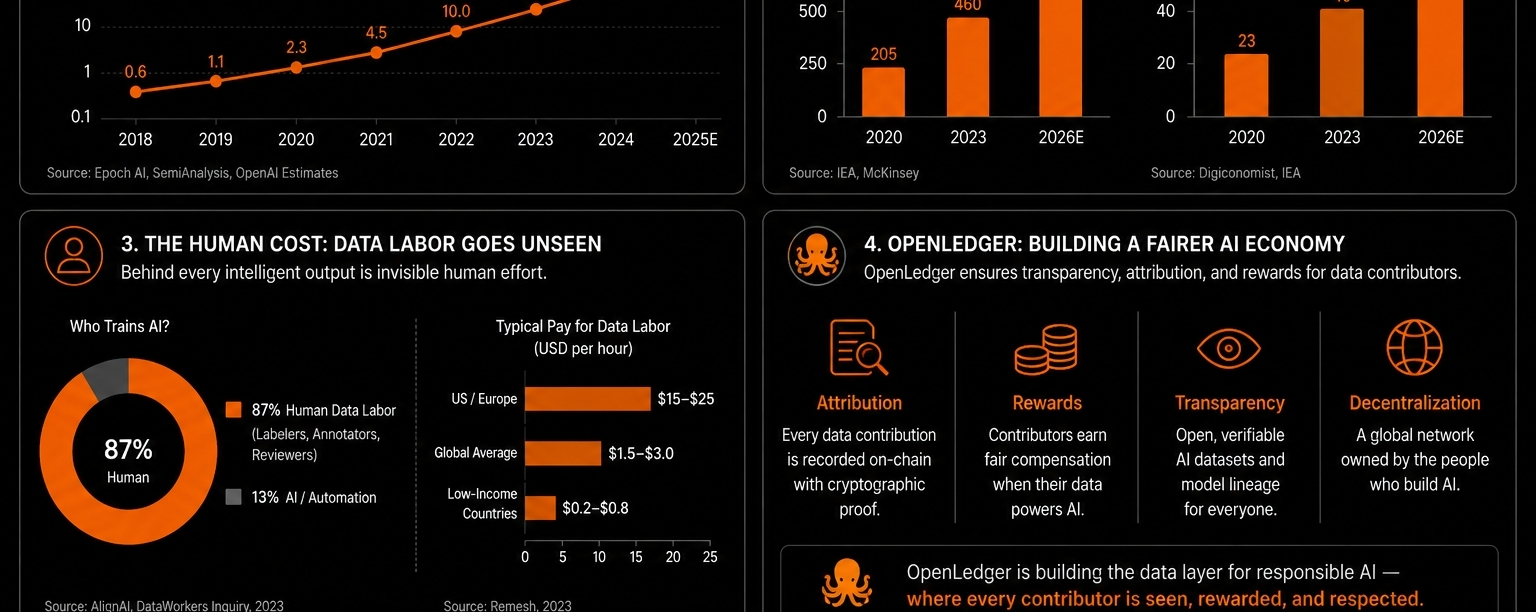
OpenLedger has been sitting in the back of my mind for a while now, mostly because it feels less like a shiny AI project and more like a quiet reaction to something people are slowly becoming uncomfortable with.
Not uncomfortable enough to stop using the systems, obviously. People rarely stop using convenient systems. But uncomfortable in the way you notice small cracks forming beneath an industry that keeps insisting everything is evolving exactly as planned.
The strange thing about AI right now is how casually the world talks about intelligence as if it appeared out of nowhere. Every company talks about breakthroughs, acceleration, scale, agents, reasoning, autonomy. But very few people stop long enough to acknowledge the enormous amount of human residue underneath all of it. That’s really what modern AI feels like sometimes. Human residue collected at industrial scale.
Millions of tiny invisible contributions scattered across the internet over years, slowly absorbed into systems that now feel detached from the people who fed them.
OpenLedger seems built around that irritation more than around the technology itself.
And honestly, I think that’s why it keeps drawing attention back toward it.
Because the problem underneath it is real.
The internet has always had this habit of separating contribution from ownership. Social platforms turned people into unpaid content machines long before AI arrived. Communities built value while platforms accumulated leverage. People generated culture while systems quietly monetized the environment around them. Most users accepted it because participation felt free, or fun, or useful enough to ignore the imbalance.
AI just intensified the pattern until it became impossible not to notice anymore.
Now intelligence itself is becoming centralized around infrastructure most people don’t control, built partly from data most people never realized they were contributing. There’s something deeply strange about that once you sit with it long enough.
And crypto, for all its flaws, has always been unusually sensitive to these kinds of imbalances. Sometimes too sensitive. The industry sees extraction everywhere because extraction has basically shaped its worldview from the beginning. That paranoia occasionally becomes exhausting, but every now and then it points toward something real before the rest of the market catches up.
OpenLedger feels like one of those moments where the frustration actually makes sense.
Not because the project has magically solved anything yet. Most infrastructure projects look cleaner before real usage arrives. Reality tends to introduce behavior nobody accounted for in the early diagrams. But the instinct behind OpenLedger feels connected to a real pressure building underneath the AI economy.
Who owns intelligence once intelligence becomes collective?
Not philosophically. Economically.
That question is starting to matter now.
A year or two ago people mostly cared about whether models worked. Now the conversation is shifting toward who controls the pipelines, who owns the data, who captures the value, who becomes dependent on whom once AI systems turn into infrastructure instead of novelty.
The atmosphere around AI has changed fast. You can feel it.
At first it felt experimental and open. Now it feels territorial. Companies are racing to secure datasets, distribution, compute access, interfaces, ecosystems. Everyone talks about openness publicly while quietly building walls underneath the surface.
That contradiction keeps getting harder to ignore.
And maybe that’s why projects like OpenLedger keep emerging. Because the industry itself seems increasingly aware that intelligence markets are forming before ownership structures around them have been figured out properly.
Still, there’s a part of this entire space that feels messy in a way people don’t fully discuss enough.
The second financial incentives touch open systems, behavior changes immediately.
Not eventually. Immediately.
Crypto already learned this the hard way over and over again. Communities become engagement farms. Governance becomes theater. Participation becomes optimized for rewards instead of meaning. People learn to simulate authenticity because authenticity itself becomes economically useful.
There’s no reason AI ecosystems would avoid the same gravity.
If data becomes monetizable, people will mass-produce low-quality synthetic contributions pretending to be useful.
If agents become assets, ecosystems will flood with automated noise disguised as productivity.
If reputation systems emerge, entire industries will appear around manipulating reputation systems.
That’s what humans do inside incentive structures. We optimize them until the original purpose starts bending under the weight of the optimization itself.
And honestly, that’s the part I keep wondering about with OpenLedger.
Not whether the vision sounds compelling. Most visions sound compelling in this market.
The real question is whether systems built around intelligence ownership can survive contact with real human behavior once scale arrives.
Because scale changes everything.
Small communities behave one way. Financial ecosystems behave another.
The internet already struggles with fake engagement before attaching direct liquidity to intelligence coordination. Once money starts flowing through contribution systems, distortion becomes inevitable. Some of it subtle. Some of it overwhelming.
The strange thing is I don’t even think OpenLedger ignores this tension. If anything, the project feels like it emerged directly from observing how unsustainable current structures already are.
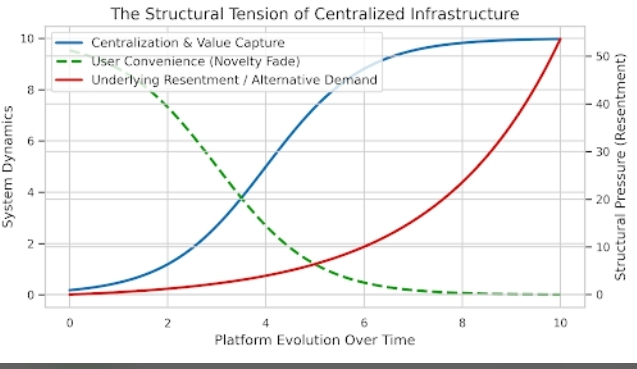
Right now the AI economy depends heavily on centralized ownership sitting on top of decentralized contribution. That imbalance probably works during rapid growth phases because convenience hides structural issues for a while. But eventually concentration creates pressure beneath itself.
History repeats that pattern constantly.
Platforms centralize.
Users become dependent.
Value accumulates upward.
Resentment builds quietly underneath.
Then alternative systems start appearing around the edges.
A few survive long enough to force structural changes.
OpenLedger feels connected to that cycle more than to pure AI hype. Less like a futuristic fantasy and more like an attempt to respond to a pressure that already exists.
And honestly, the timing makes sense.
The market is slowly realizing models alone are probably not the final moat anymore. Intelligence is becoming more abundant. Open-source keeps catching up faster than expected. Smaller teams reproduce capabilities that once looked impossible to replicate outside giant corporations. So naturally the focus starts shifting elsewhere
Toward unique datasets and ecosystems instead of isolated models.
That’s where projects like OpenLedger start becoming interesting, even if skepticism remains necessary.
Because skepticism absolutely should remain necessary here.
Crypto has a long history of identifying legitimate problems while building unstable solutions around them. Sometimes the diagnosis is accurate but the infrastructure collapses under incentives, governance issues, speculation, or simple human exhaustion.
And AI makes all of this even harder because intelligence itself is difficult to measure cleanly.
What counts as meaningful contribution?
Who decides what data matters more?
How do you prevent synthetic behavior from overwhelming authentic participation?
How do decentralized systems avoid slowly centralizing anyway once power and capital accumulate?
These are not small problems. They’re structural problems.
But maybe that’s exactly why OpenLedger keeps lingering in conversations despite the noise surrounding AI projects lately. It feels rooted in a genuine irritation people can already feel forming around the future of AI ownership.
Not everybody can articulate it yet.
But people sense it.
The sense that modern intelligence systems are becoming economically enormous while remaining strangely disconnected from the collective human activity feeding them.
The sense that contributors remain replaceable while infrastructure owners become indispensable.
The sense that openness gets celebrated culturally while control consolidates financially.
Those tensions are real enough that projects attempting to address them will probably keep emerging regardless of whether any single one succeeds completely.
Because the deeper issue is not disappearing.
If anything, it’s accelerating.
And that’s probably the most interesting thing about OpenLedger right now. Not the branding. Not the AI narrative. Not the blockchain layer.
Just the fact that it exists at all feels like evidence that the internet is starting to argue with itself again over who actually owns the value being created inside these systems.