

OpenLedger made me stop and think differently about what we are actually trying to build in this industry.
Not because of the hype. Not because of the token price or the roadmap slides. But because somewhere in the middle of reading about what it is attempting to do, I realized I had been thinking about the AI and blockchain space the wrong way. Most of us have.
Let me explain what I mean.
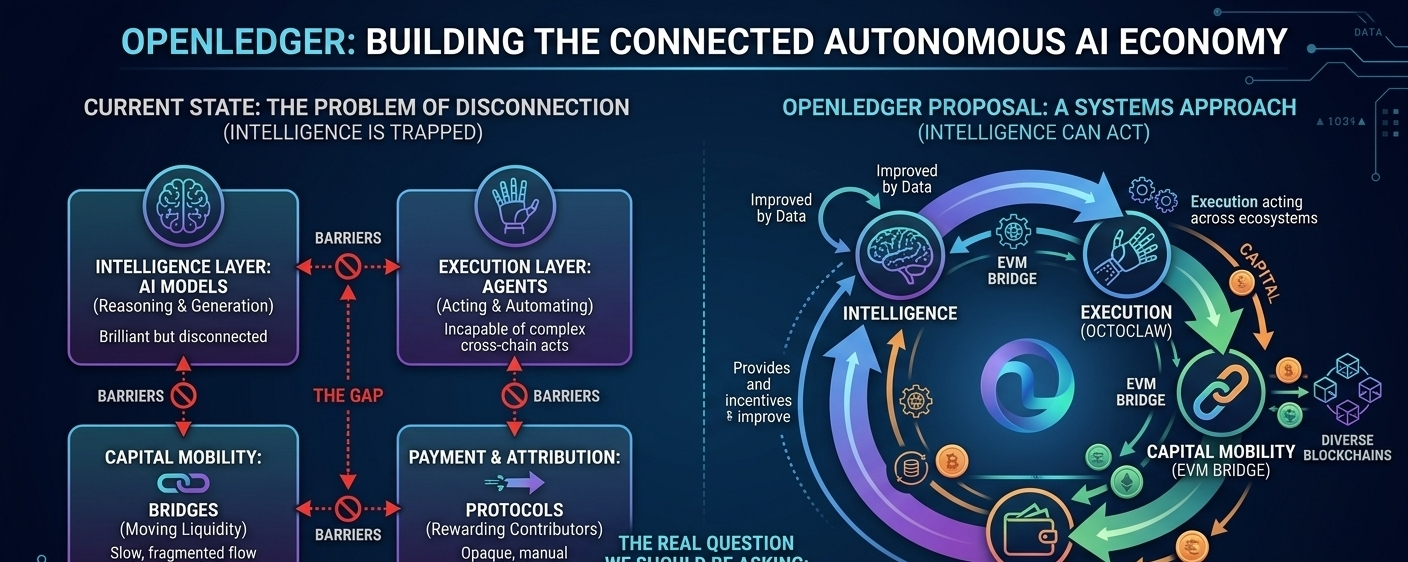
For years, the conversation in crypto has been about ownership. Who owns the data. Who controls the network. Who gets the rewards. And those are real questions worth asking. But there is a quieter problem underneath all of that, one that rarely gets the attention it deserves. The problem of connection. Not just connecting blockchains. Not just connecting wallets. But connecting intelligence, execution, capital, and value into something that actually functions as a whole system.
Right now, those four things live in completely separate worlds. You have AI models that can reason and generate. You have agents that can act and automate. You have bridges that move liquidity between chains. And you have protocols trying to figure out how to reward contributors in an AI-driven economy. Each of these is genuinely interesting on its own. But none of them talk to each other in a meaningful way. And I think that gap is more important than most people realize.
Think about it in human terms. Imagine hiring the smartest analyst in the world, someone who can research, reason, and produce brilliant output. But they cannot open a browser. They cannot move money. They cannot get paid for their work without three different intermediaries taking a cut. How useful is that intelligence, really? It is trapped. Brilliant but disconnected.
This is more or less where autonomous AI systems are today. The intelligence layer has matured faster than everything around it. And so now we have these incredibly capable models sitting on top of infrastructure that was never designed to support them as economic actors.
What OpenLedger appears to be working toward is building those missing connections. The execution layer, which they call OctoClaw, is not just automation for the sake of automation. It is the idea that an intelligent system should be able to act in the world, not just respond to prompts. The EVM bridge is not just about moving tokens. It is about giving these agents the financial mobility they would need to actually function across ecosystems. And the payment and attribution layer is perhaps the most philosophically interesting piece, because it raises a question we have not fully answered yet. When an AI system creates real economic value, who should receive that value, and how should it be tracked in a way that is transparent and verifiable?
These are not small questions. And I do not think they have obvious answers.
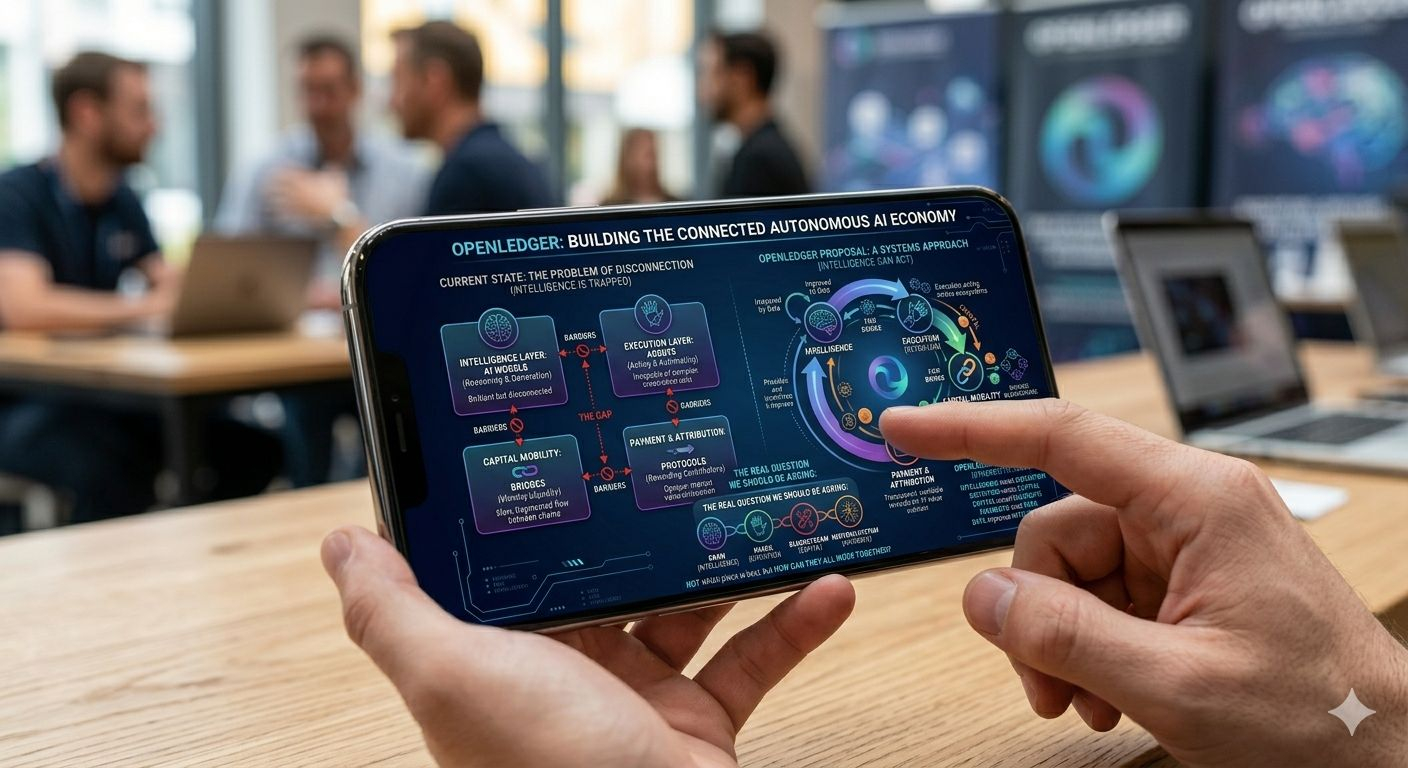
What makes OpenLedger worth watching is that it seems to understand this is a systems problem, not a product problem. You cannot solve it by building one excellent component. The intelligence needs the execution. The execution needs the capital mobility. The capital mobility needs the payment rails. The payment rails need better data. Better data improves the intelligence. It is a loop, and the loop only becomes powerful when every part of it is functioning.
That is also, honestly, where my uncertainty lives. Building one layer well is hard. Building four layers simultaneously and making them reinforce each other is an entirely different kind of challenge. History in this space is full of ambitious projects that solved one piece beautifully and then struggled when the adjacent pieces did not develop at the same pace. The vision can be coherent and still fail in execution if the sequencing is wrong.
So I find myself holding two thoughts at the same time. The architectural thinking here is genuinely interesting, and the problem being addressed is real. But the degree of difficulty is significant, and the margin for error on a four-layer thesis is much smaller than a single-product bet.
What I keep coming back to is this. We talk a lot about the future of AI agents, autonomous systems, decentralized economies. But we rarely ask the honest structural question underneath all of it. What does the infrastructure actually need to look like for any of that to function at scale? Not just one piece. The whole thing.
If the intelligence layer is the brain, and execution is the hands, and capital mobility is the bloodstream, and payments are the nervous system that closes the loop, then maybe the most important question is not which project has the best model or the fastest bridge. Maybe the question is which project understands that all of it has to work together.
Is the industry ready to think that way yet? Are builders, or are we still optimizing in isolation?
And if a connected autonomous AI economy does eventually emerge, what does that mean for the rest of us, not just as traders, but as participants in systems that increasingly act without being asked?
These are the questions I think are worth sitting with. The answers are not here yet. But the fact that someone is building toward them at all feels like it means something.