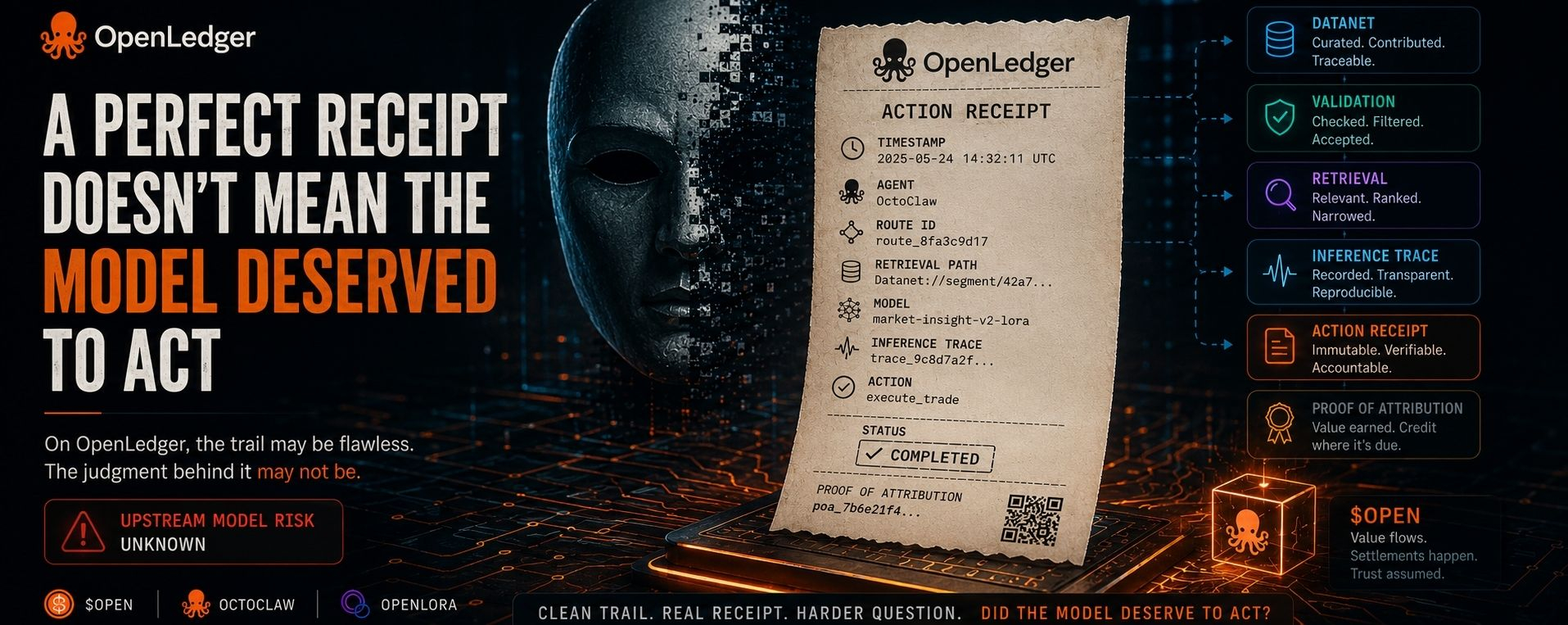
What keeps bothering me about @OpenLedger is not whether agents can act. It is not even whether receipts exist. Honestly, the problem is the opposite. The receipt exists too well.
Clean timestamp. Clean route. Retrieval path intact. Inference trace attached. Action history preserved neatly enough that everyone in the room relaxes the second they open it. That is the part that feels dangerous.
A broken workflow would almost be easier to understand. People would see the mess, blame the system, and move on. But OpenLedger is designed to leave structure behind. Datanets, validation layers, contributor lineage, retrieval paths, inference traces, Proof of Attribution — the stack preserves evidence everywhere. That is better than the usual black-box systems where nobody can explain why a model acted the way it did after something expensive already happened.
Still, the existence of a clean action trail creates another problem entirely. Eventually the workflow itself starts looking more trustworthy than the model underneath it ever deserved to be.
Imagine a specialized model sitting inside an automated agent route. Maybe it handles research flows, market analysis, operational decisions, or some internal automation layer. The model came through ModelFactory. It survived economically because OpenLoRA kept deployment cheap enough. It was trained on a Datanet that looked acceptable on paper contributor history clean enough, validation passed, provenance mostly intact.
Then the agent goes live. Retrieval enters. The model responds. The action executes. The receipt lands.
Everything looks disciplined.
But what exactly did that receipt prove?
It proved the sequence happened. Nothing more.
The receipt can verify the route, preserve timestamps, and document the workflow perfectly while still saying absolutely nothing about whether the underlying model deserved to operate that close to action in the first place.
That distinction matters more than people admit.
OpenLedger is extremely good at preserving procedural clarity. You can inspect the retrieval layer, trace contributors, review inference history, follow attribution paths, and later even connect settlement logic through open if value gets generated. The system leaves behind evidence almost everywhere.
But procedural clarity is not the same thing as epistemic confidence.
And people constantly blur those two together.
Not maliciously either. Socially. The second a workflow becomes legible, humans start trusting it more. A clean record creates emotional stability. Teams open the action trail, see the timestamps, the route IDs, the preserved sequence, and suddenly the conversation becomes softer.
“We know what happened.”
Fine. But knowing what happened is not the same thing as knowing whether the intelligence behind the action was actually reliable enough to deserve trust. Those are completely different problems.
The most dangerous models are rarely the obviously broken ones. The dangerous ones are the models that work most of the time. The ones that appear stable long enough for organizations to operationalize them.
Maybe retrieval quietly leans too heavily on a narrow slice of the Datanet. Maybe certain contributor groups influence outputs more than expected. Maybe validation filtered out messy but important edge-case data because the provenance looked suspicious or formatting quality failed some threshold.
Everything still looks clean from the outside.
Until the exact missing edge case becomes the difference between “the action looked reasonable” and “the action should never have happened.”
The receipt still lands perfectly. That is the uncomfortable part.
OpenLedger can preserve an immaculate action trail around a judgment layer that was never as robust as the surrounding workflow makes it appear. And once that receipt exists, institutions begin borrowing confidence from it.
You can almost watch the psychology happen in real time. Ops teams open the logs. Risk teams review the route history. Product teams scroll through inference traces looking for reassurance. The cleaner the trail becomes, the easier it is to forget that the model itself may still be dangerously thin in the exact areas the workflow cannot afford weakness.
Then the ecosystem expands. External teams plug into OpenLedger-native agent surfaces because the infrastructure now feels civilized. The interfaces are cleaner. The routes are standardized. The workflow looks governed instead of experimental.
But those downstream users never see the arguments that happened weeks earlier. They do not see validation trimming uncomfortable data. They do not see retrieval narrowing over time. They do not see builder decisions inside ModelFactory where operational convenience quietly won over robustness. They do not see OpenLoRA extending the life of a model that probably should have died earlier under real economic pressure.
They only see the receipt.
One clean action log. One timestamp. One preserved route.
And suddenly everyone in the room starts treating procedural evidence like evidence of judgment quality.
That is the real handoff failure.
Because once agents sit close to action, the consequences of upstream weakness change completely. A weak model inside a sandbox is manageable. A weak model wrapped inside preserved workflows, structured receipts, attribution layers, and operational legitimacy becomes something else entirely.
Now the system is no longer just exposing model behavior. It is packaging model behavior inside institutional confidence. And #OpenLedger is almost too good at making that packaging legible.
Datanet there. Validation there. Inference trace there. Action receipt there. Attribution there. Forensics everywhere.
Still no guarantee the model underneath deserved the trust the workflow now visually communicates.
I keep imagining some future review room after an agent action starts feeling slightly off. Not catastrophic. Just wrong enough to trigger concern.
One person has the receipt open. Another reviews the inference trace. Someone else is checking retrieval history. Eventually somebody notices the same contributor family appearing over and over again inside the lineage.
Then someone finally says the obvious thing too late:
“This is not actually an action-trail problem.”
“It is a model-quality problem wrapped inside an exceptionally clean action-trail object.”
And suddenly nobody knows which layer is supposed to own the confidence failure. Was it retrieval? Validation? The Datanet? The builder decisions inside ModelFactory? The economics that allowed OpenLoRA to keep the model alive long enough for institutional dependence to form?
Because eventually someone has to answer for the trust the receipt created.
And this is not an argument against receipts. Receipts matter. Provenance matters. Sequence integrity matters. OpenLedger is probably correct to preserve far more of that information than most systems currently do.
The danger begins afterward.
Once the record becomes clean enough, people quietly start treating it as partial proof that the intelligence underneath it was deeply vetted. Not formally. Not technically. Operationally. The same way institutions always smuggle confidence through process artifacts.
A clean workflow starts borrowing trust for work it never actually performed.
That is the real wound inside systems like this.
And it becomes even more dangerous once value settlement enters the picture. Because the moment agent actions connect to money, counterparties, automated execution, or economic coordination, people stop reading receipts as documentation. They start reading them as evidence of legitimacy.
Then eventually someone traces the workflow backward and realizes the uncomfortable truth:
The system preserved the paperwork better than the model deserved.
And that is when the clean record starts causing damage. Not because the receipt failed. Because it succeeded so well that everyone stopped asking the harder question.
Whether the model trained from that Datanet, shaped by that validation process, constrained by those retrieval patterns ever deserved to sit that close to action in the first place.
If the cleanest thing in the workflow is the receipt itself while the underlying intelligence remains fragile in the places that matter most, then what exactly is the system proving?
That it preserved what happened?
Or that it became exceptionally good at preserving the appearance of confidence after the wrong model was already allowed too close to action?