
Executive overview
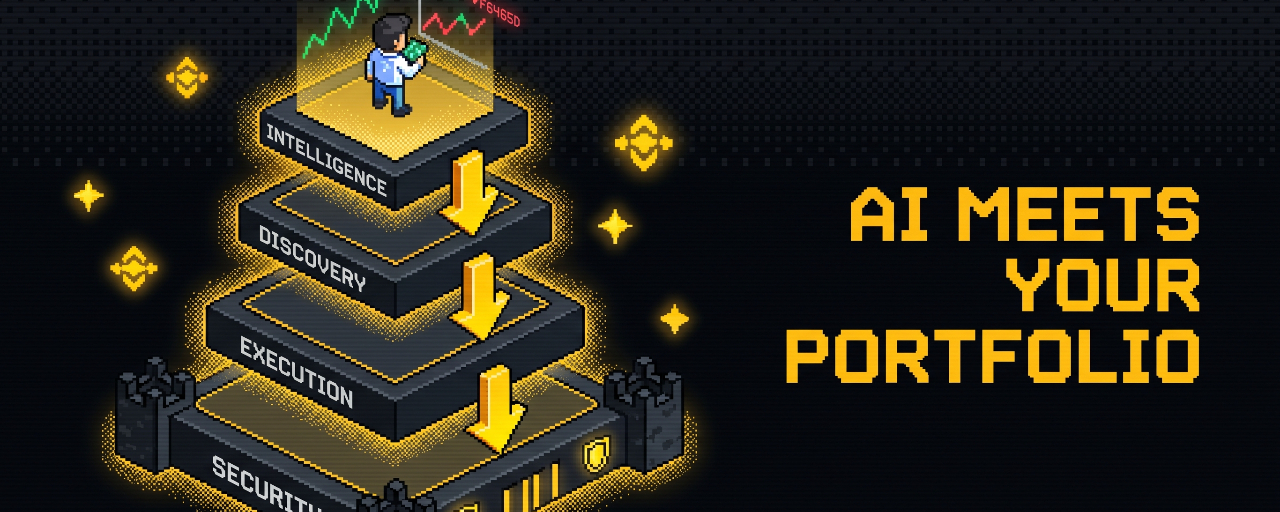
Binance has been steadily turning its exchange and wallet into an AI-native trading environment, layering AI across market data, portfolio insights, education, and even security. Recent launches include Binance AI for personalized insights and token reports, AI Agent Skills that let external agents plug directly into spot, futures, and wallet data, and AI-powered sentiment and narrative tools in Binance Wallet. Together, these systems aim to shorten the gap between retail and professional workflows by automating data digestion, surfacing narrative and flow signals, and wiring execution into AI-driven tooling.
At the same time, Binance emphasizes that AI outputs are not investment advice and may be inaccurate, highlighting the need for human oversight and risk management. For traders, the practical takeaway is that AI is becoming the default interface to their portfolios: instead of manually scanning charts, feeds, and contracts, users increasingly interact with smart layers that pre-filter noise into actionable views—if they understand the strengths and limitations.
Binance’s AI layers today
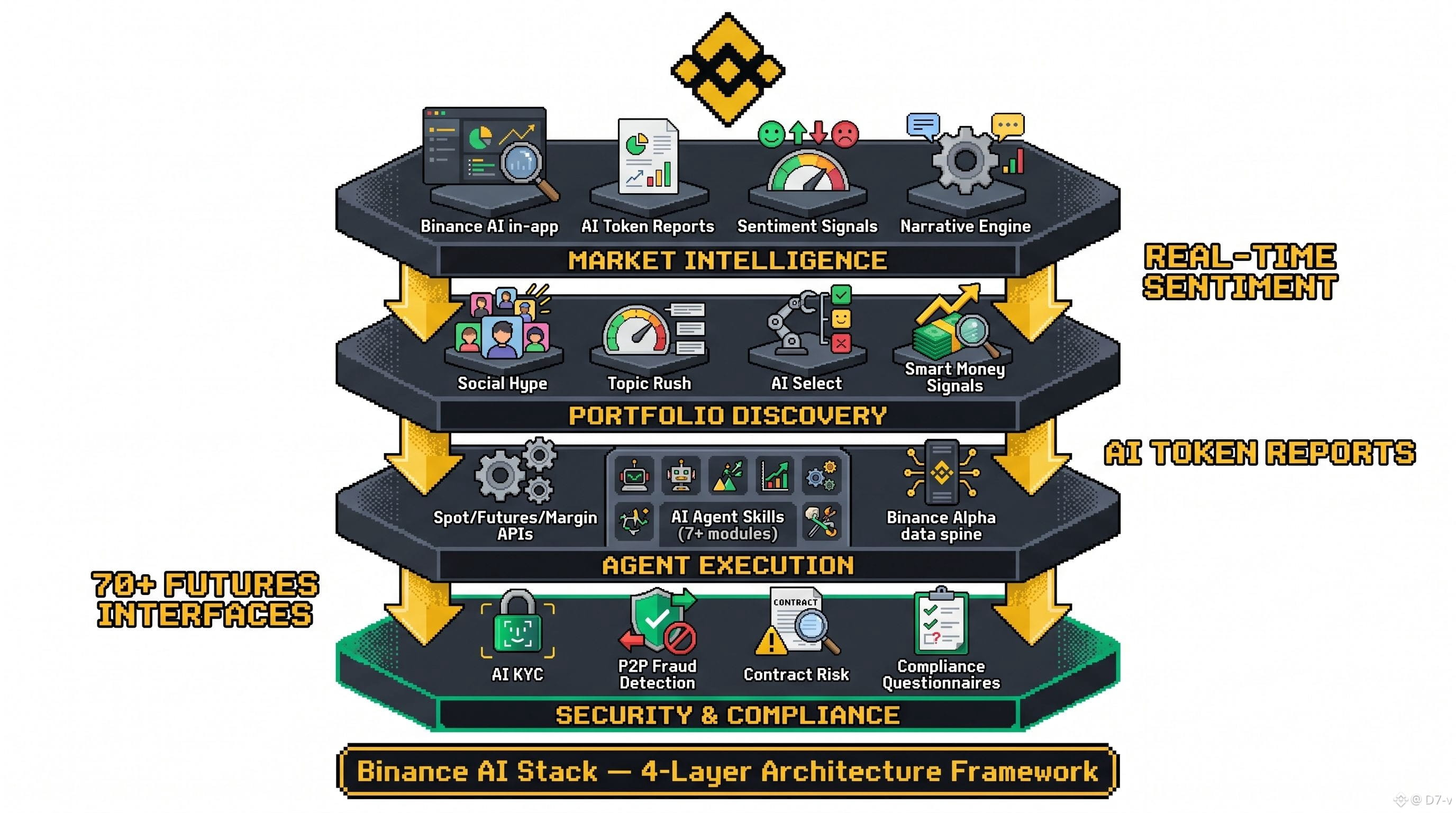
Binance’s AI integration can be broken into several functional layers: market intelligence, portfolio and trend discovery, execution via agents, and platform security/compliance.
Binance AI: personalized market intelligence in-app
Binance AI is positioned as an intelligent layer inside the core app that analyzes market movements, investor sentiment, and token-specific trends to provide real-time analytics and personalized insights. It adapts outputs to each trader’s profile, issuing alerts on significant movements, recommendations aligned with a user’s positions and history, and notifications on tokens that match the user’s strategy.
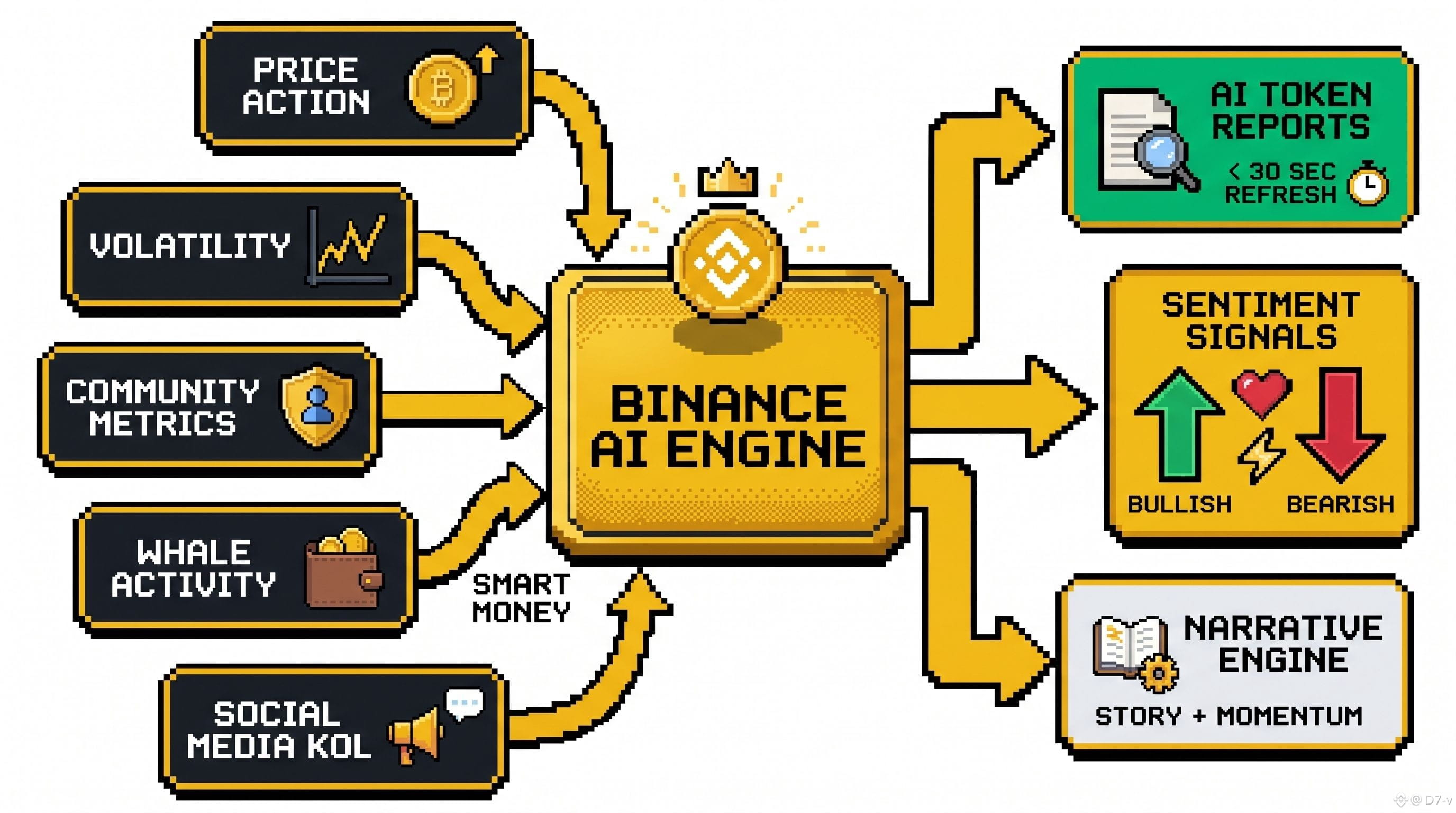
The system pulls from a mix of price action, volatility, and community metrics and packages them into AI Token Reports that summarize historical performance, volatility patterns, and liquidity and community indicators for each asset. This allows users to get a quick read on risk–reward characteristics without manually stitching together data from multiple sources.
AI Token Reports, narratives, and sentiment signals
Beyond the in-app assistant, Binance has deployed AI Token Reports, AI Token Narratives, and Token Sentiment Signals across both the exchange and Binance Wallet. AI Token Reports deliver a concise, frequently refreshed overview of a token’s market outlook in under about half a minute, incorporating positive indicators, risk factors, and community sentiment derived from spot trading data, whale activity, and buy/sell analytics.
Sentiment and smart money signals in the wallet track real-time social media activity, key opinion leader behavior, and trading flows to produce bullish or bearish indicators and surface key events moving perception. The AI Token Narrative engine aggregates social posts, news, and trading data to describe a token’s “story,” cultural relevance, and momentum, letting users trade not just on raw numbers but also on narrative positioning.
Wallet-level AI: Social Hype, Topic Rush, and AI Assistant
At the self-custody layer, Binance Wallet has introduced Social Hype, Topic Rush, and an AI Assistant focused on on-chain research and trend discovery. Social Hype ranks trending tokens across chains like BSC, Solana, and Base by analyzing large-scale social media data, essentially giving users a heatmap of where attention is clustering.
Topic Rush tracks capital inflows into narratives, classifying them as Early, Rising, or Viral so users can differentiate between still-forming themes and late-stage momentum plays. The embedded AI Assistant summarizes key token data and context, compressing fundamentals and flows into digestible answers and reducing the time to first decision for wallet users.
Educational AI: Binance Sensei as a Web3 mentor
Binance Sensei, integrated into Binance Academy, acts as an AI tutor that answers user questions with concise TL;DR-style explanations and recommends further educational content. When a user queries a blockchain or trading concept, Sensei returns a short summary and three relevant articles, effectively turning the Academy into a conversational interface. This lowers the learning curve for newer users while also giving more advanced traders a faster route to reference material.
Platform and security AI
Outside pure trading, Binance uses AI chatbots, fraud and risk models, and compliance systems to keep the platform safe and responsive. Internal chatbots resolve a large majority of user queries, while AI-powered KYC and P2P fraud detection models validate identities and flag malicious activity using a mix of language models and computer vision. Real-time risk monitoring and proprietary compliance models scan for anomalous behavior and help the exchange keep pace with fast-evolving regulatory expectations.
AI Agent Skills and the automation stack
The most structurally important shift is the emergence of AI Agent Skills—a toolkit that turns Binance into a first-class backend for autonomous or semi-autonomous trading agents.
What AI Agent Skills are
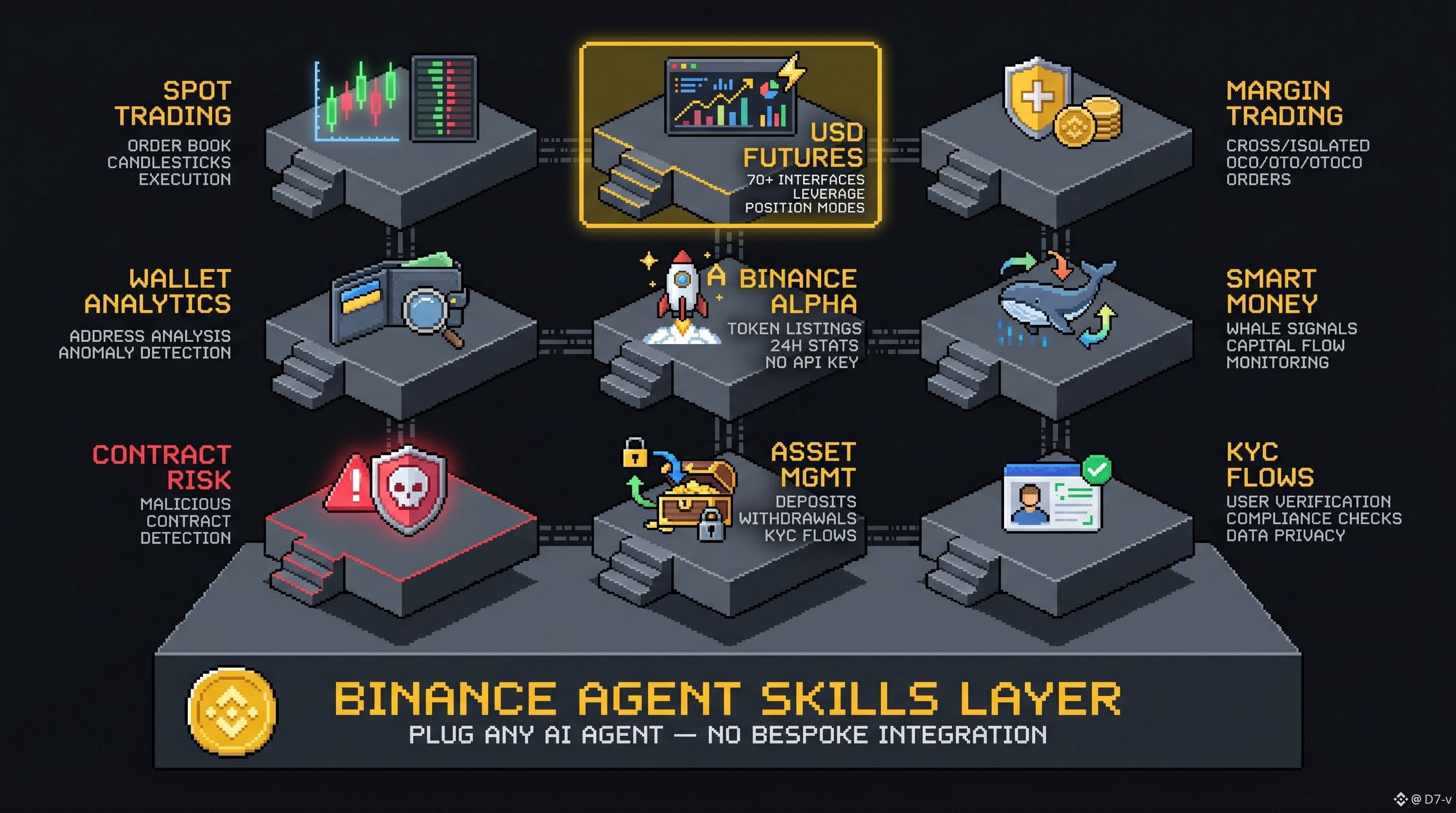
AI Agent Skills are modular capability packages that expose standardized interfaces for market data, trading execution, wallet analytics, and security checks to any compatible AI agent. The initial batch of seven Skills covers spot trading data and execution, wallet address analysis, token metadata lookup, structured market rankings, meme token lifecycle tracking, smart money signal monitoring, and contract risk detection.
Subsequent updates have added Skills for USD‑margined futures, margin trading, Binance Alpha market data, and asset management operations, extending support to derivatives, leverage management, account-level fund flows, and operational controls. Collectively, these Skills allow AI agents to pull candlesticks, order books, listings, and aggregated flows; place, modify, and cancel complex order types; adjust leverage and margin modes; and handle deposits, withdrawals, and KYC-aware flows within compliance boundaries.
Binance Alpha and data access
The Binance Alpha Skill is the key data spine for AI agents, giving them direct access to token listings, exchange information, candlestick charts, aggregated trading flows, and 24‑hour statistics via official APIs without requiring user API keys. This design allows strategies to run on production-grade data feeds while reducing friction around key management, especially for research, backtesting, and paper-trading contexts.
For systematic traders and quant teams, this effectively turns Binance into a plug-and-play venue where an agent can observe markets, test logic on testnet, and gradually escalate to mainnet execution with guardrails and additional confirmations for live trading.
Execution, margin, and asset skills
On the execution side, the USD‑margined futures Skill exposes over 70 interfaces that span order book and funding data, order placement, cancellation and modification, leverage tweaks, position modes, and algorithmic orders on both mainnet and testnet. The margin trading Skill lets agents toggle cross versus isolated margin, borrow and repay assets, submit advanced order types like OCO, OTO, and OTOCO, and monitor collateral ratios, interest rates, and liquidation metrics.
The asset management Skill connects into deposits, withdrawals, spot and fund account balances, fee structures, and coin conversion while also handling small-debt conversion and integrating compliance questionnaires when required. This combination lets external agents act not only as trade executors but as full portfolio operators within defined constraints.
How automation levels (and reshapes) the trading field
Compression of the information gap
Historically, professional trading desks had an edge largely because they could ingest and interpret more data faster—order books, flow, sentiment, and macro signals—and wire it into systematic frameworks. Binance’s AI stack compresses this gap by offering retail users access to structured token reports, sentiment dashboards, trend rankings, and agent-accessible APIs that mirror institutional workflows.
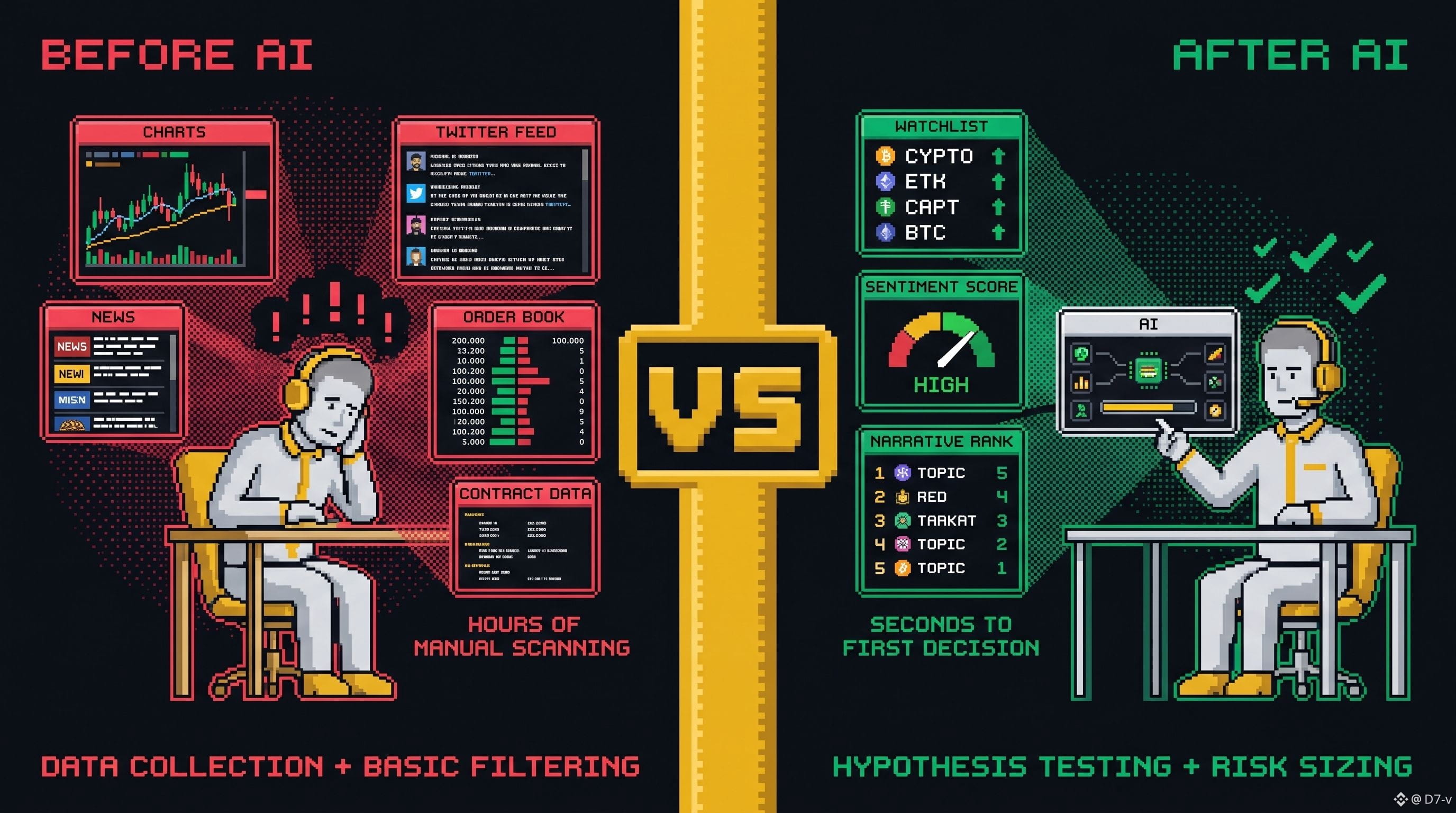
Tools like AI Token Reports, Smart Money Signals, and AI Select (which ranks tokens by real-time sentiment and attention) provide pre-digested views of narratives and flows that would otherwise require significant tooling and data engineering. In practice, this means that a retail user can see where capital and attention are moving and access structured risk indicators in seconds rather than hours.
From manual scanning to AI-first workflows
For everyday traders, the workflow shifts from manually scanning charts, Twitter feeds, and news to querying AI layers that summarize key moves and risks. Instead of building bespoke dashboards, users can lean on Binance AI, wallet AI features, and Sensei-style interfaces to obtain a short list of candidates or narratives to investigate.
This does not eliminate the need for discretion, but it changes where effort is spent: the time previously burned on data collection and basic filtering can be redeployed into hypothesis testing, trade structuring, and risk sizing.
Democratizing access to agent infrastructure
At the automation layer, AI Agent Skills open up institutional-style infrastructure to a broader audience, including independent quants, small funds, and advanced retail users. Any AI framework—whether a hosted model or a local agent stack—can plug into Binance’s unified interface to access market data, rankings, wallet analytics, and execution tools without bespoke integrations for each function.
This modularity should, in principle, lower the barrier to building and running algorithmic strategies and portfolio agents by removing much of the exchange-integration and data-plumbing overhead that historically favored larger players.
Risk management and compliance integration
Binance’s emphasis on security analytics and compliance-aware agent operations is also part of leveling the field, because it bakes basic hygiene into the infrastructure rather than leaving it to each user or developer. Contract risk detection, wallet anomaly analysis, and P2P scam detection offer an automated first line of defense, especially for users without deep security expertise.
Similarly, having KYC flows, questionnaire logic, and jurisdictional constraints integrated into asset and account Skills means that AI-driven strategies are more likely to operate within regulatory expectations by default, reducing the operational risk cliffs that smaller players might otherwise face.
Trade-offs, risks, and open questions
Overreliance and herding risk
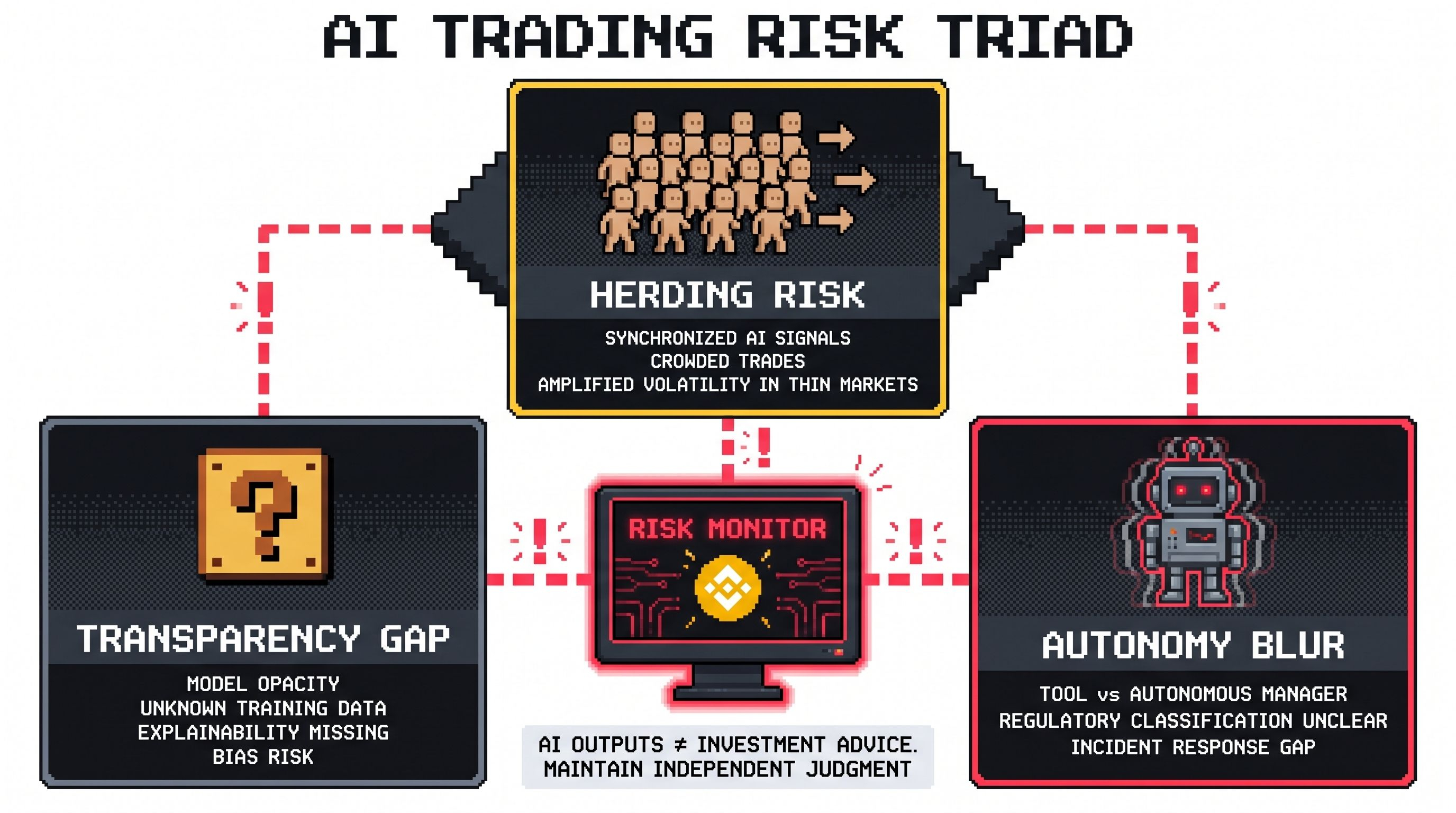
One clear risk is that as more users lean on similar AI signals—especially sentiment scores, narrative rankings, and “smart money” indicators—herding behavior and crowded trades may intensify. In thinly traded tokens or during stressed conditions, synchronized reactions by AI-influenced traders could amplify volatility instead of smoothing it.
Binance itself warns that AI-generated outputs may be inaccurate and do not constitute investment advice, signaling that users must maintain independent judgment and robust risk controls.
Transparency, model governance, and bias
Most of Binance’s AI systems are described at the feature level, but not in terms of exact model architectures, training datasets, or bias mitigation approaches. This opacity raises standard questions about explainability, edge-case behavior, and how different user segments may receive different suggestions under similar conditions.
For regulators and sophisticated users, there is an open question around how AI-driven nudges (for example, which tokens are highlighted in dashboards) intersect with best-execution duties, conflict of interest concerns, and disclosure obligations, particularly if proprietary models are tuned using internal order flow or user behavior.
Autonomy versus control for agents
The Agent Skills design foregrounds modularity and security checks, but as agents gain richer access to leverage, account operations, and external data, the boundary between “tool” and “autonomous manager” becomes blurry. It is not yet clear how regulators will classify assets traded or managed primarily by autonomous systems, or where responsibility sits when an agent misbehaves due to model error or adversarial inputs.
Binance notes that it does not endorse third-party AI agents and positions Skills as neutral infrastructure, but there is still a governance challenge around revoking access, handling abuse, and coordinating incident response when agents cause systemic stress.
Practical implications for traders and builders
How intermediate traders can use these tools
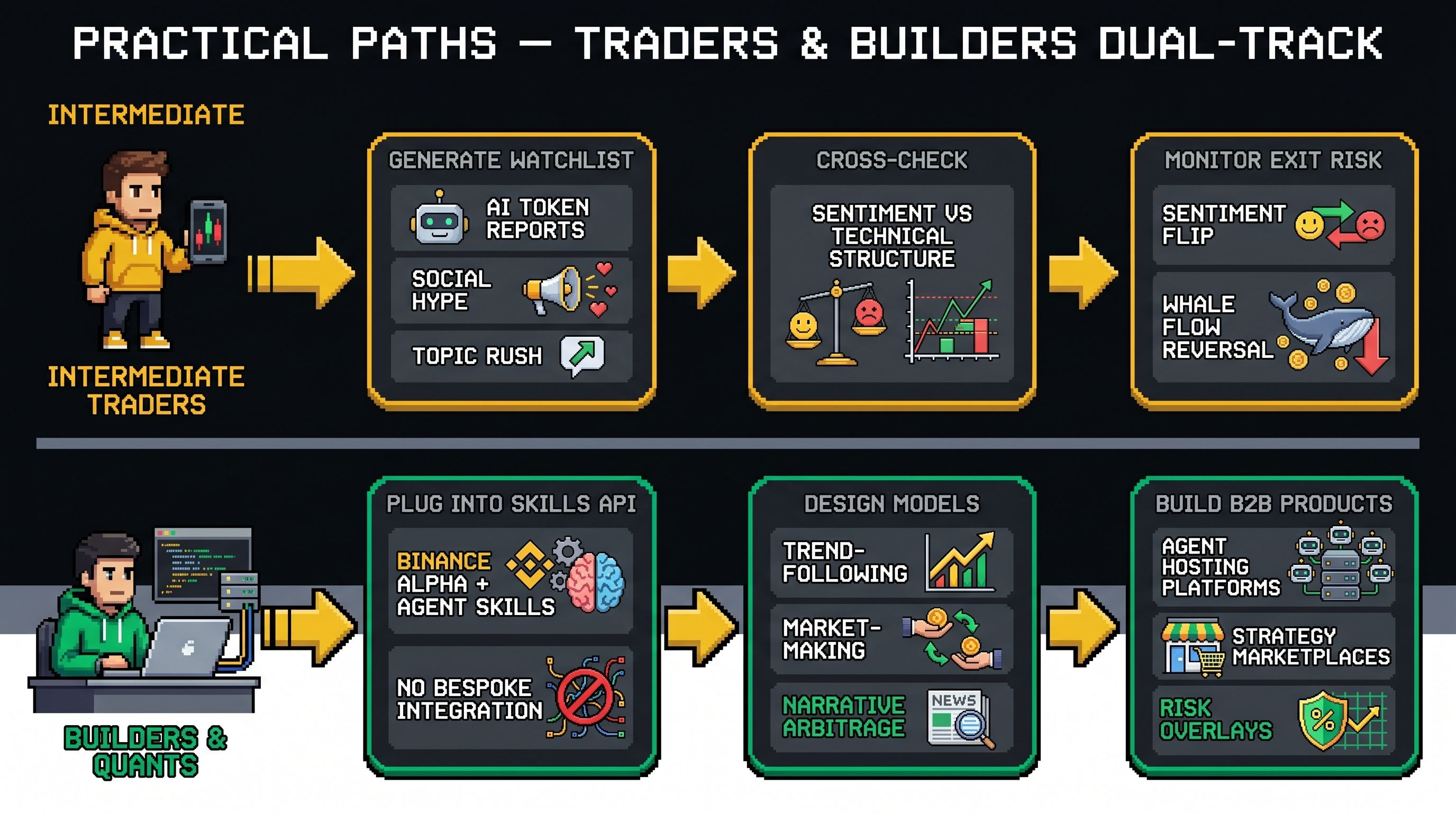
For intermediate retail traders, the most practical path is to treat Binance AI outputs as a screening and context layer rather than a signal to follow blindly. AI Token Reports, sentiment tools, and Social Hype/Topic Rush can be used to:
Generate watchlists based on emerging narratives and capital flows.
Cross-check whether a token’s story and sentiment align with technical structure.
Identify potential exit risk when sentiment flips or whale flows reverse.
Complementing AI views with independent charting, on-chain analysis, and position-level risk rules can help capture the upside of automation while mitigating overreliance.
Opportunities for quants and fintech teams
For quants, copy-trading shops, and fintech teams, Binance’s AI Agent Skills and Alpha access reduce integration friction for deploying strategies and portfolio agents. Teams can focus on designing and validating models—whether systematic trend-following, market-making, or narrative arbitrage—while relying on the Skills layer for data, execution, and some security analytics.
This opens space for new B2B products such as agent-hosting platforms, strategy marketplaces that plug directly into Skills, and risk overlays that sit between user portfolios and autonomous systems.
Builder and ecosystem angles
The integration of Binance Wallet AI tools, on-chain narrative detection, and agent infrastructure suggests a broader ecosystem play: positioning Binance as the default backend for AI-native crypto apps, not just a venue for human traders. External projects can use Skills and wallet tools to build interfaces where users interact primarily with AI layers—think “AI co-pilot for DeFi” or “agent-native asset managers”—with Binance providing data, execution, and security rails behind the scenes.
For builders, the key is to design experiences that make the human–AI boundary explicit, surface uncertainty and conflict between signals, and allow users to override or constrain agent behavior easily.
Conclusion
Binance’s AI push is turning the exchange and wallet into a stack of composable intelligence layers: personalized analytics for individuals, agent-ready interfaces for developers, and AI-based security and support under the hood. This stack meaningfully narrows the tooling gap between retail and professional participants by compressing data, sentiment, and execution infrastructure into accessible features and APIs.
However, leveling the field does not eliminate risk. AI can accelerate both good and bad decisions, and shared reliance on similar models may create new feedback loops and systemic behaviors. Traders and builders who treat AI as a powerful but fallible co-pilot—rather than an oracle—will be best positioned to benefit from this new wave of automation.