
Executive summary
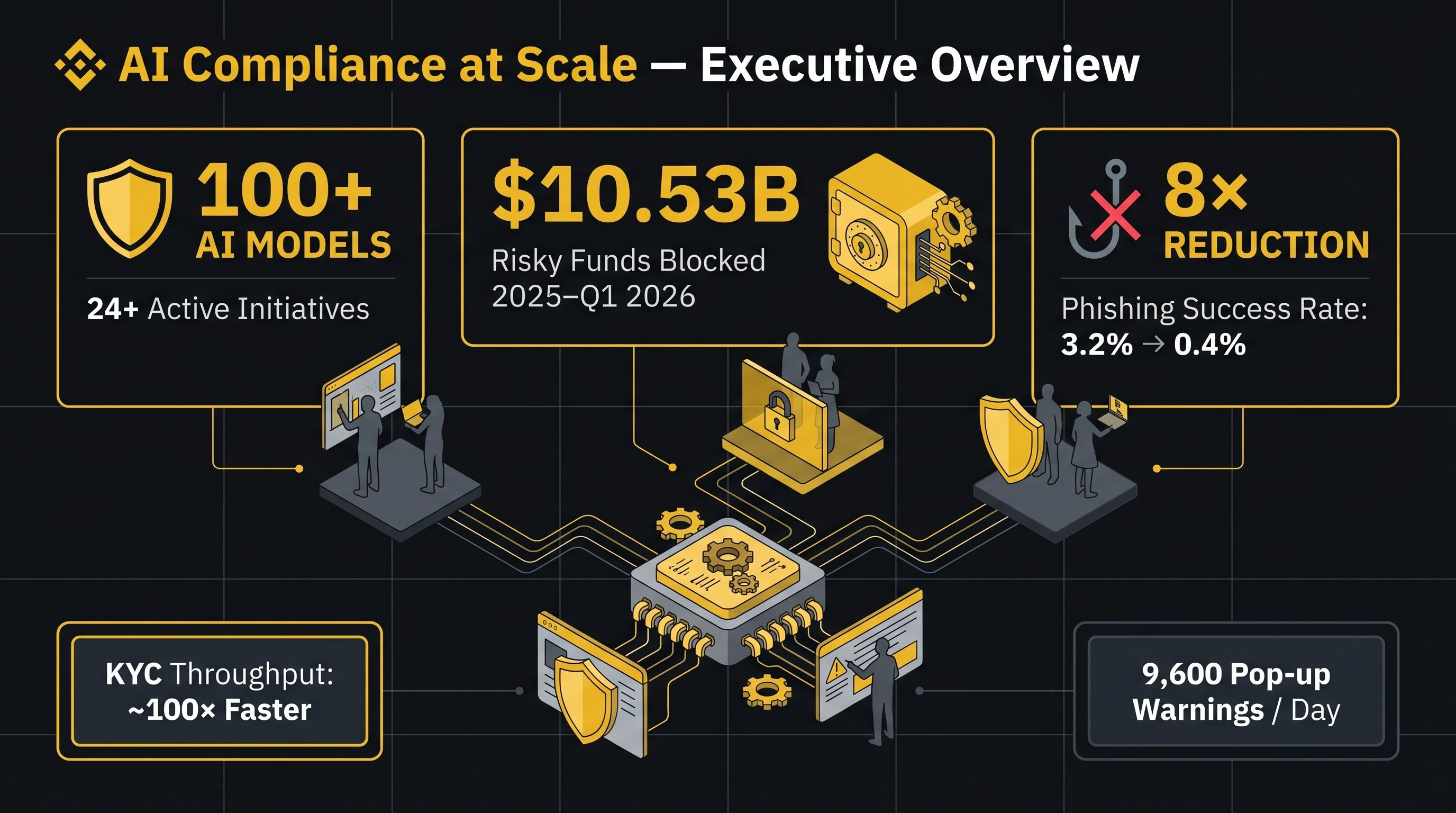
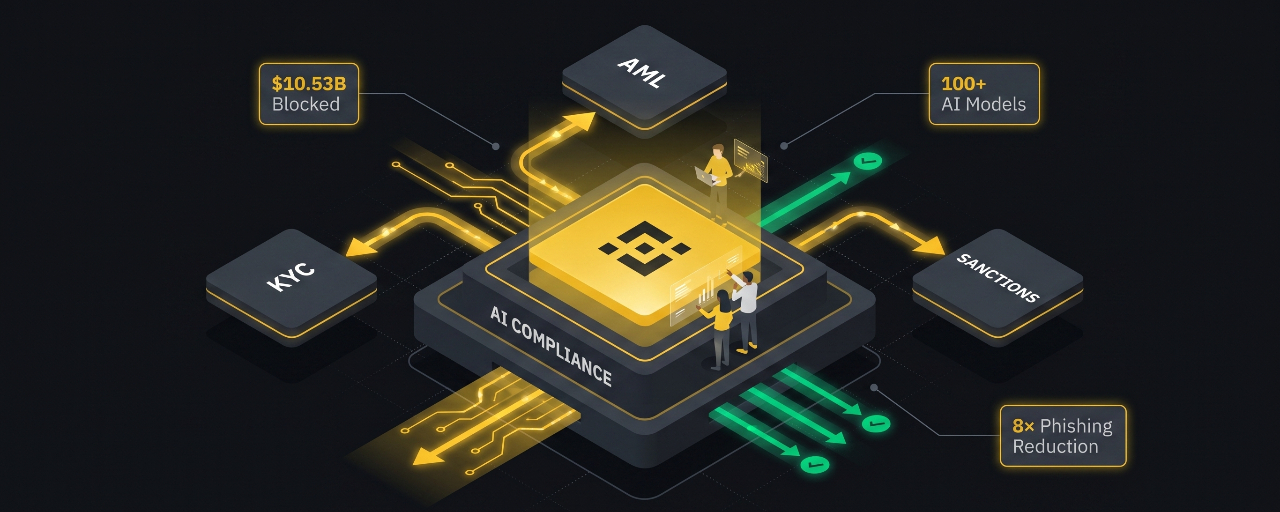
Artificial intelligence is rapidly becoming the backbone of compliance for leading crypto platforms, turning risk management from a manual cost center into always‑on infrastructure that can operate at exchange scale. Binance illustrates this shift: it now runs more than 24 AI security and compliance initiatives powered by over 100 models, which it says have blocked about 10.53 billion USD in risky user funds from 2025 through Q1 2026. By slashing phishing success rates eightfold, reducing illicit fund exposure by 96%, and boosting KYC throughput by around 100x, these systems show how AI‑driven controls can increase both platform safety and user experience at the same time.
For regulators and institutions, AI compliance provides the audit trails, sanctions screening, and real‑time AML capabilities they now expect from systemically important financial intermediaries. For users, it underpins the basic question of whether they can trust an exchange with their identity, funds, and long‑term participation in on‑chain finance. This report connects Binance’s AI compliance investment to the larger adoption story: mass adoption needs mass trust, and mass trust at crypto scale is impossible without AI‑driven compliance.
Why trust is the bottleneck for crypto adoption
From speculative experiments to critical infrastructure
Crypto has evolved from niche speculation to infrastructure that now handles trillions in annual trading volume, cross‑border remittances, and increasingly tokenized real‑world assets. As this happens, the core adoption bottleneck is no longer just UX or fees; it is whether regulators, banks, and mainstream users believe that crypto venues can operate with the same standards of safety, transparency, and accountability as traditional finance.
Studies on user behavior show that AML and KYC frameworks are now a major driver of exchange choice, with stricter regulatory environments shaping whether users prefer centralized or decentralized venues. Users and institutions might tolerate some volatility, but they will not tolerate repeated fraud, sanctions breaches, or opaque risk management. Trust becomes a precondition for everything else—liquidity, integrations, and institutional capital.
The rising bar for compliance
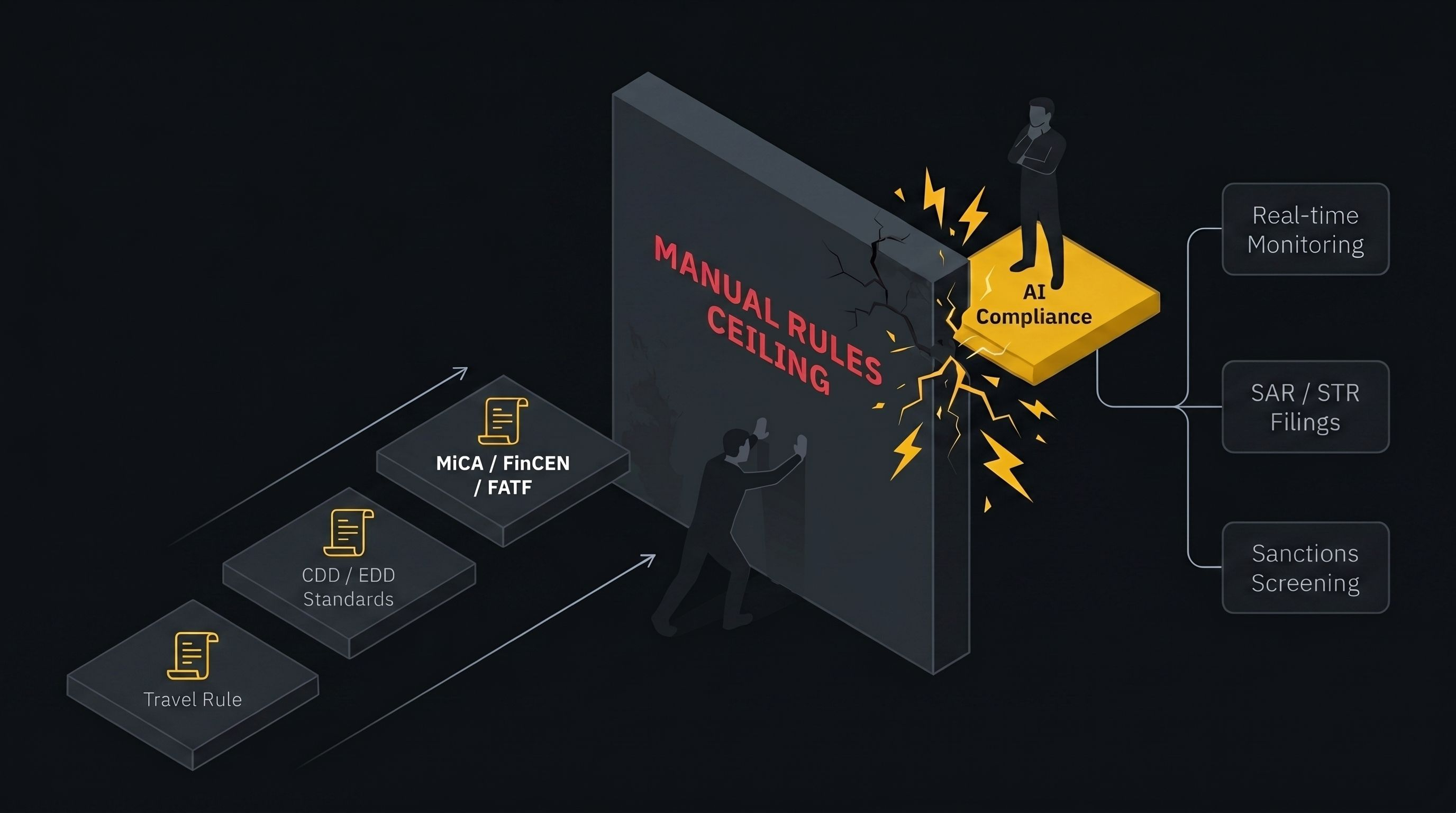
Global regulators have steadily raised expectations on virtual asset service providers: from Travel Rule implementation for cross‑border transfers, to stricter CDD/EDD standards, to explicit AML/KYC requirements in regimes such as MiCA, FinCEN guidance, and FATF recommendations. Enforcement actions against major exchanges for AML and KYC failings—frequently citing inadequate transaction monitoring and weak customer due diligence—have made it clear that “regulatory arbitrage” is no longer a sustainable strategy.
At the same time, regulators increasingly expect real‑time monitoring, high‑quality suspicious activity reporting, and robust sanctions screening similar to large banks. Meeting this bar across millions of users and thousands of assets, on‑ and off‑chain, is beyond what manual rules and human analysts alone can handle. This is where AI compliance becomes essential rather than optional.
What "AI compliance" means in practice
Core building blocks
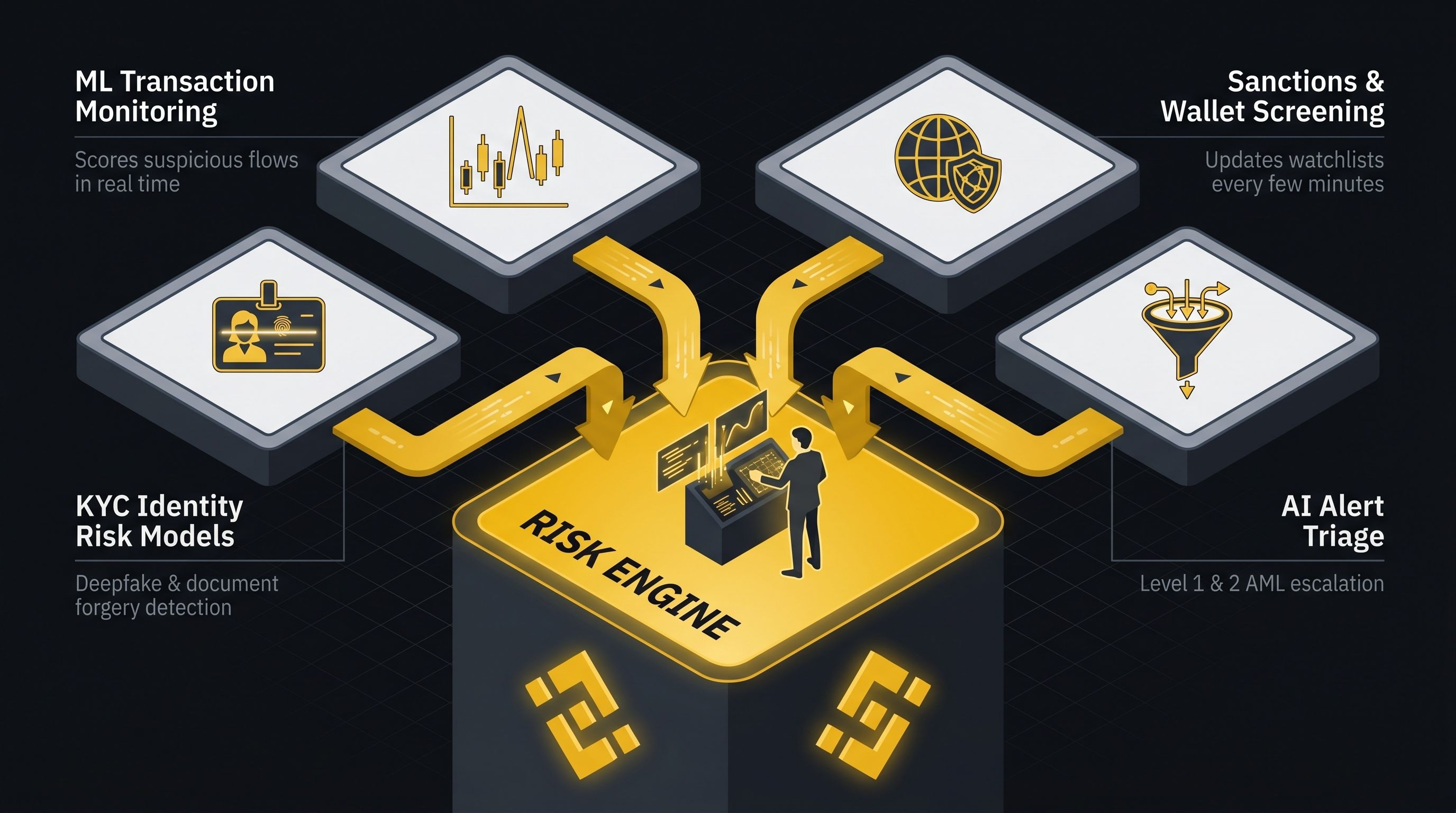
AI compliance in crypto typically combines several technical components:
Machine‑learning transaction monitoring that scores and flags suspicious flows, including unusual patterns in trading, deposits, withdrawals, and P2P transfers.
AI‑driven sanctions and wallet screening that continuously checks addresses and counterparties against global watchlists and risk databases, updating in near real time.
KYC and identity risk models that use computer vision, liveness checks, and behavior analytics to detect document forgery, impersonation, and deepfake attacks.
AI‑assisted alert handling, where agents triage Level 1 and Level 2 AML alerts, document reasoning, and escalate only truly complex cases to human investigators.
These components plug into streaming data pipelines, enabling continuous monitoring instead of daily batch jobs. That architecture shift—from periodic checks to real‑time risk engines—is what allows compliance to scale alongside user growth and transaction volume.
Why AI is structurally better than rules alone
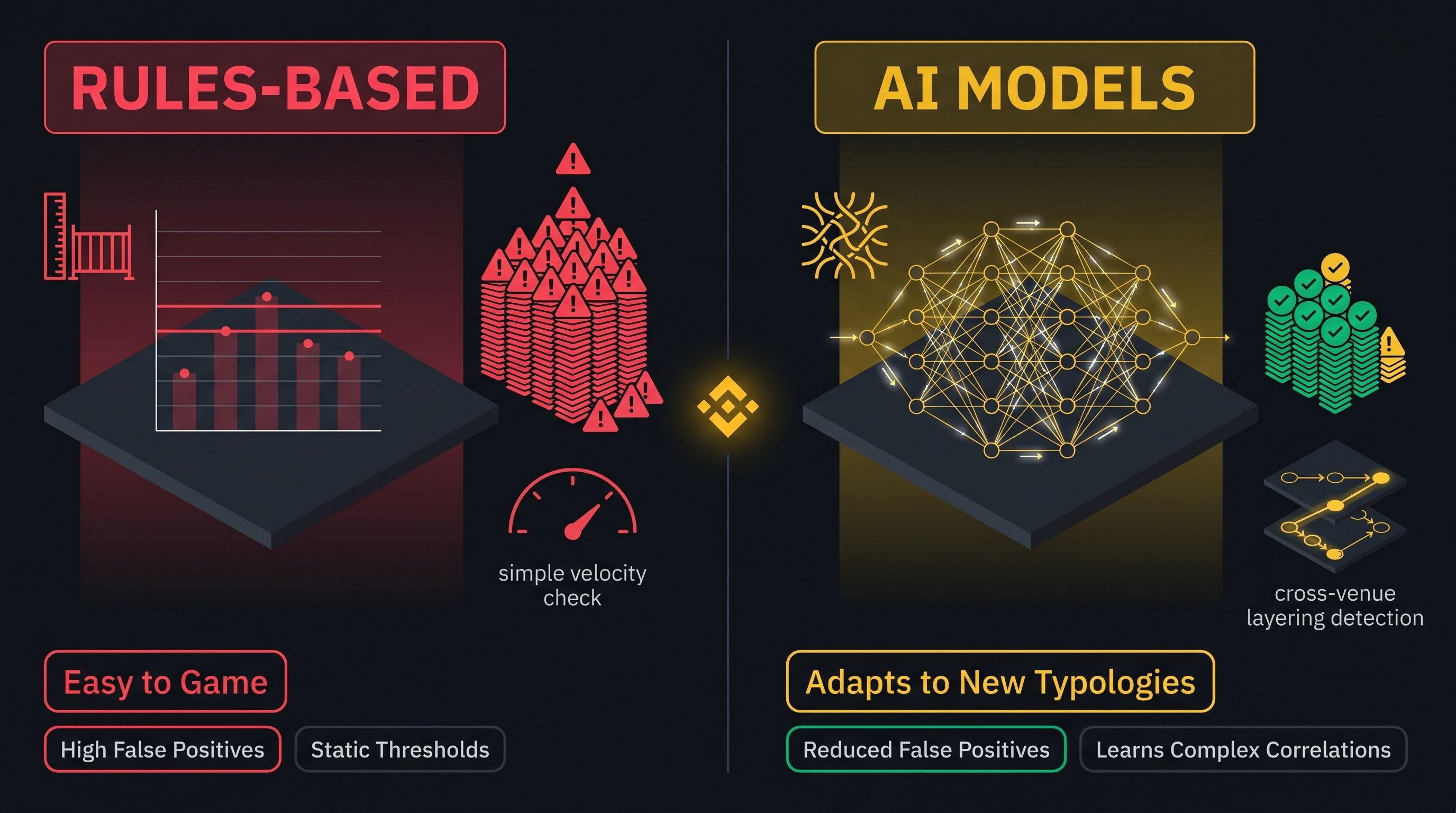
Traditional rules‑based systems rely on static thresholds (for example, fixed transfer amounts or simple velocity checks) that generate high false positives and are easy for sophisticated actors to game. AI models, by contrast, learn complex correlations and behaviors, adapting to new typologies such as cross‑venue layering, mixer use, or AI‑generated phishing campaigns.
In the AML and screening space, both financial regulators and solution providers now emphasize that AI can significantly improve accuracy, reduce false positives, and cut investigation time, while still keeping a human in the loop for oversight. For exchanges, this directly translates into lower compliance backlogs, more consistent decisions, and better ability to show regulators that controls are effective in practice, not just on paper.
Binance as a case study of AI compliance at scale
From ML pilots to AI infrastructure
Binance began by applying machine learning models to monitor suspicious activity, building streaming data pipelines to feed real‑time features into fraud detection systems. Over time, this evolved into a risk AI team and a suite of AI‑driven solutions to identify P2P scams, theft of payment details, and account‑takeover attacks across the platform.
By 2025–2026, Binance describes AI not as a feature but as core security infrastructure, with more than 24 AI security and compliance programs powered by over 100 live models. These models sit across login, trading, and withdrawal flows, feeding into a central risk engine that continuously recombines rules and ML models to detect abnormal behavior.
Quantifying the impact
Recent disclosures show the scale of this AI stack:
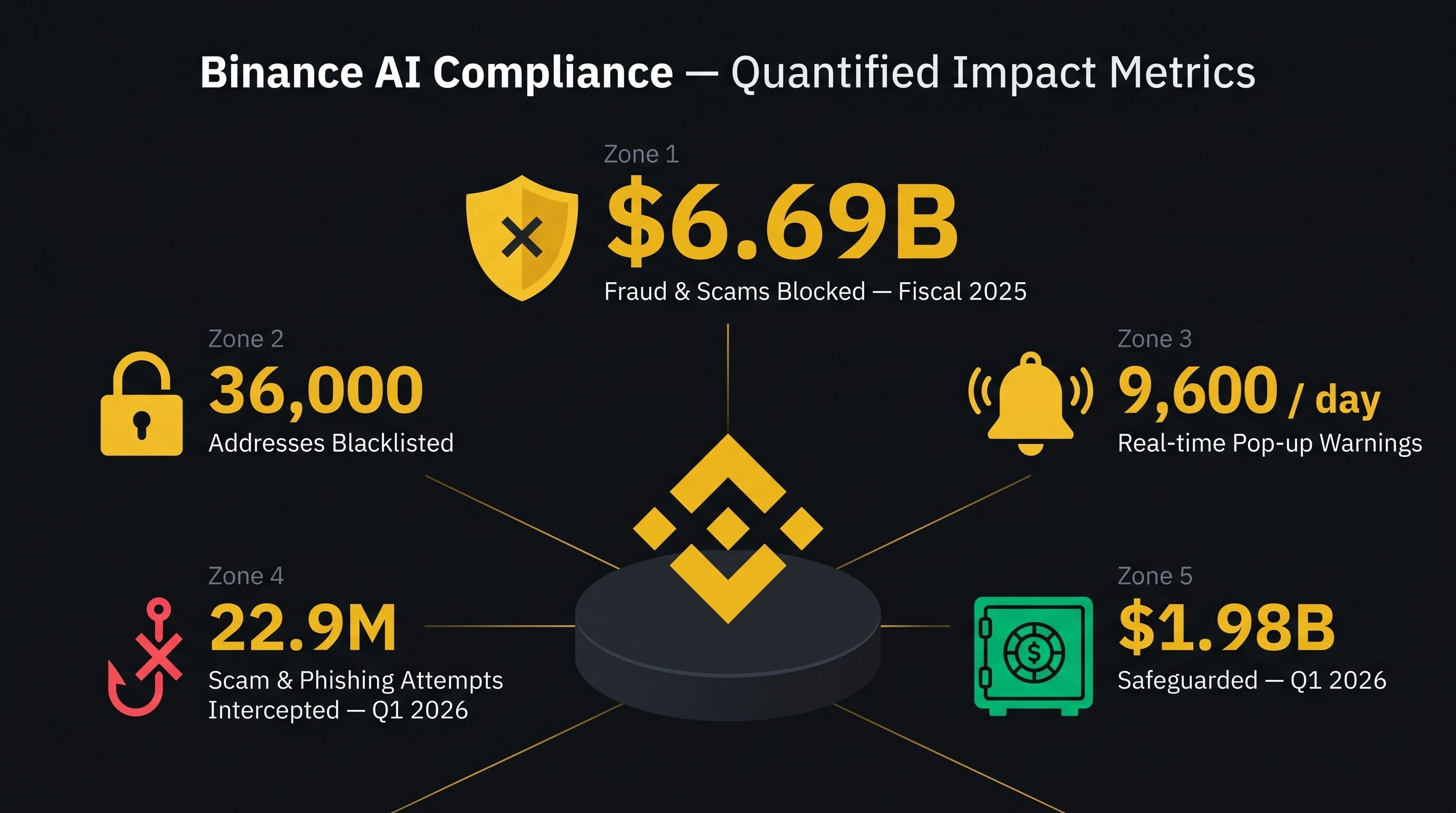
More than 100 AI models across 24+ initiatives have collectively blocked approximately 10.53 billion USD in risky user funds from 2025 through Q1 2026.
Enhanced detection systems blocked around 6.69 billion USD in fraud and scam attempts in fiscal 2025, blacklisted roughly 36,000 addresses, and issued about 9,600 real‑time pop‑up warnings per day.
In Q1 2026 alone, AI systems intercepted 22.9 million scam and phishing attempts, safeguarding an estimated 1.98 billion USD, while driving phishing success rates down from 3.2 percent to 0.4 percent—an eightfold reduction.
On the KYC side, Binance highlights AI‑based face‑attack and liveness models that are updated to counter physical masks, static photo spoofing, deepfake videos, and synthetic face swaps, and claims around a 100x increase in KYC processing throughput thanks to these models. For users, this means faster onboarding with stronger protection against identity fraud; for regulators, it means more robust identity assurance at scale.
Rule‑engine automation: Strategy Factory
One notable component is Binance’s Strategy Factory, an AI‑powered rule engine that automates and optimizes risk rules. Instead of analysts manually writing and tuning hundreds of static rules, Strategy Factory lets them assemble modular rules that are continuously refined using data‑driven optimization, leading to more precise and adaptive fraud detection.
This kind of AI‑assisted rule management matters because many regulatory frameworks still expect clear, explainable rules rather than pure black‑box models. Strategy Factory provides a bridge: models surface insights and patterns, while the resulting rules remain auditable and documentable for supervisors.
How AI compliance changes the regulator and institution calculus
Aligning with regulator expectations
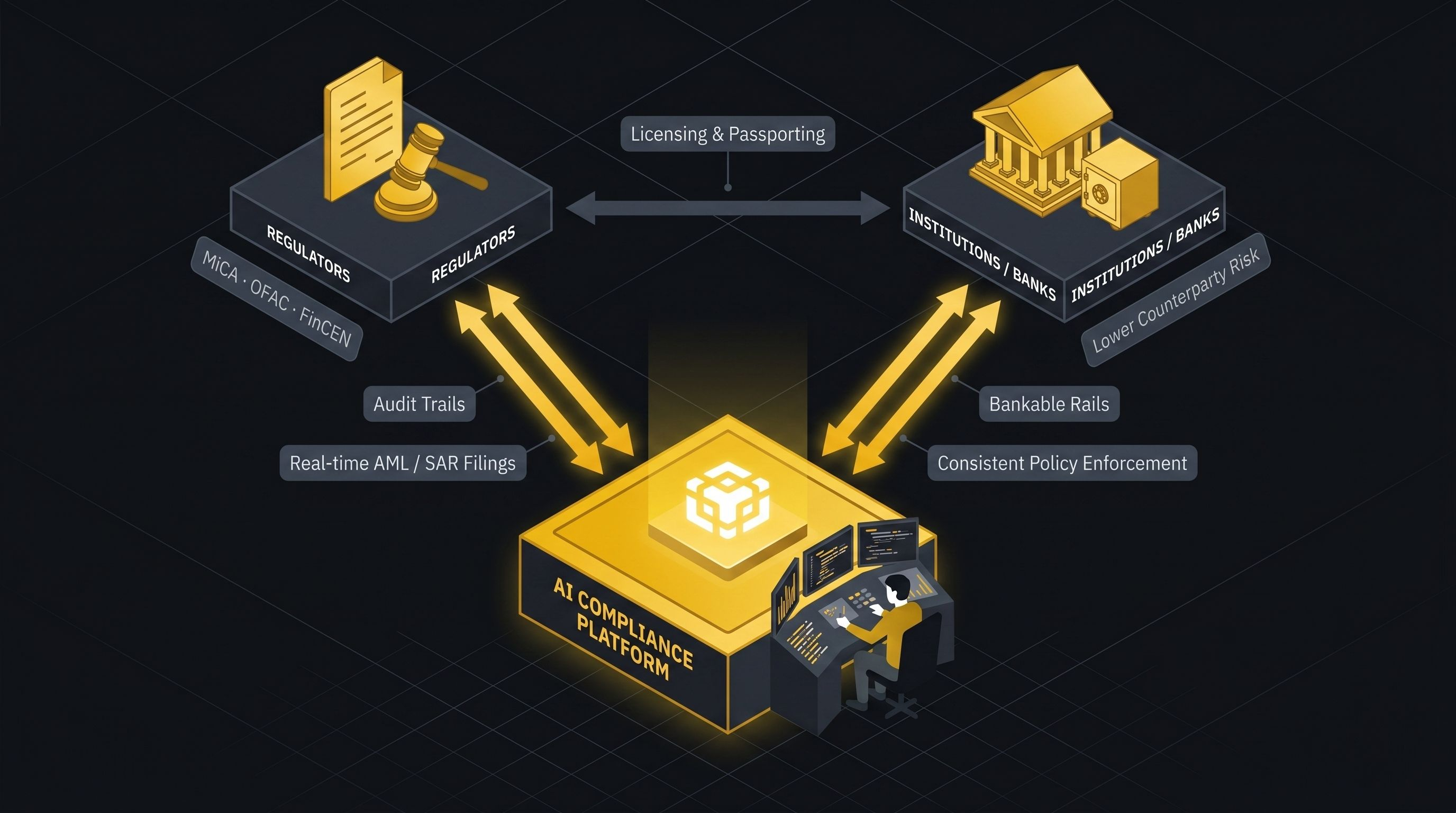
Regulators increasingly want three things from exchanges: continuous AML monitoring, strong sanctions and name screening, and clear, auditable documentation of how risks are identified and handled. AI‑driven compliance stacks, when built correctly, are well‑positioned to deliver all three.
First, AI‑based transaction monitoring can operate in real time and at high throughput, identifying suspicious patterns that static scenarios miss and supporting better SAR/STR filings. Second, AI‑powered crypto screening services can continuously monitor addresses, update sanctions lists every few minutes, and provide consolidated views of risk across jurisdictions, traits that align closely with regulatory expectations for sanctions controls.
Third, modern AI compliance platforms log every alert, decision, and disposition with timestamps and reasoning, creating an audit trail that is “regulator‑ready” and directly usable during exams or investigations. When AI agents are trained against specific regulatory guidance (for example, OCC, OFAC, FinCEN, MiCA), this further helps demonstrate that their behavior is consistent with current rules rather than ad‑hoc risk appetite.
Making exchanges bankable and investable
From the perspective of banks and institutional investors, exchanges with strong, AI‑enhanced compliance are more attractive because they lower counterparty, reputational, and regulatory risk. Third‑party providers emphasize that AI‑driven AML/KYC can dramatically reduce alert volumes, speed up investigations, and keep compliance teams within manageable headcount while still scaling volume.
In parallel, robust compliance is becoming a prerequisite for access to traditional rails—bank accounts, payment processors, and custody partnerships. Institutions are more willing to integrate with crypto venues that can show real‑time screening, consistent policy enforcement, and clear documentation of how risky customers and transactions are handled, something AI agents and rule engines increasingly make feasible.
How AI compliance improves user‑level trust
Protecting users from scams and account takeover
For everyday users, the most tangible impact of AI compliance is whether they get scammed, phished, or locked out of their accounts.
On Binance, AI models now detect and block millions of phishing and scam attempts per quarter, recovering thousands of user accounts each month as part of incident response. AI‑powered monitoring can flag unusual login behavior, withdrawals to known risky addresses, and P2P trades that match scam typologies, triggering pop‑up warnings or outright blocks that prevent losses before funds leave the platform.
Similar approaches are used in the wider financial sector, where large banks report preventing billions in fraud losses using AI‑based detection systems, suggesting that AI compliance is now table stakes for any institution handling large volumes of digital value. As users internalize that AI‑equipped platforms demonstrably prevent more fraud than manual systems, the presence of strong AI controls becomes a positive trust signal rather than a hidden back‑office detail.
Balancing security with UX and privacy
A frequent criticism of compliance in crypto is that heavy KYC and monitoring erode privacy and create friction that pushes users to less regulated venues. Research on exchange choice shows that while stricter KYC can reduce the appeal of centralized exchanges for some cohorts, well‑designed frameworks and user education can mitigate these effects.
AI can help rebalance this trade‑off. By increasing KYC throughput and accuracy, exchanges can shorten onboarding while still keeping impostors and synthetic identities out. Real‑time risk scoring allows for tiered controls where low‑risk users enjoy smoother experiences, while high‑risk patterns trigger additional checks, aligning with recommendations for tiered KYC systems that maximize both compliance and participation.
On‑chain AI compliance and the bridge to traditional finance
Extending AI to on‑chain monitoring
Although much of Binance’s AI stack focuses on platform activity (login, trades, withdrawals), similar techniques are being applied to on‑chain activity. For example, AI‑enhanced on‑chain monitoring for specific protocols has been used to identify money‑laundering patterns in real time and automatically freeze abnormal transactions, preventing millions in suspicious flows.
This kind of AI‑driven on‑chain surveillance complements address‑level sanctions lists by detecting behavioral patterns (for example, rapid hops through newly created wallets) that might not yet appear on traditional watchlists. As exchanges and protocols converge—through staking, L2 bridges, and tokenized assets—the ability to monitor both custodial accounts and on‑chain flows using AI becomes a decisive compliance advantage.
Paving the way for RWA and institutional use cases
Traditional institutions exploring tokenized real‑world assets, stablecoins, and on‑chain settlement need high comfort that the venues they use will not create unmanageable AML or sanctions exposure. AI compliance, combined with transparent reporting, helps provide that comfort by demonstrating that risk controls can operate at the required scale and speed.
When AI systems can show quantifiable reductions in illicit fund exposure (for example, Binance’s claimed 96 percent drop) and concrete amounts of prevented losses, they give regulators and institutions a stronger basis for approving new products, integrations, and pilot programs. Over time, that clears the path for mainstream financial use cases—RWA issuance, institutional DeFi access, and cross‑border payments—to grow on top of compliant crypto infrastructure.
Design principles for responsible AI compliance
Guardrails regulators will look for
As AI becomes central to compliance, regulators are starting to ask not just whether a platform uses AI, but how.
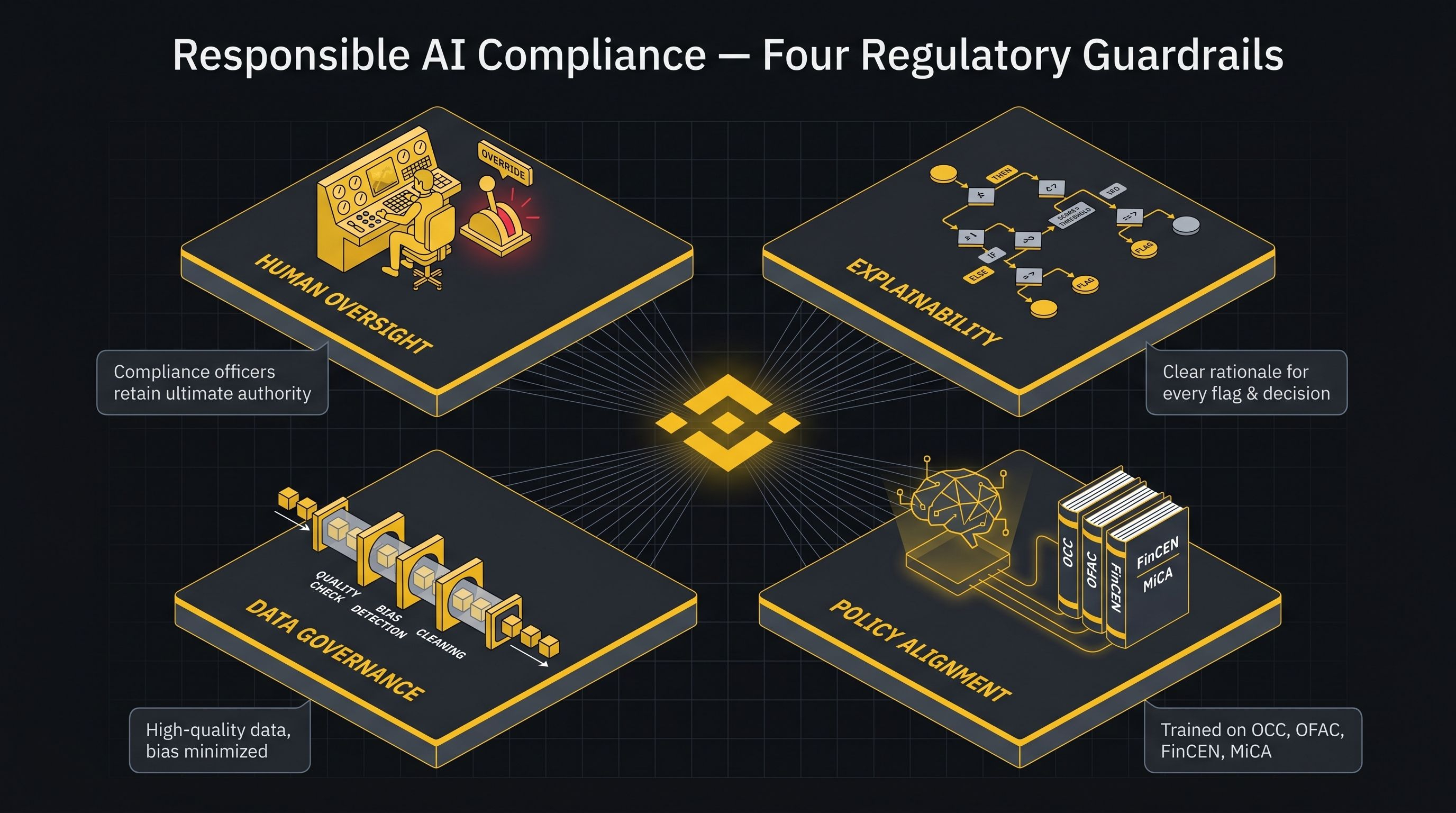
Key guardrails include:
Human oversight: Ensuring that human compliance officers retain ultimate responsibility and can override AI decisions where appropriate.
Explainability: Using models and rule engines that can provide clear rationales for flags and decisions, especially in enforcement and customer offboarding.
Data governance: Maintaining high‑quality, up‑to‑date data pipelines, and minimizing bias or blind spots in training data that could lead to inconsistent treatment of users.
Policy alignment: Training AI agents on actual regulatory texts and internal policies, and periodically validating their outputs against those standards.
Platforms that can demonstrate these properties will be better positioned in licensing, examinations, and cross‑border passporting discussions.
Avoiding "AI washing" in compliance narratives
There is a risk that exchanges adopt the language of AI without making the substantial investments required to operate trustworthy systems. Regulators and counterparties will look past marketing to concrete metrics: false‑positive rates, investigation times, sanctions hit accuracy, and realized fraud losses prevented.
For Binance, the detailed metrics it reports—blocked amounts, reduced phishing rates, address blacklists, KYC throughput—are examples of the kind of evidence stakeholders increasingly expect. For the industry as a whole, the bar will rise: claims about “AI‑powered compliance” will need to be backed by verifiable performance data and robust governance.
Implications for the future of crypto adoption
Mass trust as a prerequisite for mass adoption
Mass adoption of crypto requires that regulators, institutions, and everyday users see exchanges and protocols as trustworthy financial infrastructure rather than opaque black boxes. That trust rests on whether platforms can prevent abuse, respond quickly to emerging threats, and cooperate effectively with oversight.
AI compliance is emerging as the only viable way to deliver those properties at the scale of modern crypto markets. Binance’s deployment of 100+ AI models, its reported reductions in illicit exposure, and its ability to prevent billions in losses provide a proof‑of‑concept for what "trust at scale" looks like in practice.
Strategic takeaways for exchanges and builders
For other exchanges, wallets, and DeFi protocols, several strategic lessons follow:
Treat AI compliance as infrastructure, not a bolt‑on feature. Investment in data pipelines, model governance, and cross‑functional risk teams is essential.
Measure and publish outcomes. Concrete metrics on reduced risk and improved UX will matter more than generic claims of being “AI‑first.”
Build with regulators in mind. Design AI systems so that their outputs and logic can be explained and audited, and align training with evolving regulatory standards.
If the industry gets this right, AI compliance will not just help exchanges survive regulatory scrutiny; it will become a positive differentiator that accelerates the next wave of crypto adoption by making the ecosystem safer, more transparent, and more compatible with the rest of the financial system.