
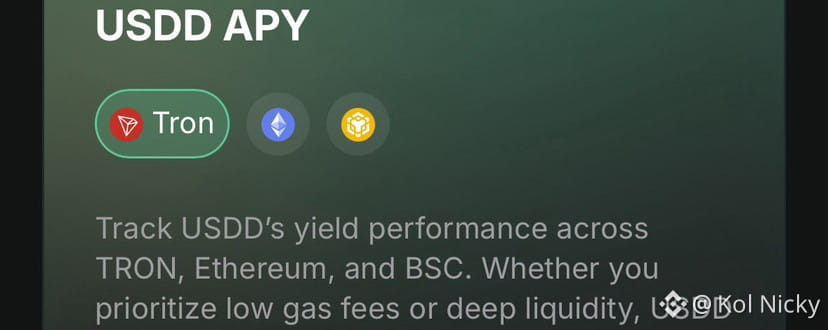
Most people chase APY without asking a more important question:
“What happens to the yield after the hype disappears?”👇
Because in DeFi, high numbers are easy.
Sustainable numbers are rare.
That’s why this USDD chart is actually more interesting than it first looks.
A lot of people will only notice:
→ 4% current APY
→ 7.41% average APY
But the real story is hidden underneath those numbers.
Look carefully at the trend.
The yield gradually compresses over time instead of exploding upward artificially.
And honestly…
that’s usually a good sign.
Why?
Because many DeFi ecosystems attract users using temporary reward inflation.
At first you see:
• 30%
• 50%
• 100% APY
Everybody rushes in.
Liquidity spikes.
TVL jumps.
People celebrate.
Then emissions slow down…
and the entire system starts collapsing under its own weight.
The APY was never real infrastructure.
It was marketing.
USDD appears to be taking a different approach.
Instead of chasing unsustainable yield wars, the system seems focused on maintaining:
→ stable returns
→ predictable earning structures
→ flexible liquidity
→ and long-term participation.
And honestly…
that matters more than flashy screenshots.
The chart itself quietly reveals something important:
USDD yield isn’t trying to behave like a casino.
It’s behaving more like financial infrastructure.
That’s also why the multi-chain setup matters.
USDD yield is accessible across:
• TRON
• Ethereum
• BNB Chain
And each chain serves different user priorities:
→ lower fees
→ deeper liquidity
→ broader DeFi integrations
→ cross-chain capital movement
That flexibility is important because stablecoin users are no longer just “holders.”
They are active capital allocators.
They move liquidity where:
• risk-adjusted yield makes sense
• fees remain efficient
• and liquidity stays accessible.
Now combine that with sUSDD.
This is where the ecosystem becomes more interesting.
Instead of leaving stablecoins idle, users can move into a yield-bearing structure designed for passive accumulation while remaining inside the broader USDD ecosystem.
And honestly…
the passive part is underrated.
Most DeFi strategies today demand constant attention:
→ monitoring pools
→ rotating farms
→ chasing emissions
→ adjusting leverage
→ optimizing positions weekly
But many users eventually realize something:
The best systems are often the ones that don’t require obsession.
That’s why simplicity itself becomes valuable.
Deposit.
Accumulate.
Maintain flexibility.
Stay liquid.
Another thing people overlook:
Stablecoins are becoming the operating system of DeFi itself.
Not just trading pairs.
Not just “safe assets.”
But the actual infrastructure layer behind:
• lending
• settlements
• collateral
• payments
• yield systems
• AI-related transactions
• cross-chain liquidity
And USDD’s recent ecosystem growth reflects that broader transition.
The focus no longer appears limited to “being a stablecoin.”
It’s becoming:
→ a yield layer
→ a liquidity layer
→ a collateral layer
→ and a cross-chain financial tool at the same time.
𝐌𝐲 𝐅𝐢𝐧𝐚𝐥 𝐓𝐡𝐨𝐮𝐠𝐡𝐭𝐬
I think the next phase of DeFi will reward protocols that prioritize:
→ sustainability over hype
→ consistency over temporary spikes
→ infrastructure over narratives
Because eventually…
users stop asking:
“How high is the APY?”
And start asking:
“How long can this system realistically sustain itself?”
That’s the real competition now.
@@USDD - Decentralized USD @Justin Sun孙宇晨 #USDD #Tron #Stablecoins #defi #TRONEcoStar