

OpenLedger (OPEN) vs Other Crypto Coins: Can AI Blockchains Become the Next Big Narrative?
The cryptocurrency market continues to evolve beyond simple digital payments and smart contracts. Over the last few years, new sectors such as decentralized finance, gaming, real-world assets, and artificial intelligence have emerged as major growth areas. Among these trends, AI-related blockchain projects are attracting increasing attention from investors, developers, and technology enthusiasts.
One project that has gained significant interest is OpenLedger (OPEN). Unlike traditional cryptocurrencies that focus mainly on transactions or decentralized applications, OpenLedger is building infrastructure specifically designed for the AI economy. The project aims to create a blockchain where data providers, AI model developers, and autonomous AI agents can generate value and receive rewards for their contributions.
As someone who has been analyzing AI and blockchain projects for several months, I believe OpenLedger represents a different vision compared to many established cryptocurrencies. The question is whether this vision can compete with giants such as Bitcoin, Ethereum, Solana, BNB, and other AI-focused projects.
What Is OpenLedger?
OpenLedger is an AI-native blockchain ecosystem focused on unlocking liquidity for data, machine learning models, and AI agents. The platform seeks to create a decentralized marketplace where participants can monetize valuable AI resources instead of relying on centralized technology companies.
The core idea is simple. Artificial intelligence requires data, computing resources, models, and users. Today, much of that value is captured by large corporations. OpenLedger aims to redistribute value back to contributors through blockchain-based ownership and reward mechanisms.
The OPEN token serves as the economic layer that powers transactions, incentives, governance, and ecosystem growth.
OpenLedger vs Bitcoin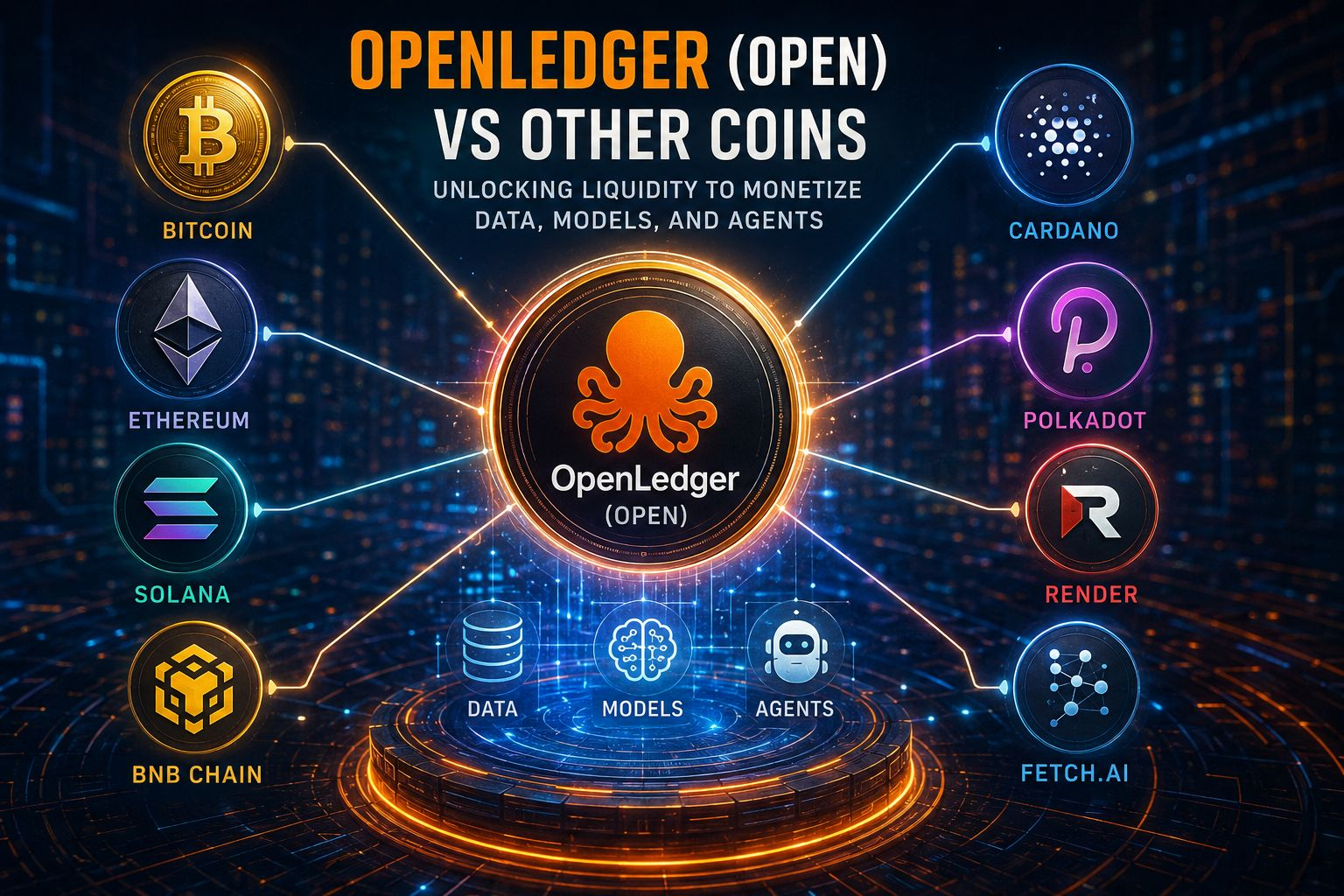
Bitcoin remains the largest cryptocurrency in the world. Its primary goal is to serve as a decentralized store of value and digital alternative to traditional money.
Bitcoin focuses on security, scarcity, and decentralization. It does not directly support AI applications or advanced smart contract ecosystems.
OpenLedger takes a completely different approach.
Bitcoin is designed to preserve value.
OpenLedger is designed to create value through AI participation.
In my opinion, comparing OpenLedger directly with Bitcoin is difficult because both projects target different markets. Bitcoin appeals to investors seeking long-term digital scarcity, while OpenLedger focuses on building infrastructure for future AI economies.
Bitcoin may remain the safer asset due to its maturity and adoption. However, OpenLedger potentially offers higher growth opportunities if AI blockchain adoption accelerates over the coming years.
OpenLedger vs Ethereum
Ethereum introduced smart contracts and transformed blockchain technology by enabling decentralized applications.
Today, Ethereum supports thousands of projects across DeFi, NFTs, gaming, and tokenized assets.
The biggest advantage Ethereum has over OpenLedger is its enormous developer community. Thousands of applications already operate on Ethereum, creating powerful network effects.
However, Ethereum was not originally designed for AI-specific use cases.
OpenLedger is attempting to build infrastructure optimized specifically for AI assets, data ownership, and agent economies.
I think OpenLedger's biggest opportunity lies in specialization. While Ethereum serves as a general-purpose blockchain, OpenLedger focuses on solving AI-specific problems.
The challenge is whether specialization can outperform Ethereum's massive ecosystem advantage.
OpenLedger vs Solana
Solana became popular because of its high transaction speed and low fees. The network can process large numbers of transactions efficiently, making it attractive for developers and users.
Many AI projects already deploy applications on Solana due to its performance advantages.
Compared to Solana, OpenLedger is not simply competing on speed. Instead, it focuses on creating economic systems specifically for AI data and models.
Solana provides the highway.
OpenLedger aims to build the AI city on top of that highway.
As a trader, I see Solana as a broader infrastructure bet, while OpenLedger represents a more focused AI investment thesis.
If AI becomes one of the dominant blockchain sectors, OpenLedger may capture value through its niche specialization.
OpenLedger vs BNB Chain
BNB Chain benefits from the massive ecosystem surrounding Binance. The network has strong liquidity, active users, and extensive developer support.
One advantage BNB Chain has is accessibility. Millions of users can easily access projects through Binance's infrastructure.
OpenLedger currently lacks this scale.
However, OpenLedger offers something unique. Rather than focusing on general blockchain activity, it aims to build an ecosystem where AI assets become productive and monetizable.
I believe OpenLedger's success depends on attracting AI developers who need specialized infrastructure rather than competing directly with BNB Chain's user base.
OpenLedger vs Render
Render is one of the most recognized AI-related crypto projects. It focuses on decentralized GPU computing.
The network allows users to rent unused GPU resources for rendering and AI workloads.
Render solves the computing problem.
OpenLedger focuses on solving the data, model, and agent ownership problem.
These projects may actually complement each other rather than compete directly.
AI requires computing power, quality data, and effective models. Render addresses one piece of the puzzle while OpenLedger addresses another.
This distinction is important because many investors mistakenly group all AI projects into a single category.
OpenLedger vs Bittensor
Bittensor is perhaps the most interesting comparison because both projects target AI economies.
Bittensor creates a decentralized machine intelligence network where participants contribute AI capabilities and receive rewards.
Both projects believe AI should be decentralized.
Both projects aim to reward contributors.
Both projects challenge centralized AI monopolies.
The difference lies in execution.
Bittensor primarily focuses on decentralized intelligence networks.
OpenLedger focuses on monetizing AI assets through liquidity and ownership frameworks.
In my opinion, Bittensor currently has stronger recognition within the crypto AI sector. However, OpenLedger introduces unique concepts around AI asset liquidity that could attract developers seeking new monetization opportunities.
OpenLedger vs Fetch.ai
Fetch.ai focuses on autonomous economic agents capable of performing tasks without human intervention.
The project has been developing AI agent technology for several years and remains one of the best-known AI cryptocurrencies.
OpenLedger shares some overlap because it also supports AI agents.
The difference is that OpenLedger places stronger emphasis on monetization and ownership structures.
Fetch.ai asks how agents can operate.
OpenLedger asks how agents can create and distribute value.
Both approaches are valuable, but OpenLedger potentially addresses broader economic questions surrounding AI adoption.
Strengths of OpenLedger
One major strength is timing.
Artificial intelligence is becoming one of the most important technological trends globally. Every month brings new AI breakthroughs, products, and applications.
Projects positioned at the intersection of AI and blockchain may benefit from increasing attention and investment.
Another strength is narrative alignment.
Investors often look for projects connected to emerging technological trends. OpenLedger fits directly within the AI infrastructure narrative.
The project's focus on ownership and monetization also addresses real challenges facing AI developers and contributors.
As AI ecosystems grow, fair reward distribution may become increasingly important.
Risks and Challenges
Despite its potential, OpenLedger faces significant challenges.
Competition is intense.
Large ecosystems such as Ethereum, Solana, and BNB Chain already possess massive user bases and developer communities.
OpenLedger must convince developers that specialized AI infrastructure provides advantages worth migrating for.
Another challenge is adoption.
Many blockchain projects have excellent technology but struggle to attract real users.
Success ultimately depends on whether developers, businesses, and AI creators actively use the network.
Regulatory uncertainty surrounding AI and digital assets could also create obstacles for future growth.
Investors should remember that early-stage projects often experience substantial volatility and uncertainty.
My Personal Analysis
After studying AI-focused blockchain projects, I think OpenLedger represents one of the more interesting attempts to create an economic layer for artificial intelligence.
Most blockchain projects focus on transactions.
Most AI projects focus on intelligence.
OpenLedger focuses on value creation and ownership.
That distinction makes it stand out.
I believe the project's future depends on execution rather than narrative alone. AI is currently one of the strongest themes in technology, but long-term winners will be determined by adoption, utility, and ecosystem development.
If OpenLedger successfully creates a marketplace where data providers, model creators, and AI agents can efficiently monetize their contributions, the project could become a significant player within the AI blockchain sector.
Final Thoughts
OpenLedger is not trying to replace Bitcoin, Ethereum, Solana, or BNB Chain. Instead, it is attempting to build a specialized economy centered around artificial intelligence.
Compared with traditional cryptocurrencies, OpenLedger offers a more focused AI investment thesis. Compared with other AI projects, it differentiates itself through its emphasis on liquidity, ownership, and monetization.
I think OpenLedger remains a high-risk but potentially high-reward project. Its success will depend on whether decentralized AI economies become a major part of the future digital landscape.
For investors interested in the intersection of blockchain and artificial intelligence, OpenLedger is certainly a project worth monitoring closely as the AI revolution continues to expand.@OpenLedger $OPEN @OpenLedger #OpenLedger $OPEN
