
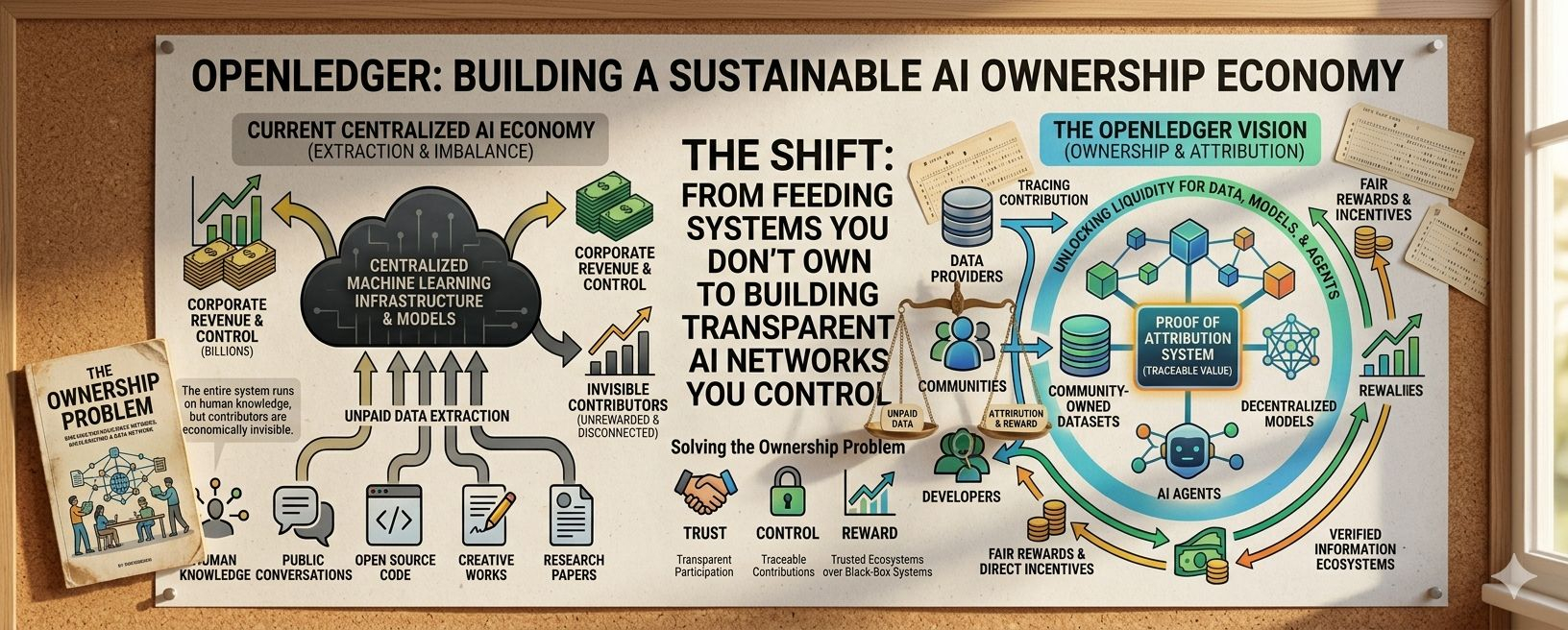
The current AI boom feels exciting until you think about it for more than ten minutes.
Then it starts feeling a little weird.
Because underneath all the shiny demos and productivity hype, the entire system runs on human knowledge collected at internet scale. Public conversations. Open-source code. Articles. Tutorials. Forums. Creative work. Research papers. Entire communities spending years building information ecosystems online without realizing giant AI companies would eventually absorb huge portions of that knowledge into commercial machine-learning infrastructure.
And somehow most people contributing to that system remain economically invisible.
That’s the part nobody really wants to sit with too long.
AI companies keep talking about innovation, but a massive amount of the value underneath modern AI came from the public internet itself. Human beings created the data. Human beings created the context. Human beings created the information networks. Then centralized corporations with enough money and compute turned those networks into proprietary systems generating billions of dollars.
Honestly the whole thing already feels unbalanced.
And the imbalance probably gets worse as AI spreads deeper into society.
Because right now AI still feels optional for a lot of people. Helpful maybe. Interesting. A productivity tool sitting in another browser tab. But over time machine intelligence becomes infrastructure underneath daily life. Education systems depend on it. Businesses depend on it. Research depends on it. Software development depends on it. Customer support depends on it. Eventually huge sections of digital labor become tied directly to AI systems operating nonstop online.
That changes everything.
Because once intelligence itself becomes infrastructure, ownership matters a lot more than people think.
Who controls the models?
Who controls the data pipelines?
Who controls the economic value generated by AI systems trained partly from public human knowledge?
Right now the answer mostly points toward giant centralized companies.
That’s exactly why OpenLedger stands out to me more than most AI projects in crypto right now. They’re not just trying to build another chatbot or fake “AI ecosystem” for hype engagement. The project actually seems focused on a deeper structural problem most of the industry avoids because it’s uncomfortable.
The ownership problem.
Right now the AI economy mostly works like an extraction system. Public information flows upward into centralized machine-learning models. Economic value flows upward into centralized infrastructure companies. Contributors stay mostly invisible while the systems built partly from their knowledge become increasingly powerful and profitable.
OpenLedger is basically asking whether that model stays sustainable long term.
And honestly I don’t think it does.
Because eventually people start noticing where the value actually goes. Same thing happened with social media. Early on everybody focused on convenience and growth. Years later people realized giant platforms captured enormous amounts of wealth and influence from user-generated activity while the users themselves mostly got ads and engagement metrics back.
AI feels like that exact dynamic happening again except this time the extraction layer runs even deeper.
Now companies aren’t just monetizing attention.
They’re monetizing intelligence itself.
That’s why OpenLedger’s “unlocking liquidity for data, models, and agents” idea matters more than it sounds at first. They seem to understand that future AI economies probably need transparent participation systems underneath them or society eventually pushes back against centralized control of machine intelligence.
Their Proof of Attribution system is basically trying to solve that problem by making contribution traceable instead of invisible. The idea is creating infrastructure where datasets, communities, models, and agents remain economically connected rather than functioning like unpaid raw material feeding giant black-box systems forever.
At least that’s the vision.
And honestly I think the timing makes sense because the internet itself already feels unstable underneath the AI boom. Synthetic content floods everything now. AI-generated articles. AI-generated comments. Machine-written marketing. Fake expertise everywhere. Entire websites built automatically for search traffic and ad revenue.
The web increasingly feels less human every month.
And the scary thing is future AI systems train on this environment too. Which means the internet slowly turns into this weird feedback loop where machine-generated content feeds future machine-generated systems over and over.
That sounds dangerous because it probably is dangerous.
Information quality eventually becomes infrastructure too. If AI systems train on increasingly polluted synthetic environments long enough, the outputs themselves become less reliable no matter how advanced the models are technically.
Which means trustworthy data becomes extremely valuable.
Specialized communities become valuable.
Verified information ecosystems become valuable.
That’s another reason OpenLedger’s focus on attribution and community-owned datasets keeps sticking in my head. Future AI probably doesn’t belong entirely to giant generalized models scraping the entire internet forever. It might belong more to smaller trusted ecosystems built around cleaner data and transparent contribution systems.
Because bigger models alone don’t fix structural problems.
They don’t fix ownership imbalances.
They don’t fix trust issues.
They don’t fix the fact that millions of people contribute value to AI systems while owning almost none of the infrastructure being built from that value.
And honestly I think that tension becomes one of the biggest economic questions of the next decade.
Especially once AI agents become more autonomous. Autonomous systems handling research, support, coding, logistics, analysis, scheduling, maybe eventually entire business operations nonstop online.
Who owns those systems?
Who gets paid when they generate value?
Who controls the information networks underneath them?
Right now centralized corporations are winning that race easily because centralized systems move faster. More money. Better compute. Better engineering talent. Faster coordination.
That’s reality whether crypto likes it or not.
Which is why OpenLedger is still incredibly risky obviously. Most decentralized AI projects probably fail because competing against trillion-dollar infrastructure companies is brutal.
But centralized AI creates long-term risks too. Dependency. Power concentration. Opaque systems nobody can fully inspect. Economic participation flowing upward into smaller and smaller groups controlling larger and larger sections of machine intelligence infrastructure.
That eventually becomes uncomfortable for society whether people admit it now or not.
And honestly I think OpenLedger exists because more people are starting to realize the future AI economy probably needs better ownership systems underneath it before the entire internet turns into a centralized machine pipeline nobody outside a few corporations actually controls.
