
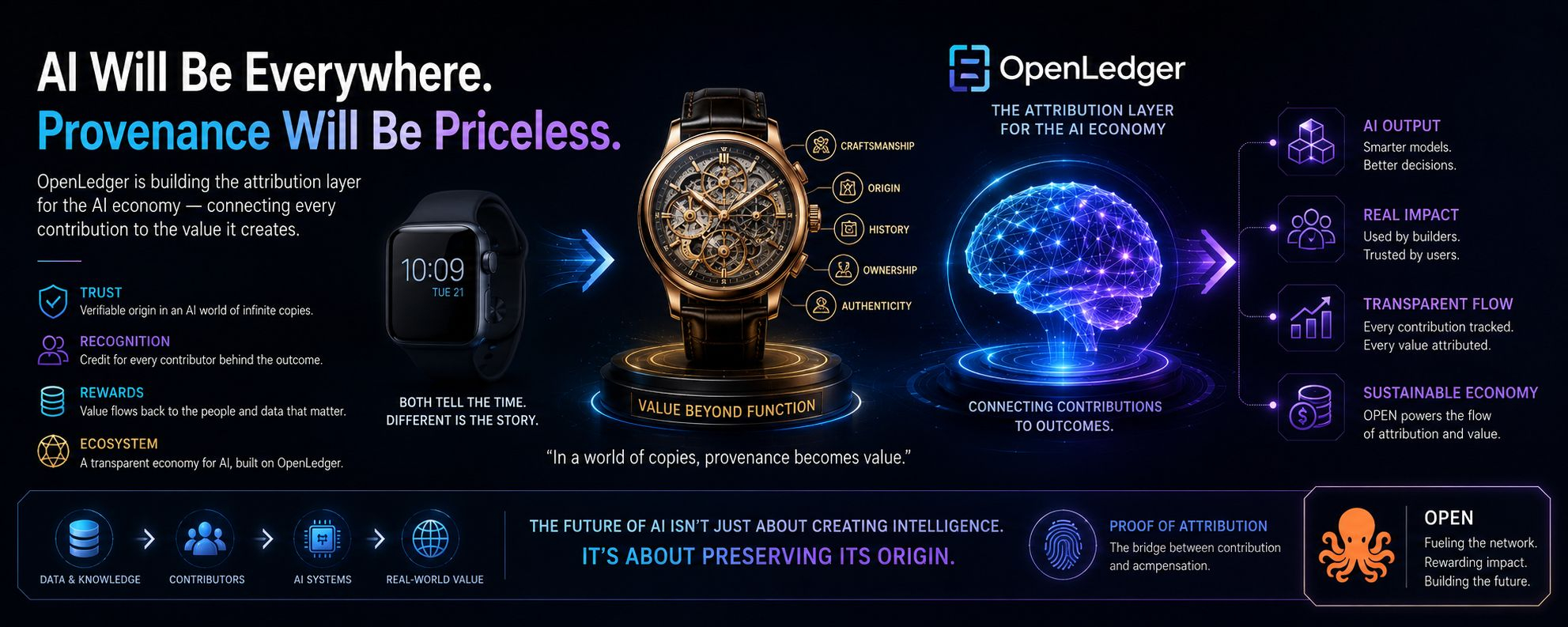
A luxury watch and a cheap watch can both tell the time.
From a purely functional perspective the difference often seems irrational. If accuracy were the only thing that mattered the cheapest digital watch would win. Yet people continue paying thousands—or even millions—for mechanical watches.
Why?
Because value has never been determined by function alone.
People care about craftsmanship. They care about history. They care about provenance. They care about knowing where something came from who created it and whether its story is authentic.
The more I think about AI, the more I wonder if it may eventually follow a similar path.
Right now the industry is obsessed with performance. Every new model is faster larger cheaper, or more capable than the last. Companies compete on benchmarks, inference speed reasoning ability and scale. The conversation revolves around outputs.
But history suggests that when a technology becomes widely available value often shifts away from the thing itself and toward the story behind it.
The internet made information abundant.
AI is making intelligence abundant.
And abundance changes what people care about.
When something becomes easy to produce attention naturally moves toward what remains scarce.
In the age of mass-produced goods craftsmanship became valuable.
In the age of digital music live experiences became valuable.
In the age of unlimited content, trust became valuable.
And in an age where AI can generate almost anything provenance may become one of the most valuable assets of all.
That is why OpenLedger stands out to me.
Most AI projects focus on generating intelligence. OpenLedger appears focused on something deeper: preserving the connection between intelligence and the people, data, and knowledge that helped create it.
At first glance that might sound like a technical challenge.
I think it is actually a human one.
Humans naturally want to know where things come from.
We want to know who deserves credit.
We want to know whether something is genuine or simply a copy of a copy of a copy.
The internet solved distribution years ago. Information can move across the world instantly. What it never solved particularly well was preserving the path behind that information.
Knowledge gets reposted.
Ideas get remixed.
Data gets repackaged.
Contributions become invisible.
The value survives but the trail disappears.
AI risks accelerating this process.
Every AI output is built on layers of contributions that most users never see. Data providers researchers domain experts annotators developers and countless other participants all influence the final result. Yet by the time an answer reaches the screen those contributors have largely vanished from view.
The output remains.
The origin fades.
OpenLedger's thesis seems to be that this missing connection matters.
Not just for fairness.
For economics.
Because if valuable data expertise and feedback help create valuable AI systems there must eventually be a way to identify those contributions and connect them to the value they generate.
That idea becomes increasingly important as synthetic content expands.
When everything can be generated instantly authenticity becomes more scarce.
When content is infinite trust becomes finite.
When intelligence becomes abundant provenance becomes valuable.
We have already seen this pattern emerge in luxury goods art collectibles financial markets and even social media. The easier it becomes to create something the more people care about verification ownership and origin.
AI may not be any different.
Of course execution is where theory meets reality.
Many projects have identified important problems.
Far fewer have solved them.
OpenLedger still faces difficult questions.
Can attribution remain accurate at scale?
Can quality contributions be separated from spam?
Can incentives reward genuine value rather than encourage manipulation?
Can provenance become useful enough that developers and users actually care?
Those questions matter more than narratives.
Because markets eventually stop rewarding stories and start rewarding utility.
That is why I do not see $OPEN as simply another AI token.
The more interesting conversation is what it represents.
A future where intelligence is not only generated but traceable.
A future where contribution is not only made but recognized.
A future where value flows not just to the final output but to the network of people and resources that made the output possible.
The next phase of the internet may not be defined solely by our ability to create information.
It may be defined by our ability to preserve context after information begins moving through increasingly complex digital systems.
Just as luxury watches derive value from the story behind the object future AI systems may derive value from the story behind the intelligence.
And in a world flooded with synthetic content that story could become more important than the output itself.
