
The problem isn't AI.
The problem is all the stuff around it.
Everyone keeps talking about smarter models. Bigger models. Faster models. New AI agents. New breakthroughs every week. Cool. Great. But none of that means much if the system underneath is still a mess.
And right now, it kind of is.
AI runs on data. Everybody knows that. But somehow the people providing that data usually end up getting the worst deal. Companies collect information from everywhere. Models get trained. Products get launched. Money gets made.
Then the people who actually created the value are nowhere to be found.
That's the part that feels broken.
For years we've been told that data is valuable. Maybe it's the most valuable thing online. But if that's true, then why is it so hard for people to actually earn from it?
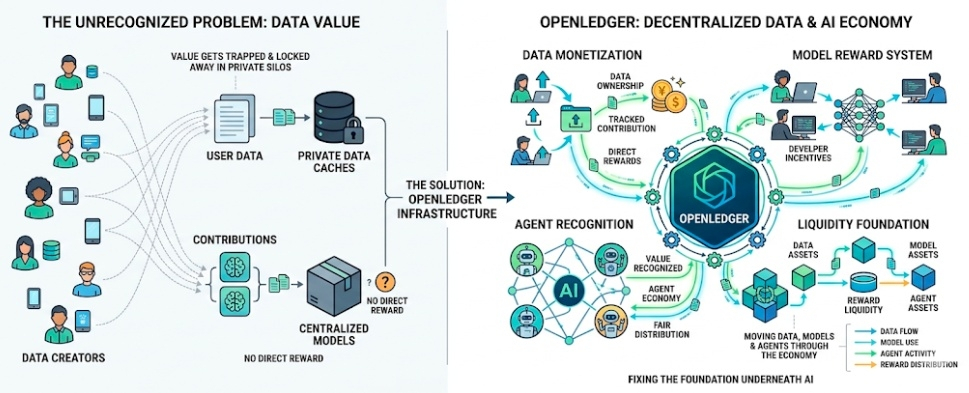
Most of the value gets trapped.
Data sits in databases. Companies lock it away. Developers build on top of it. AI systems consume it. Everyone talks about ownership until it's time to share the rewards.
Then suddenly things get quiet.
That's why OpenLedger caught my attention.
Not because it's another crypto project.
Honestly, crypto already has enough projects.
Every week there's a new chain. A new token. A new ecosystem. A new revolution that's apparently going to change everything forever.
Most of them disappear.
So when I looked at OpenLedger, I wasn't interested in the marketing. I was looking for the actual problem it's trying to solve.
And the problem is real.
Data has value.
AI models have value.
AI agents have value.
But connecting all those things together in a way that actually makes sense economically is still a huge challenge.
That's basically where OpenLedger is trying to fit in.
The idea is pretty simple.
If data is valuable, people should be able to earn from it.
If developers build useful AI models, they should be rewarded.
If AI agents are creating value inside a network, there should be a system that recognizes that value instead of letting it disappear into a black hole.
Sounds obvious.
Yet somehow the industry still struggles with it.
The funny thing is that everyone is obsessed with AI intelligence while ignoring the foundation underneath it.
Bad data creates bad results.
It always has.
You can build the smartest model on Earth. Feed it garbage and you'll still get garbage.
That's not a technology problem.
That's a data problem.
And data quality is becoming more important every year.
The AI race isn't slowing down.
Companies want more models.
Developers want more tools.
Businesses want more automation.
Everyone wants better outputs.
But better outputs usually come from better inputs.
That's where things start getting interesting.
OpenLedger isn't really competing with AI companies.
At least that's not how I see it.
It's trying to build the roads instead of the cars.
The infrastructure instead of the application.
And sometimes that's the smarter bet.
People get excited about products they can see.
They don't get excited about infrastructure.
Until they realize everything depends on it.
The internet needed infrastructure.
Cloud computing needed infrastructure.
AI needs infrastructure too.
Especially when it comes to data.
The other thing worth mentioning is liquidity.
Crypto people throw that word around all day.
Usually they're talking about trading.
OpenLedger is looking at it differently.
The goal isn't just moving tokens around.
It's creating ways for data, models, and agents to move through an economy where they can actually be used, valued, and rewarded.
Whether that works is another question.
That's always the question.
Ideas are cheap.
Execution is expensive.
Every project looks good on paper.
Every roadmap sounds amazing.
Every community says they're building the future.
Then six months later nobody remembers the name.
OpenLedger still has to prove itself.
It needs users.
It needs developers.
It needs real demand.
Not fake demand created by speculation.
Not people farming rewards and leaving.
Real usage.
That's the hard part.
Building technology is difficult.
Building an ecosystem is even harder.
You need people to show up and stay.
You need contributors.
You need builders.
You need businesses.
You need actual reasons for people to participate when the market isn't pumping.
That's where most projects fail.
The hype disappears.
The attention disappears.
Then the users disappear.
What happens after that tells you whether a project was ever solving a real problem.
I think that's why OpenLedger feels different from a lot of AI narratives floating around right now.
It's focused on something practical.
Not "AI will change the world."
We've heard that enough.
The real question is who benefits when AI changes the world.
Who owns the data?
Who gets paid?
Who captures the value?
Who gets left behind?
Those questions matter more than another chatbot announcement.
And they're only becoming more important.
Because AI isn't some future technology anymore.
It's already here.
Businesses are using it.
Developers are using it.
Researchers are using it.
Regular people are using it.
The next battle isn't about whether AI wins.
It already has.
The next battle is about how value gets distributed inside the AI economy.
That's the part nobody talks about enough.
OpenLedger is basically making a bet that data shouldn't be treated like an invisible resource anymore.
It should be recognized.
Tracked.
Rewarded.
Monetized.
Maybe that works.
Maybe it doesn't.
I'm not pretending to know.
Nobody does.
But at least it's pointing at a real problem instead of inventing one.
And these days that's enough to get my attention.
Because after years of crypto hype, endless promises, and projects chasing whatever trend is popular this month, I'm less interested in hearing who has the smartest AI.
I want to know who is fixing the stuff underneath.
The boring stuff.
The messy stuff.
The stuff nobody wants to talk about.
Because that's usually where the real value ends up being.
