
@OpenLedger I’ll be honest.
Most AI discussions feel strangely incomplete.
People talk about models becoming smarter.
They talk about agents becoming autonomous.
They talk about trillion-dollar AI markets.
But very few people talk about how value actually moves through the AI ecosystem.
And the more I think about it, the more I believe AI's biggest challenge may not be intelligence.
It may be liquidity.
Because intelligence is being created everywhere.
Researchers build models.
Developers fine-tune them.
Communities contribute datasets.
Teams create specialized agents.
Companies generate valuable workflows.
The problem is that most of these assets exist inside isolated environments.
Value gets created.
But it doesn't move efficiently.
That's where OpenLedger started making more sense to me.
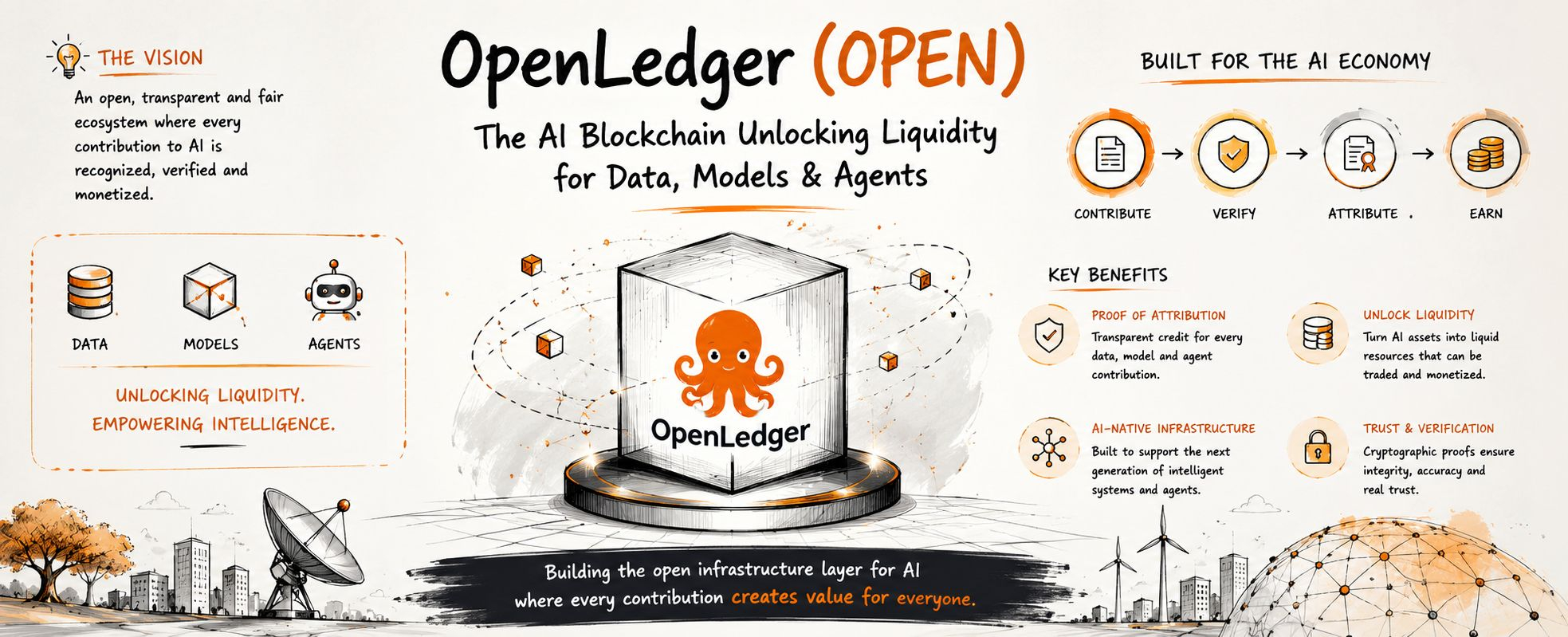
OpenLedger describes itself as an AI blockchain focused on unlocking liquidity for data, models, and agents.
At first, that sounds like another crypto slogan.
Then you start looking deeper.
And you realize they're targeting a problem most people rarely discuss.
Today, data creates value.
Models create value.
Agents create value.
Yet the people creating those assets often struggle to participate in the economic upside they help generate.
A dataset might improve thousands of AI outputs.
A specialized model might solve a niche industry problem.
An autonomous agent might automate valuable workflows.
But connecting those contributions to economic rewards remains difficult.
Most AI systems weren't designed for that.
They were designed for performance.
Not attribution.
Not monetization.
Not ownership.
OpenLedger seems to be approaching AI from a different angle.
Instead of asking:
"How do we build smarter models?"
The protocol asks:
"How do we build an economy around intelligence?"
That distinction matters.
Because AI is becoming increasingly modular.
The future probably isn't one giant model doing everything.
It's thousands of specialized systems interacting together.
Different models.
Different datasets.
Different agents.
Different contributors.
As that complexity grows, tracking value becomes harder.
OpenLedger's Proof of Attribution framework is interesting because it attempts to create transparency around those contributions.
Not simply who owns an asset.
But who helped create it.
That sounds simple until you realize how messy AI development actually is.
One dataset may influence multiple models.
One model may power hundreds of agents.
One workflow may combine dozens of independent components.
The economic relationships become incredibly complex.
OpenLedger is essentially trying to create infrastructure capable of recording those relationships.
And infrastructure tends to matter more than people realize.
Most users never think about payment rails when they send money online.
Most users never think about internet protocols when opening a website.
Infrastructure stays invisible when it works.
#OpenLedger feels like a similar type of bet.
Not a bet that AI will grow.
That already seems obvious.
A bet that AI economies will eventually require transparent systems capable of tracking where value originates and where rewards should flow.
Of course, there are challenges.
Attribution is difficult.
Economic incentives are difficult.
Governance is difficult.
And AI itself evolves so quickly that infrastructure can become outdated faster than expected.
But I keep coming back to one thought.
As AI becomes more powerful, ownership becomes more important.
As ownership becomes more important, attribution becomes more important.
And once attribution becomes important, economic coordination becomes unavoidable.
That is the chain of logic that keeps bringing me back to OpenLedger.
Not because it promises the smartest AI.
But because it is exploring how intelligence itself might become an economic asset.
And if AI truly becomes the defining technology of the next decade, the systems that organize value around intelligence may end up being just as important as the intelligence itself.
@OpenLedger #OpenLedger #openledger $OPEN
