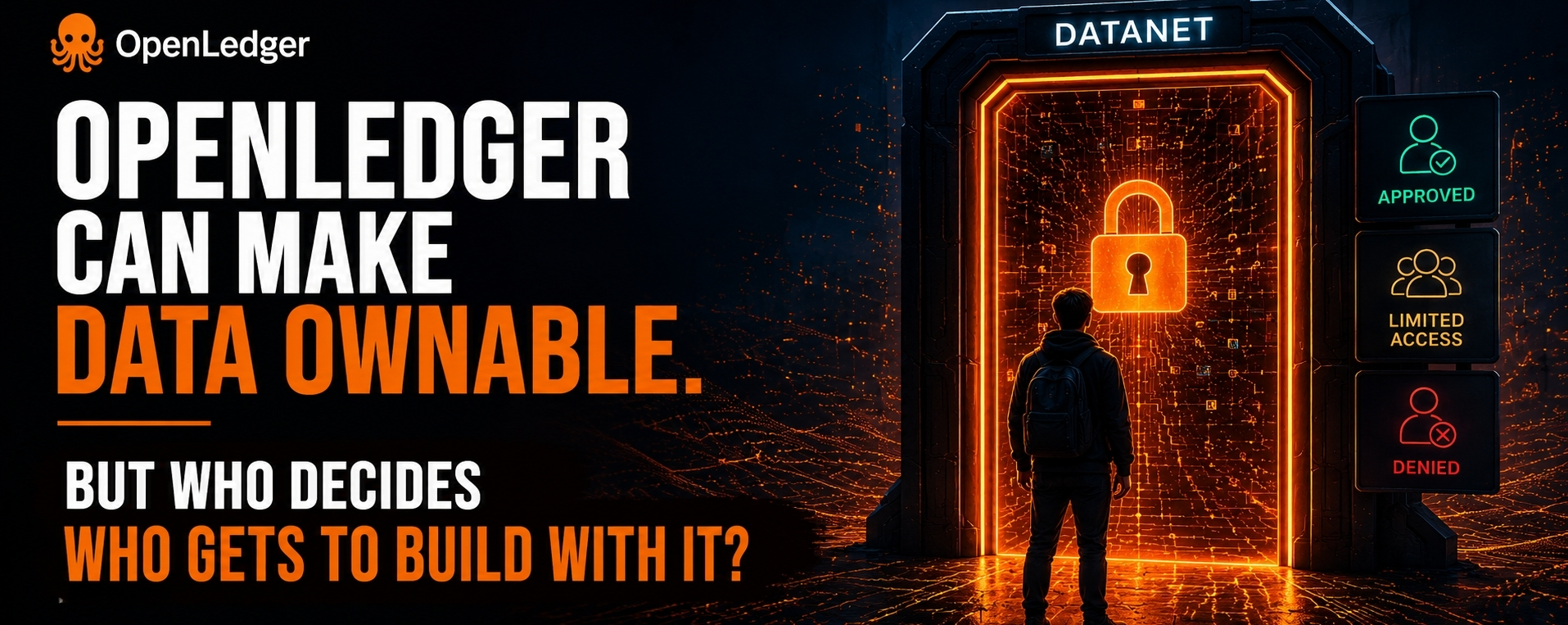
People talk about AI data as if ownership is the finish line.
I keep wondering if it's actually the starting point.
For years, the internet worked on a simple rule: if data could be collected, somebody would eventually train on it. The debate was usually about scale, quality, or legality. Very rarely was it about permission.
@OpenLedger changes that equation.
A Datanet is not just a dataset sitting on a server waiting to be consumed. It comes with ownership, attribution, usage conditions, and an expectation that contributors should benefit when value is created later.
That sounds like a data problem.
I don't think it is.
I think it's a permission problem.
Because once data becomes something that belongs to someone, access stops being automatic.
A builder can have the technical skills, the infrastructure, and the model architecture ready to go. None of that guarantees access to the data itself.
The interesting question is no longer, "Can this model be built?"
It's, "Should this model be built using this data?"
That's a very different filter.
And filters create power.
Not necessarily bad power. Just real power.
Someone decides whether a use case matches the intended purpose. Someone decides whether commercial access makes sense. Someone decides whether a training path respects the conditions attached to the data.
Those decisions happen long before attribution rewards, inference revenue, or model performance metrics enter the picture.
By the time a model starts generating value, the biggest decision may have already been made.
The model was allowed to exist.
What's fascinating is that #OpenLedger probably cannot avoid this.
Without permission, ownership becomes symbolic. Without boundaries, contributor rights become difficult to defend. Without access controls, valuable datasets risk becoming another resource that larger players can absorb without consequence.
The system needs rules.
The question is what happens when those rules become a competitive advantage of their own.
Builders often think they're competing against other builders.
In a permission-aware ecosystem, they may also be competing for eligibility.
Access becomes a resource.
And resources create bottlenecks.
That doesn't mean OpenLedger is becoming centralized. It means decentralization is more complicated than simply distributing ownership. A network can spread ownership widely while still making careful decisions about who gets to convert that ownership into models, products, and economic value.
That's the tension I keep coming back to.
OpenLedger isn't just asking who owns the data.
It's asking who gets to unlock it.
And those are not the same question at all.