
There is a kind of fatigue that only appears after years of watching the market keep changing its tone, talking about cross chain one day and autonomous agents the next, only to leave the oldest question unanswered in the end, when an action moves across many chains, what keeps it the same action. I read Openledger from that point of exhaustion, to see whether there is any system willing to deal with the broken continuity that any builder has run into once a workflow starts traveling beyond the scope of a single chain.
What made me stop was not the promise that agents would be able to do more, but the way the problem is reframed right at the core. Many systems only focus on how to move an instruction into another environment, while forgetting that getting there does not mean the context remains intact. When LayerZero helps an action keep moving across multiple chains, what is still missing is a structure tight enough to prevent the input data, the processing model, and the final output from splitting into separate pieces. Openledger is worth following because the project looks directly at that exact fracture.
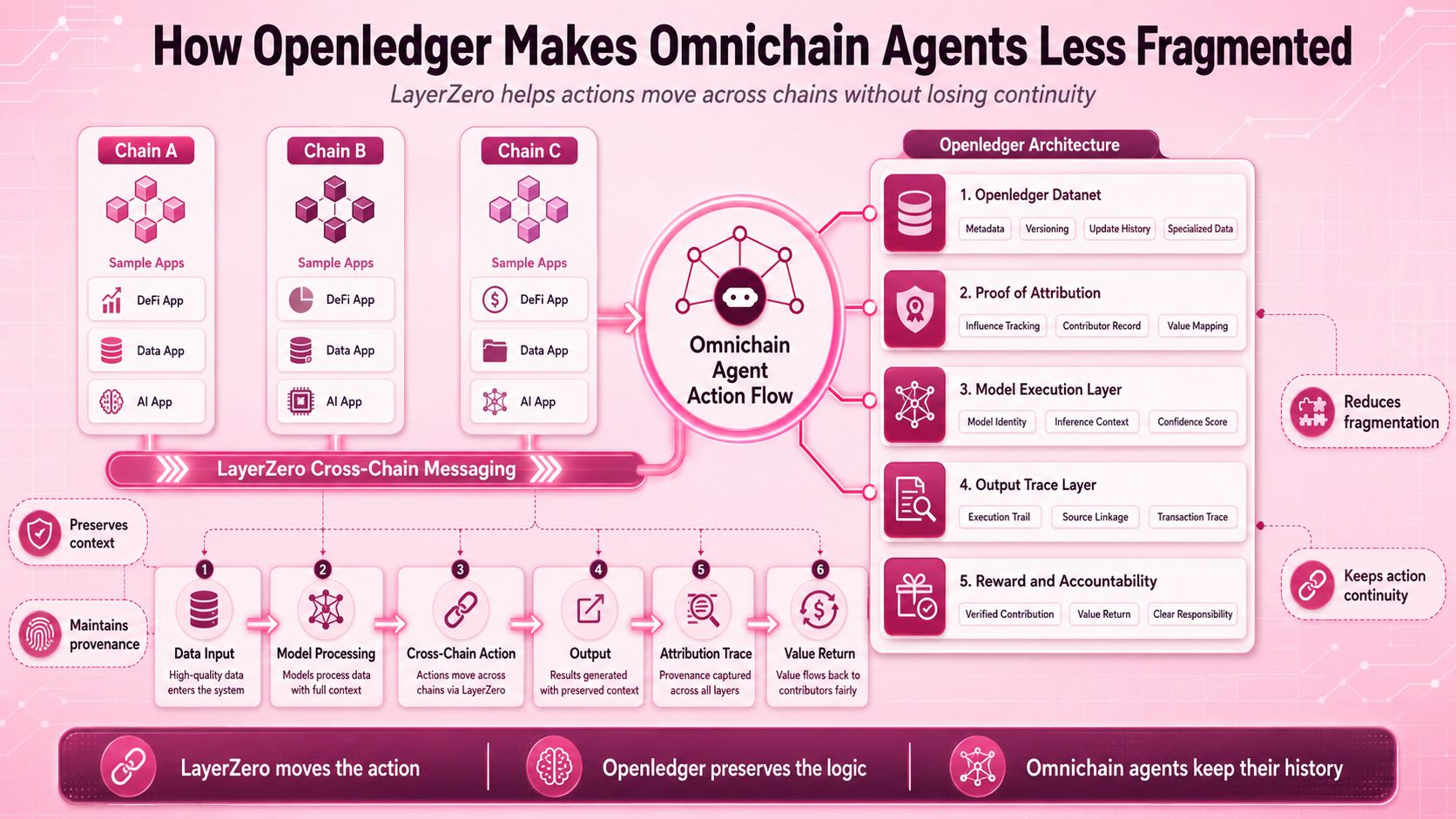
Looking at Datanet, it becomes clear that this direction is not just a slogan. Data is not treated as anonymous raw material thrown into the system and then erased once the output appears. Each dataset has to come with metadata, versioning, and an update history clear enough for every change to leave a trace. That may sound like a purely operational detail, but for omnichain agents it is a very real foundation, because every time an action jumps to another chain, the relationship between the decision and the original data risks becoming one layer thinner. The way Openledger keeps data inside the story makes me feel this is a system built from the foundation up.
The heaviest part, in my view, lies in Proof of Attribution. This is not a technical description inserted to make the text sound deeper, but an effort to force an output to carry the history of influence from what actually created it. When an agent takes specialized data, calls a model, generates an output, and then keeps acting across another chain, the part most likely to get lost is not the final answer, but the relationship between that answer and the work behind it. This is exactly where Openledger gains its own weight. Openledger does not leave attribution in the final explanatory layer, but pulls it down into the operating structure itself.
Looking deeper, it becomes obvious that this is not the kind of problem with one neat answer. With smaller models, the influence of data can be estimated in one way, while with larger models, tracing that influence has to shift into a different structure to withstand the cost and the computational scale. I value the fact that the project accepts that difficulty instead of treating provenance like a beautiful term used to build a narrative. Many people will find this part dry, but long time builders usually understand that this very dryness is what determines whether a system can truly stand on its own. At this point, Openledger feels more serious than many familiar AI descriptions.
When placed next to LayerZero, the meaning of that whole design becomes much clearer. LayerZero handles transportation, helping an action avoid dying in transit simply because of technical boundaries between chains. But movement is only a necessary condition. For omnichain agents to become less fragmented in the more important sense, the system also has to preserve the memory of the action after it has passed through multiple different environments. What I can clearly see from Openledger is the ambition to keep data, models, attribution, and outcomes attached to each other after every transition.
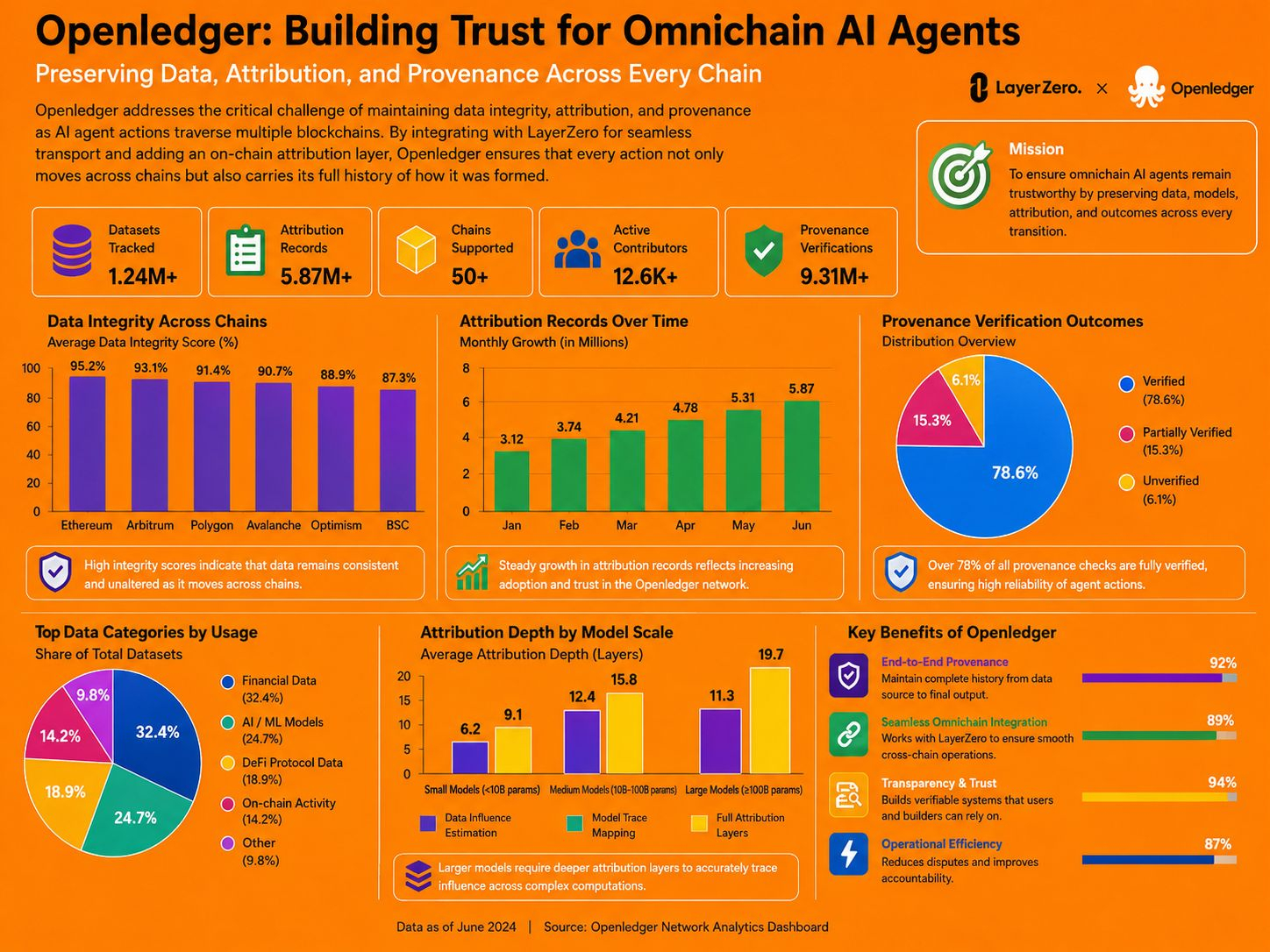
At the layer the user actually touches, the consequence of that approach is not small. If an output only appears as a clean and smooth block of content, it becomes very easy to create the illusion that everything underneath has already been solved. But what builders need is not only a polished answer, but also the ability to trace back to the model name, the relevant data source, the contributor record, the confidence score, and the execution trail clearly enough to understand why the system arrived at that result. I think Openledger understands this very well, which is why provenance is not locked inside documentation, but pulled much closer to the experience itself.
Of course, a traceability layer does not automatically make everything fair. Similar datasets can still trigger disputes over contribution weight, clean data is not always the data that creates the strongest influence, and end users will still prioritize speed over origin many times. But after years of watching the market glorify smoothness while abandoning the question of where real value is actually created, I think this direction is worth looking at closely because it breaks that compromise from the foundation. If LayerZero helps actions cross many chains without breaking during transport, while Openledger keeps the history of data, processing logic, and attribution from dissolving along the way, is this the point where omnichain agents begin to feel less fragmented in the most trustworthy sense, meaning they do not just keep moving, but also carry the full history of how they were formed.