
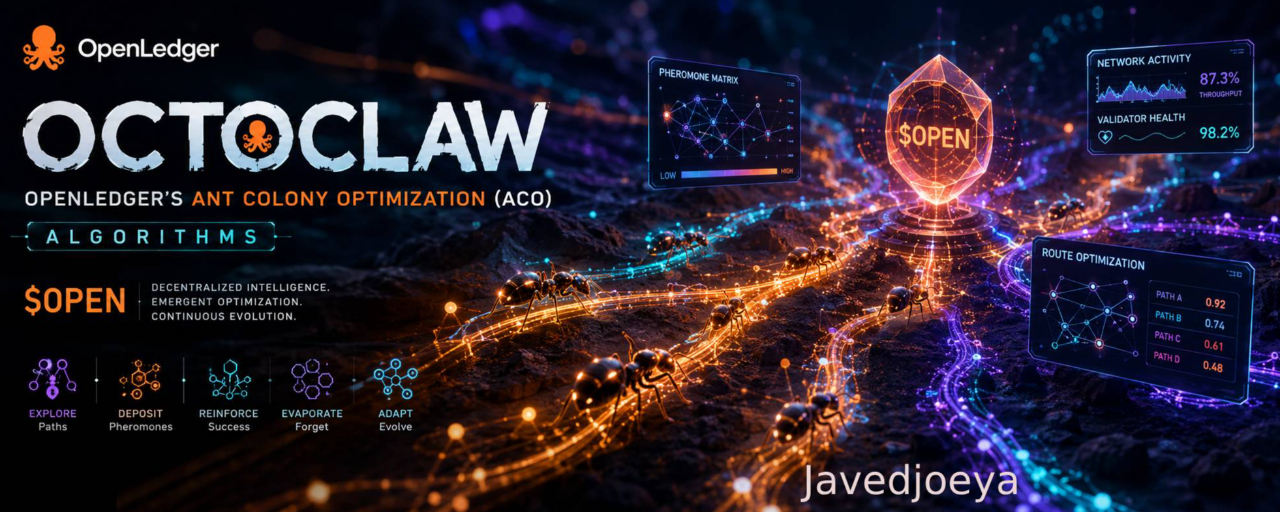
Something is already moving before I can identify what triggered it.
I open the dashboard expecting a familiar sequence of events, but the network appears to have reacted several steps ahead of my observation. Transactions are flowing, validators are reshuffling priorities, and liquidity routes seem to be adjusting themselves before any obvious pressure emerges.
The system feels less like infrastructure and more like a colony waking up.
I keep noticing small directional changes that never fully announce themselves. One route gains activity. Another loses relevance. A validator cluster becomes unusually efficient for several minutes, then disperses. Nothing fully settles.
The pattern repeats.
At the execution layer, Openledger's Octoclaw implementation of Ant Colony Optimization behaves like a field of invisible pheromone trails spread across a decentralized landscape. Activity leaves traces. Successful execution paths accumulate influence. Less efficient routes gradually fade into the background.
At least that is what appears to be happening.
The reality is more difficult to isolate.
Each transaction seems to participate in a larger conversation. Liquidity does not simply move from point A to point B. Instead, it appears to explore possibilities. Routing decisions emerge from countless local interactions, creating temporary highways across the protocol.
I am not sure why certain pathways suddenly attract attention.
A validator set that appears ordinary one hour later becomes a dominant corridor for execution. Then congestion appears. The flow disperses. Alternative routes emerge.
Execution drift appears.
The ants, metaphorically speaking, are constantly rewriting the map beneath their own feet.
I watch network activity cluster around successful outcomes. The pheromone signal strengthens. More traffic follows. Efficiency improves.
Then the very success of the route begins to alter its conditions.
Latency rises.
Competition increases.
The signal that once represented optimization starts attracting friction.
Something feels slightly off...
The protocol seems aware of this tension.
At the strategy layer, Octoclaw's ACO framework appears less concerned with finding a perfect solution than with maintaining a process of continuous discovery. Decisions emerge through probabilities rather than certainty.
The system hesitates...
For several blocks, routing preferences stabilize around a dominant path. Then an unexpected deviation appears. A smaller route suddenly receives allocation. The adjustment initially looks inefficient.
Moments later, congestion develops on the dominant route.
The alternative path absorbs pressure.
What appeared to be hesitation becomes adaptation.
Yet uncertainty remains.
I keep noticing how small inefficiencies persist at the edges of the system. Tiny delays. Slightly suboptimal allocations. Temporary misjudgments. Individually they seem insignificant.
Collectively they may matter.
ACO systems often rely on incremental reinforcement. A minor distortion in pheromone signaling can slowly compound over time. An execution route that receives excess attention today may continue attracting traffic tomorrow, not because it remains optimal, but because historical success continues influencing present decisions.
The system never stops negotiating with its own memory.
Risk signals emerge without warning.
A sudden increase in transaction volume pushes several execution corridors toward congestion. Validator responsiveness becomes uneven. Slippage widens across specific routes. Arbitrage activity intensifies.
For a moment, the network feels unstable.
The signal fades before it resolves...
Instead of collapsing into disorder, alternative execution paths begin absorbing traffic. Pheromone concentrations redistribute. Previously overlooked routes gain relevance. Activity spreads outward.
The correction is imperfect.
Some users experience delays.
Some opportunities disappear.
Yet the broader structure remains intact.
This self-correcting behavior is perhaps one of the most fascinating aspects of the architecture. Instability does not arrive as a catastrophic event. It appears as a localized imbalance. The colony senses pressure and gradually shifts its attention elsewhere.
Not instantly.
Not flawlessly.
But often just enough.
The memory layer introduces another level of complexity.
Every successful route leaves a trace.
Every validator performance record contributes to future expectations.
Every execution history becomes part of the environment influencing subsequent decisions.
I find myself wondering whether the system remembers too much.
Historical efficiency can become a form of inertia. A route that was optimal under yesterday's conditions may continue attracting traffic long after circumstances change.
Then again, forgetting creates its own dangers.
If pheromone decay occurs too rapidly, valuable experience disappears. The network may repeatedly rediscover lessons it has already learned.
The balance feels fragile.
Memory creates intelligence.
Memory also creates bias.
I keep noticing situations where the protocol appears caught between those two realities.
As activity increases, drift and divergence become more visible.
Multiple optimization paths emerge simultaneously.
One section of the network favors speed.
Another prioritizes reliability.
A third appears focused on reducing congestion risk.
None of them are entirely wrong.
None of them fully dominate.
The result resembles competing colonies operating within the same environment. Signals overlap. Reinforcement patterns conflict. Local optimization begins diverging from global optimization.
Execution drift appears again.
The protocol seems to fragment into parallel interpretations of efficiency.
What fascinates me is how long these competing realities can coexist before one gains temporary dominance.
Temporary success eventually arrives.
For a brief period, everything aligns.
Transaction throughput increases.
Routing efficiency improves.
Congestion falls.
Validator participation remains stable.
Execution costs narrow.
The network appears synchronized.
The colony has found a path.
Watching the telemetry during these moments is strangely satisfying. Signals reinforce one another. Adaptation becomes almost effortless. The architecture demonstrates exactly why ant colony optimization remains such a compelling framework for decentralized coordination.
Then new side effects emerge.
The successful route attracts attention.
More traffic follows.
Liquidity concentrates.
Competitive behaviors intensify.
The optimization itself becomes a source of new pressure.
Success alters the environment that produced success.
The pattern repeats.
Recursive feedback loops begin appearing everywhere.
A correction creates another imbalance.
That imbalance triggers a secondary correction.
The secondary correction produces additional signals.
Those signals influence future routing decisions.
The network starts reacting not only to conditions but to its own reactions.
Complexity compounds.
Hidden costs emerge.
The system becomes increasingly difficult to model through static assumptions.
I am not sure why this feels less like software and more like ecology.
Perhaps because no single component appears fully responsible for the observed behavior.
Validators respond to incentives.
Routes respond to traffic.
Agents respond to probabilities.
Users respond to outcomes.
The protocol responds to all of them simultaneously.
Nothing fully settles.
The longer I watch, the more difficult it becomes to separate optimization from adaptation.
Is Openledger's Octoclaw framework discovering better solutions, or is it simply becoming more effective at surviving changing conditions?
The distinction seems important.
An intelligent system may optimize toward an objective.
An adaptive system may continuously redefine what optimization means.
In decentralized environments, consensus itself feels less like agreement and more like temporary alignment between countless competing preferences.
Coordination emerges.
Then dissolves.
Then emerges again.
The colony never reaches a final state.
It merely continues negotiating with uncertainty.
Perhaps that is the deeper lesson hidden inside ant colony optimization. Intelligence may not reside in any individual route, validator, agent, or decision. It may emerge from the constant interaction between memory, exploration, reinforcement, and decay.
Or perhaps what appears to be intelligence is simply persistence observed over a sufficiently long timeframe.
As I continue monitoring the network, execution paths shift once more, pheromone trails strengthen and weaken, validators reorganize, and fresh signals begin replacing the old ones before they can be fully interpreted.
If every optimized path eventually changes the environment that made it optimal, what exactly is the system learning?